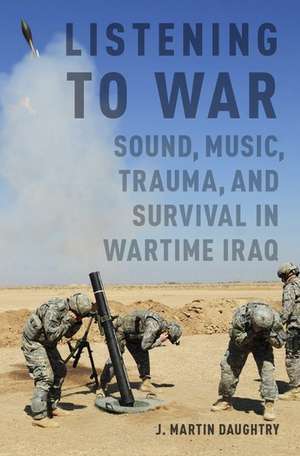
Listening to War: Sound, Music, Trauma, and Survival in Wartime Iraq
Autor J. Martin Daughtryen Limba Engleză Hardback – 8 oct 2015
Preț: 301.65 lei
Preț vechi: 334.72 lei
-10%
Puncte Express: 452
Carte disponibilă
Livrare economică 05-11 noiembrie
Livrare prin curier în România Termenul estimat este afișat lângă disponibilitate.
Transport gratuit de la 400.00 lei Plată online sau ramburs, în funcție de opțiunile comenzii.
Retur gratuit în 14 zile Comandă securizată și suport în română.
Specificații
ISBN-13: 9780199361496
ISBN-10: 0199361495
Pagini: 360
Dimensiuni: 157 x 236 x 31 mm
Greutate: 0.68 kg
Editura: Oxford University Press
Colecția OUP USA
Locul publicării:New York, United States
ISBN-10: 0199361495
Pagini: 360
Dimensiuni: 157 x 236 x 31 mm
Greutate: 0.68 kg
Editura: Oxford University Press
Colecția OUP USA
Locul publicării:New York, United States
V-ar putea interesa
-
 Music and the MindAnthony StorrPreț: 77.41 lei
 -
 The New Music: The Avant-Garde since 1945Reginald Smith BrindlePreț: 488.11 lei
 -
 Embellishing 16th-Century MusicHoward Mayer Brown-19%Preț: 413.79 lei510.84 lei
 -
 Music, Imagination, and CultureNicholas Cook-31%Preț: 630.14 lei916.97 lei
 -
 Dalcroze Today: An Education through and into MusicMarie-Laure Bachmann-28%Preț: 492.42 lei687.62 lei
 -
 Musical Composition in the Twentieth CenturyArnold Whittall-28%Preț: 520.60 lei725.85 lei
 -
 Beethoven's Anvil: Music in Mind and CultureWilliam L. Benzon-16%Preț: 102.81 lei122.37 lei
 -
 Aural Awareness: Principles and PracticeGeorge Pratt-29%Preț: 532.31 lei749.01 lei
 -
 -12%Preț: 471.97 lei539.24 lei
 -
 John Thompson's Easiest Piano Course Part 4John ThompsonPreț: 56.41 lei
 -
 The AB Guide to Music Theory, Part IEric Taylor-5%Preț: 58.77 lei62.07 lei
 -
 Music Theory in Practice, Grade 2Eric Taylor-7%Preț: 59.65 lei64.40 lei
 -
 The Elements of MusicJason MartineauPreț: 52.13 lei
Recenzii
To say that Listening to War is ground-breaking, penetrating, and vitally important doesn't begin to convey the affective and intellectual impact of engaging with this work. More than challenging music and sound apprehension and scholarship, the book offers painful, visceral access to the ways in which ears suffer, bodies suffer, places suffer in wartime. There is no escape into abstraction or aestheticization here. It's shattering, from the very beginning...
Apart from its own awe-inspiring comprehensiveness, the book provides a foundation for continued exploration of such emergent fields as cognitive ecology, extended mind theory, and the relationship between gesture and cognition.
Listening to War is an original if deeply idiosyncratic book.
Apart from its own awe-inspiring comprehensiveness, the book provides a foundation for continued exploration of such emergent fields as cognitive ecology, extended mind theory, and the relationship between gesture and cognition.
Listening to War is an original if deeply idiosyncratic book.
Notă biografică
J. Martin Daughtry is an associate professor of ethnomusicology and sound studies at New York University. His work centers on acoustic violence; voice; listening; sound studies; the Iraq war, and musics of the Russian-speaking world. Daughtry is co-editor, with Jonathan Ritter, of Music in the Post-9/11 World (Routledge 2007), and has published essays in Social Text, Ethnomusicology, Music and Politics, Russian Literature, Poetics Today, and a number of edited collections.
Cuprins
- Dedication
- Note on Transliteration
- Introduction: Composing Thoughts on Sound and Violence
- -In Lieu of an Epigraph: Sound-centered Memories of Operation Iraqi Freedom
- -The Belliphonic
- -Intellectual Predecessors
- -A Necessary Detour
- -Approaches and Challenges
- Fragment #1: The Presence of Mind to Save an Ear: Ali's Story
- Section I: Sonic Matériel
- Chapter 1: Belliphonic Sounds and Indoctrinated Ears: The Elements of Wartime Audition
- -Charting the Belliphonic
- -Listening, Structure, and Positionality
- -Vehicular Sounds
- -Communications
- -Civilian Sounds
- -Weapons
- Chapter 2: Mapping Zones of Wartime (In)audition
- -The Zone of the Audible Inaudible
- -The Narrational Zone
- -The Tactical Zone
- -The Trauma Zone
- -A Complicating Factor: Iraqi Civilian Auditors
- -Another Complicating Factor: Sound and Psychological Trauma
- -Conclusion
- Fragment #2: Stealth and Improvisation in the Desert: Jason's Story
- Fragment #3: Loudly Searching in the Resonant Darkness: The Anatomy of a Nighttime House Raid
- Section II: Structures of Listening, Sounding, and Emplacement
- Introduction to section II
- Chapter 3: Auditory Regimes
- -Ideals of Military Audition
- -National Audition
- -Oblique Indoctrination of Belliphonic Ears
- -Situational Awareness
- -The Inclusive Auditory Regime of Iraqi Civilians
- -Auditory Literacy, Competence, Virtuosity
- -Incommensurability
- Chapter 4: Sonic Campaigns
- -Sound (and Violence)
- -Violence (and Sound)
- -The Omnidirectionality of Sound and Violence
- -Sonic Campaigns
- Chapter 5: Acoustic Territories
- -Emplacement, Displacement, Transplacement
- -Sound and Territoriality
- -The Virtual Acoustic Territory of Recorded Sound
- -The Radiant Acoustic Territories of Wartime
- -The Resonant Acoustic Territories of Baghdad
- -The Resonant Acoustic Territory of the body
- -Life at the Intersection of Regime, Campaign and Territory
- Fragment #4: Fatal Mishearing
- Section III: Music, Mediation, and Survival
- Chapter 6: Mobile Music in the Military
- -Introducing the Wartime iPod
- -A Century of Recorded Music on the Battlefield
- -iPods in the Iraq War
- -Amping Up, Staying Focused, Cooling Down: Technologies of Self-regulation in Combat
- -Moving Bodies, Loosening Tongues, Adjusting Crosshairs: Technologies for Manipulating Others in Combat
- -Concluding Thoughts
- Fragment #5: From "Hell's Bells " to "Silent Night ": A Conversation about Music in the Military
- Fragment #6: Keeping the Music Turned Down Low: Shymaa's Story
- Chapter 7: A Time of Troubles for Iraqi Music
- -Iraq's Musical Legacy
- -Post-invasion Challenges
- -Political Violence
- -Sectarian Violence
- -U.S. Forces Targeting Music
- -The Attenuated Acoustic Territory of Iraqi Musical Practice
- Conclusion: The Amplitude of Violence
- Fragment #7: Listening as Poiesis: Tareq's Story
- Acknowledgments
- Glossary
- Works Cited
- Index