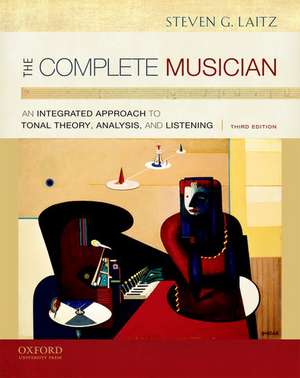
The Complete Musician: An Integrated Approach to Tonal Theory, Analysis, and Listening
Autor Steven G. Laitzen Limba Engleză Hardback – 8 iun 2011
Analiza auditivă și structurală reprezintă nucleul acestei lucrări monumentale, care transformă teoria muzicală dintr-o disciplină abstractă într-o experiență senzorială completă. Apreciem în mod deosebit felul în care The Complete Musician reușește să ancoreze fiecare concept teoretic în sunetul real, punând la dispoziția cititorului un vast repertoriu de aproape 4.500 de exemple muzicale. Ne-a atras atenția calitatea excepțională a înregistrărilor realizate la Eastman, care permit o audiție critică și o înțelegere profundă a nuanțelor armonice.
Abordarea autorului Steven G. Laitz este una integrativă: nu studiem doar reguli de conducere a vocilor, ci experimentăm relația dintre analiză, interpretare și auz intern. Textul este structurat pentru a ghida studentul de la fundamentele muzicale până la complexitățile texturale ale repertoriului tonal. Complementar lui Theory for Today's Musician Textbook din aceeași perioadă, dar cu o perspectivă mai riguros axată pe muzica tonală clasică și pe o integrare mult mai strânsă între scris și auz, The Complete Musician se impune prin profunzimea detaliului tehnic.
În contextul operei sale, această ediție rafinează viziunea expusă în Graduate Review of Tonal Theory, adaptând conceptele complexe pentru nivelul studiilor de licență fără a sacrifica rigoarea. Dacă în lucrările sale anterioare Steven G. Laitz punea accent pe sinteză, aici observăm o extindere a exercițiilor practice și a materialelor de suport, menite să transforme cititorul într-un muzician complet, capabil să aplice teoria direct pe instrument sau în compoziție.
Preț: 471.97 lei
Preț vechi: 539.24 lei
-12%
Carte tipărită la comandă
Livrare economică 10-16 decembrie
Specificații
ISBN-10: 0199742782
Pagini: 896
Dimensiuni: 211 x 259 x 40 mm
Greutate: 1.77 kg
Ediția:Third Edition
Editura: Oxford University Press
Colecția OUP USA
Locul publicării:New York, United States
V-ar putea interesa
-
 Music and the MindAnthony StorrPreț: 78.63 lei
 -
 I Saw the World End: A Study of Wagner's RingDeryck Cooke-27%Preț: 515.10 lei708.81 lei
 -
 The New Music: The Avant-Garde since 1945Reginald Smith Brindle-19%Preț: 514.63 lei635.34 lei
 -
 Embellishing 16th-Century MusicHoward Mayer Brown-19%Preț: 427.82 lei528.17 lei
 -
 Music, Imagination, and CultureNicholas Cook-30%Preț: 651.38 lei933.17 lei
 -
 The Concept of MusicRobin Maconie-32%Preț: 617.09 lei904.98 lei
 -
 Dalcroze Today: An Education through and into MusicMarie-Laure Bachmann-27%Preț: 508.97 lei699.76 lei
 -
 Musical Composition in the Twentieth CenturyArnold Whittall-27%Preț: 538.12 lei738.67 lei
 -
 Beethoven's Anvil: Music in Mind and CultureWilliam L. Benzon-16%Preț: 102.81 lei122.37 lei
 -
 Aural Awareness: Principles and PracticeGeorge Pratt-28%Preț: 550.22 lei762.23 lei
 -
 John Thompson's Easiest Piano Course Part 4John ThompsonPreț: 56.64 lei
De ce să citești această carte
Pentru orice student sau muzician care dorește să depășească simpla memorare a regulilor de armonie, această carte oferă un sistem de învățare bazat pe context. Veți câștiga o ureche muzicală antrenată și o capacitate analitică superioară, sprijinită de zeci de ore de material audio. Este resursa definitivă pentru a înțelege cum funcționează cu adevărat muzica tonală, de la structură la emoție.
Despre autor
Steven G. Laitz este un pedagog și teoretician de renume, profesor în cadrul Eastman School of Music. Expertiza sa se concentrează pe analiza muzicală aplicată și pe pedagogia teoriei tonale, fiind recunoscut pentru abilitatea de a conecta rigoarea academică de practica interpretativă. Prin lucrările sale, Laitz a redefinit standardele moderne în predarea teoriei muzicale, punând accent pe integrarea auzului absolut și a analizei structurale în formarea muzicienilor profesioniști. Contribuția sa la Oxford University Press rămâne un punct de referință în bibliografia de specialitate la nivel mondial.