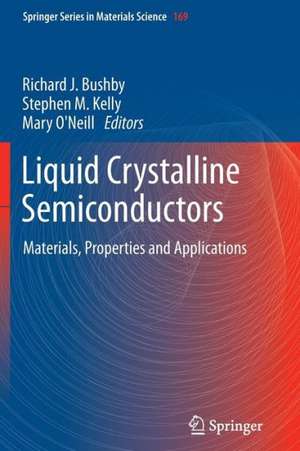
Liquid Crystalline Semiconductors: Springer Series in Materials Science, cartea 169
Editat de Richard J. Bushby, Stephen M. Kelly, Mary O'Neillen Limba Engleză Paperback – 14 dec 2014
Within the family of organic electronic materials, liquid crystals are relative newcomers. The first electronically conducting liquid crystals were reported in 1988 but already a substantial literature has developed. The advantage of liquid crystalline semiconductors is that they have the easy processability of amorphous and polymeric semiconductors but they usually have higher charge carrier mobilities. Their mobilities do not reach the levels seen in crystalline organics but they circumvent all of the difficult issues of controlling crystal growth and morphology. Liquid crystals self-organise, they can be aligned by fields and surface forces and, because of their fluid nature, defects in liquid crystal structures readily self-heal.
With these matters in mind this is an opportune moment to bring together a volume on the subject of ‘Liquid Crystalline Semiconductors’. The field is already too large to cover in a comprehensive manner so the aim has been to bring together contributions from leading researchers which cover the main areas of the chemistry (synthesis and structure/function relationships), physics (charge transport mechanisms and optical properties) and potential applications in photovoltaics, organic light emitting diodes (OLEDs) and organic field-effect transistors (OFETs).
This book will provide a useful introduction to the field for those in both industry and academia and it is hoped that it will help to stimulate future developments.
Din seria Springer Series in Materials Science
- 18%
 Preț: 1271.73 lei
 - 18%
 Preț: 1778.82 lei
 - 18%
 Preț: 1001.54 lei
 - 15%
 Preț: 581.81 lei
 - 18%
 Preț: 989.42 lei
 - 18%
 Preț: 940.77 lei
 - 18%
 Preț: 991.80 lei
 - 18%
 Preț: 1297.99 lei
 - 18%
 Preț: 1271.83 lei
 - 18%
 Preț: 1150.30 lei
 - 18%
 Preț: 1439.81 lei
 - 18%
 Preț: 924.14 lei
 -
 Preț: 447.75 lei
 - 24%
 Preț: 1014.10 lei
 - 18%
 Preț: 981.33 lei
 - 18%
 Preț: 1168.61 lei
 - 15%
 Preț: 644.51 lei
 - 18%
 Preț: 954.08 lei
 - 15%
 Preț: 667.19 lei
 - 24%
 Preț: 940.03 lei
 - 24%
 Preț: 1201.95 lei
 - 18%
 Preț: 1002.41 lei
 - 18%
 Preț: 1271.16 lei
 - 18%
 Preț: 1267.90 lei
 - 18%
 Preț: 944.71 lei
 - 18%
 Preț: 2061.38 lei
 - 15%
 Preț: 646.82 lei
 - 18%
 Preț: 1286.25 lei
 - 18%
 Preț: 993.27 lei
 - 15%
 Preț: 662.58 lei
 - 18%
 Preț: 1283.56 lei
 - 18%
 Preț: 983.13 lei
 - 18%
 Preț: 994.32 lei
 - 15%
 Preț: 664.14 lei
 - 18%
 Preț: 986.35 lei
Preț: 618.67 lei
Preț vechi: 727.85 lei
-15%
Puncte Express: 928
Carte tipărită la comandă
Livrare economică 04-18 decembrie
Livrare prin curier în România Termenul estimat este afișat lângă disponibilitate.
Transport gratuit pentru acest produs Plată online sau ramburs, în funcție de opțiunile comenzii.
Retur gratuit în 14 zile Comandă securizată și suport în română.
Specificații
ISBN-13: 9789400795570
ISBN-10: 9400795572
Pagini: 284
Ilustrații: X, 274 p.
Dimensiuni: 155 x 235 x 16 mm
Greutate: 0.44 kg
Ediția:2013
Editura: Springer
Colecția Springer Series in Materials Science
Seria Springer Series in Materials Science
Locul publicării:Dordrecht, Netherlands
ISBN-10: 9400795572
Pagini: 284
Ilustrații: X, 274 p.
Dimensiuni: 155 x 235 x 16 mm
Greutate: 0.44 kg
Ediția:2013
Editura: Springer
Colecția Springer Series in Materials Science
Seria Springer Series in Materials Science
Locul publicării:Dordrecht, Netherlands
V-ar putea interesa
-
 -32%Preț: 1386.63 lei2036.06 lei
 -
 The Story of SemiconductorsJohn W. Orton-20%Preț: 398.15 lei497.51 lei
 -
 Superconducting State: Mechanisms and PropertiesVladimir Z. Kresin-31%Preț: 934.21 lei1356.59 lei
 -
 Quantum Processes in SemiconductorsBrian K. Ridley-22%Preț: 499.23 lei639.67 lei
 -
 Frontiers in Nanoscale Science of Micron/Submicron DevicesEugenia V. Buzaneva-18%Preț: 1893.64 lei2309.31 lei
 -
 Heterostructure Epitaxy and Devices - Head'97Peter Kordos-18%Preț: 1270.64 lei1549.56 lei
 -
 Emerging Nanoelectronic DevicesAn Chen-9%Preț: 864.51 lei950.02 lei
 -
 Semiconductor Laser EngineeringEpperlein-9%Preț: 887.71 lei975.51 lei
 -
 Organic Light-Emitting Materials and DevicesZhigang Rick Li-18%Preț: 1647.23 lei2008.81 lei
 -
 -18%Preț: 430.10 lei524.85 lei
 -
 III-Nitride Based Light Emitting Diodes and ApplicationsTae-Yeon Seong-15%Preț: 654.20 lei769.65 lei
 -
 -15%Preț: 669.75 lei787.94 lei
 -
 Semiconductor Devices and Integrated ElectronicsA. G. Milnes-15%Preț: 647.59 lei761.86 lei
 -
 Variation-Aware Advanced CMOS Devices and SRAMChanghwan ShinPreț: 415.06 lei
 -
 -15%Preț: 674.57 lei793.61 lei
 -
 Semiconductor Technologies in the Era of ElectronicsYong Hoon Kang-15%Preț: 662.13 lei778.98 lei
Public țintă
ResearchCuprins
Preface.- 1 Introduction.- 2 Charge Transport in Liquid Crystalline Semiconductors.- 3 Columnar Liquid Crystalline Semiconductors.- 4 Synthesis of Columnar Liquid Crystals.- 5 Charge Transport in Reactive Mesogens and Liquid Crystal Polymer Networks.- 6 Optical Properties of Liquid Crystals.- 7 Organic Light-Emitting diodes (OLEDs) and OLEDs with Polarised Emission.- 8 Liquid Crystals for Organic Photovoltaics.- 9 Liquid Crystals for Organic Field-Effect Transistors.
Textul de pe ultima copertă
This is an exciting stage in the development of organic electronics. It is no longer an area of purely academic interest as increasingly real applications are being developed, some of which are beginning to come on-stream. Areas that have already been commercially developed or which are under intensive development include organic light emitting diodes (for flat panel displays and solid state lighting), organic photovoltaic cells, organic thin film transistors (for smart tags and flat panel displays) and sensors.
Within the family of organic electronic materials, liquid crystals are relative newcomers. The first electronically conducting liquid crystals were reported in 1988 but already a substantial literature has developed. The advantage of liquid crystalline semiconductors is that they have the easy processability of amorphous and polymeric semiconductors but they usually have higher charge carrier mobilities. Their mobilities do not reach the levels seen in crystalline organics but they circumvent all of the difficult issues of controlling crystal growth and morphology. Liquid crystals self-organise, they can be aligned by fields and surface forces and, because of their fluid nature, defects in liquid crystal structures readily self-heal.
With these matters in mind this is an opportune moment to bring together a volume on the subject of ‘Liquid Crystalline Semiconductors’. The field is already too large to cover in a comprehensive manner so the aim has been to bring together contributions from leading researchers which cover the main areas of the chemistry (synthesis and structure/function relationships), physics (charge transport mechanisms and optical properties) and potential applications in photovoltaics, organic light emitting diodes (OLEDs) and organic field-effect transistors (OFETs).
This book will provide a useful introduction to the field for those in both industry and academia and it is hoped that it will help to stimulate future developments.
Within the family of organic electronic materials, liquid crystals are relative newcomers. The first electronically conducting liquid crystals were reported in 1988 but already a substantial literature has developed. The advantage of liquid crystalline semiconductors is that they have the easy processability of amorphous and polymeric semiconductors but they usually have higher charge carrier mobilities. Their mobilities do not reach the levels seen in crystalline organics but they circumvent all of the difficult issues of controlling crystal growth and morphology. Liquid crystals self-organise, they can be aligned by fields and surface forces and, because of their fluid nature, defects in liquid crystal structures readily self-heal.
With these matters in mind this is an opportune moment to bring together a volume on the subject of ‘Liquid Crystalline Semiconductors’. The field is already too large to cover in a comprehensive manner so the aim has been to bring together contributions from leading researchers which cover the main areas of the chemistry (synthesis and structure/function relationships), physics (charge transport mechanisms and optical properties) and potential applications in photovoltaics, organic light emitting diodes (OLEDs) and organic field-effect transistors (OFETs).
This book will provide a useful introduction to the field for those in both industry and academia and it is hoped that it will help to stimulate future developments.