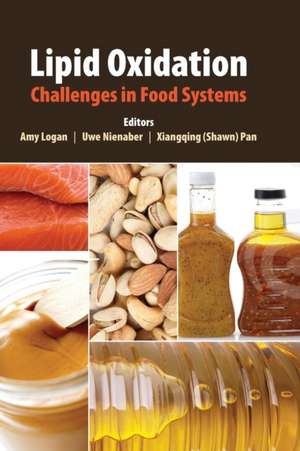
Lipid Oxidation: Challenges in Food Systems: Academic Press and AOCS Press
Editat de Amy S. Logan, Uwe Nienaber, Xiangqing (Shawn) Panen Limba Engleză Paperback – 19 aug 2016
- Five chapters on naturally-derived antioxidants that focus on applications within food systems
- Contributors include an international group of leading researchers from academic, industrial, and governmental entities
- Discusses the oxidative stability of enzymatically produced oils and fats
- Provides overviews on the complexities of lipid oxidation mechanisms, and emulsion systems most suseptible to rapid lipid oxidation




Preț: 1087.03 lei
Preț vechi: 1194.54 lei
-9%
Puncte Express: 1631
Carte tipărită la comandă
Livrare economică 21 noiembrie-05 decembrie
Livrare prin curier în România Termenul estimat este afișat lângă disponibilitate.
Transport gratuit pentru acest produs Plată online sau ramburs, în funcție de opțiunile comenzii.
Retur gratuit în 14 zile Comandă securizată și suport în română.
Specificații
ISBN-13: 9780128102299
ISBN-10: 0128102292
Pagini: 548
Dimensiuni: 152 x 229 mm
Greutate: 0.73 kg
Editura: ELSEVIER SCIENCE
Colecția Academic Press and AOCS Press
Seria Academic Press and AOCS Press
ISBN-10: 0128102292
Pagini: 548
Dimensiuni: 152 x 229 mm
Greutate: 0.73 kg
Editura: ELSEVIER SCIENCE
Colecția Academic Press and AOCS Press
Seria Academic Press and AOCS Press
Cuprins
Preface
Chapter 1: Challenges in Elucidating Lipid Oxidation Mechanisms: When, Where, and How do Products Arise?
Chapter 2: Challenges in Analyzing Lipid Oxidation: Are One Product and One Sample Concentration Enough?
Chapter 3: Oxidation in Different Food Matrices: How Physical Structure Impacts Lipid Oxidation in Oil-in-Water Emulsions and Bulk Oils
Chapter 4: Substrate and Droplet Size: Important Factors for Understanding Aqueous Lipid Oxidation
Chapter 5: The Role of the Interfacial Layer and Emulsifying Proteins in the Oxidation in Oil-in-Water Emulsions
Chapter 6: Oxidative Stability of Enzymatically Processed Oils and Fats
Chapter 7: The Polar Paradox: How an Imperfect Conceptual Framework Accelerated Our Knowledge of Antioxidant Behavior
Chapter 8: Role of Hydrophobicity on Antioxidant Activity in Lipid Dispersions: From the Polar Paradox to the Cut-Off Theory
Chapter 9: Understanding Antioxidant and Prooxidant Mechanisms of Phenolics in Food Lipids
Chapter 10: Antioxidant Evaluation and Antioxidant Activity Mechanisms
Chapter 11: Strategies to Minimize Oxidative Deterioration in Aquatic Food Products: Application of Natural Antioxidants from Edible Mushrooms
Chapter 12: The Natural Antioxidant Ergothioneine: Resources, Chemical Characterization, and Applications
Chapter 13: Rosemary and Green Tea Extracts as Natural Antioxidants: Chemistry, Technology, and Applications
Chapter 14: Using Natural Plant Extracts to Delay Lipid Oxidation in Foods
Chapter 15: Strategies to Prevent Oxidative Deterioration in Oil-in-Water Emulsion Systems: Canola-Based Phenolic Applications
Chapter 1: Challenges in Elucidating Lipid Oxidation Mechanisms: When, Where, and How do Products Arise?
Chapter 2: Challenges in Analyzing Lipid Oxidation: Are One Product and One Sample Concentration Enough?
Chapter 3: Oxidation in Different Food Matrices: How Physical Structure Impacts Lipid Oxidation in Oil-in-Water Emulsions and Bulk Oils
Chapter 4: Substrate and Droplet Size: Important Factors for Understanding Aqueous Lipid Oxidation
Chapter 5: The Role of the Interfacial Layer and Emulsifying Proteins in the Oxidation in Oil-in-Water Emulsions
Chapter 6: Oxidative Stability of Enzymatically Processed Oils and Fats
Chapter 7: The Polar Paradox: How an Imperfect Conceptual Framework Accelerated Our Knowledge of Antioxidant Behavior
Chapter 8: Role of Hydrophobicity on Antioxidant Activity in Lipid Dispersions: From the Polar Paradox to the Cut-Off Theory
Chapter 9: Understanding Antioxidant and Prooxidant Mechanisms of Phenolics in Food Lipids
Chapter 10: Antioxidant Evaluation and Antioxidant Activity Mechanisms
Chapter 11: Strategies to Minimize Oxidative Deterioration in Aquatic Food Products: Application of Natural Antioxidants from Edible Mushrooms
Chapter 12: The Natural Antioxidant Ergothioneine: Resources, Chemical Characterization, and Applications
Chapter 13: Rosemary and Green Tea Extracts as Natural Antioxidants: Chemistry, Technology, and Applications
Chapter 14: Using Natural Plant Extracts to Delay Lipid Oxidation in Foods
Chapter 15: Strategies to Prevent Oxidative Deterioration in Oil-in-Water Emulsion Systems: Canola-Based Phenolic Applications