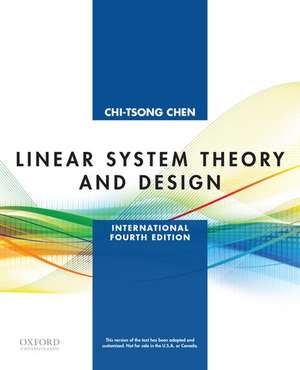
Linear System Theory and Design: International Fourth Edition: The Oxford Series in Electrical and Computer Engineering
Autor Chi-Tsong Chenen Limba Engleză Paperback – 27 feb 2014
Din seria The Oxford Series in Electrical and Computer Engineering
- 25%
 Preț: 1585.02 lei
 - 24%
 Preț: 907.51 lei
 - 23%
 Preț: 941.04 lei
 - 24%
 Preț: 1592.65 lei
 - 27%
 Preț: 1539.47 lei
 - 27%
 Preț: 1542.05 lei
 - 27%
 Preț: 730.85 lei
 - 24%
 Preț: 1707.85 lei
 - 24%
 Preț: 1711.28 lei
 - 24%
 Preț: 1706.65 lei
 - 27%
 Preț: 1635.92 lei
 - 27%
 Preț: 1414.45 lei
 - 12%
 Preț: 328.26 lei
 - 27%
 Preț: 1468.82 lei
 - 14%
 Preț: 1221.42 lei
Preț: 1661.09 lei
Preț vechi: 2202.96 lei
-25%
Puncte Express: 2492
Carte tipărită la comandă
Livrare economică 27 noiembrie-02 decembrie
Livrare prin curier în România Termenul estimat este afișat lângă disponibilitate.
Transport gratuit pentru acest produs Plată online sau ramburs, în funcție de opțiunile comenzii.
Retur gratuit în 14 zile Comandă securizată și suport în română.
Specificații
ISBN-13: 9780199964543
ISBN-10: 0199964548
Pagini: 416
Ilustrații: b/w illus.
Dimensiuni: 231 x 196 x 23 mm
Greutate: 0.75 kg
Ediția:Fourth Edition
Editura: Oxford University Press
Colecția OUP USA
Seria The Oxford Series in Electrical and Computer Engineering
Locul publicării:New York, United States
ISBN-10: 0199964548
Pagini: 416
Ilustrații: b/w illus.
Dimensiuni: 231 x 196 x 23 mm
Greutate: 0.75 kg
Ediția:Fourth Edition
Editura: Oxford University Press
Colecția OUP USA
Seria The Oxford Series in Electrical and Computer Engineering
Locul publicării:New York, United States
V-ar putea interesa
-
 -15%Preț: 628.02 lei738.84 lei
 -
 Fundamentals of Programmable Logic Controllers and Ladder LogicOrlando CharriaPreț: 363.43 lei
 -
 Small Signal Stability in Power Systems: Concept and ControlAhmed Abdulsalam AbdulqaderPreț: 246.09 lei
 -
 -5%Preț: 738.79 lei777.68 lei
 -
 Mechatronics: Electronics in Products and ProcessesDavidAllan Bradley-18%Preț: 690.56 lei842.15 lei
 -
 Optimization of Unit OperationsBela G. Liptak-18%Preț: 1435.59 lei1750.71 lei
 -
 Oracls: a Design System for Linear Multivariable ControlErnest S. Armstrong-18%Preț: 1904.26 lei2322.28 lei
 -
 Control of Uncertain Dynamic SystemsShankar P. Bhattacharyya-18%Preț: 2834.83 lei3457.11 lei
 -
 Breaking the Chains of CapitalismMarco D'AnnaPreț: 144.20 lei
 -
 -18%Preț: 1532.31 lei1868.67 lei
 -
 Signals and SystemsChi-Tsong ChenPreț: 156.42 lei
 -
 Systems, Automation, and ControlNabil Derbel-11%Preț: 550.80 lei618.88 lei
 -
 Hanns Peter Jörgl: Repetitorium Regelungstechnik. Band 2Hanns Peter Jörgl-9%Preț: 630.55 lei692.91 lei
Notă biografică
Chi-Tsong Chen is Professor Emeritus of Electrial and Computer Engineering at Stony Brook University, New York
Cuprins
- 1 Introduction
- 1.1 Introduction
- 1.2 Overview
- 1.2.1 A brief history
- 2 Mathematical Descriptions of Systems
- 2.1 Introduction
- 2.2 Causality, lumpedness, and time-invariance
- 2.2.1 Impulses
- 2.3 Linear time-invariant (LTI) systems
- 2.3.1 Multi-input multi-output case
- 2.4 Linear time-varying systems
- 2.3.1 Linearization
- 2.5 RLC circuits { Comparisons of various descriptions
- 2.6 Mechanical and hydraulic systems
- 2.7 Proper rational transfer functions
- 2.8 Discrete-time linear time-invariant systems
- 2.9 Concluding remarks
- Problems
- 3 Linear Algebra
- 3.1 Introduction
- 3.2 Basis, representation, and orthonormalization
- 3.3 Linear algebraic equations
- 3.4 Similarity transformation
- 3.5 Diagonal form and Jordan form
- 3.6 Functions of a square matrix
- 3.7 Lyapunov equation
- 3.8 Some useful formula
- 3.9 Quadratic form and positive de niteness
- 3.10 Singular value decomposition
- 3.11 Norms of matrices
- Problems
- 4 State-Space Solutions and Realizations
- 4.1 Introduction
- 4.2 General solution of CT LTI state-space equations
- 4.2.1 Discretization
- 4.2.2 General solution of DT LTI state-space equations
- 4.3 Computer computation of CT state-space equations
- 4.3.1 Real-time processing
- 4.3.2 Op-amp circuit implementation
- 4.4 Equivalent state equations
- 4.4.1 Canonical forms
- 4.3.2 Magnitude scaling in op-amp circuits
- 4.5 Realizations
- 4.5.1 Multi-input multi-output case
- 4.6 Solution of linear time-varying (LTV) equations
- 4.6.1 Discrete-time case
- 4.7 Equivalent time-varying equations
- 4.8 Time-varying realizations
- Problems
- 5 Stability
- 5.1 Introduction
- 5.2 Input-output stability of LTI systems
- 5.3 Discrete-time case
- 5.4 Internal stability
- 5.4.1 Discrete-time case
- 5.5 Lyapunov theorem
- 5.5.1 Discrete-time case
- 5.6 Stability of LTV systems
- Problems
- 6 Controllability and Observability
- 6.1 Introduction .
- 6.2 Controllability
- 6.2.1 Controllability indices
- 6.3 Observability
- 6.3.1 Observability indices
- 6.4 Canonical decomposition
- 6.5 Conditions in Jordan-form equations
- 6.6 Discrete-time state-space equations .
- 6.6.1 Controllability to the origin and reachability
- 6.7 Controllability after sampling
- 6.8 LTV state-space equations
- Problems
- 7 Minimal Realizations and Coprime Fractions
- 7.1 Introduction
- 7.2 Implications of coprimeness
- 7.2.1 Minimal realizations
- 7.2.2 Complete characterization
- 7.3 Computing coprime fractions
- 7.3.1 QR decomposition
- 7.4 Balanced realization
- 7.5 Realizations from Markov parameters
- 7.6 Degree of transfer matrices
- 7.7 Minimal realizations{Matrix case
- 7.8 Matrix polynomial fractions
- 7.8.1 Column and row reducedness
- 7.8.2 Computing matrix coprime fractions
- 7.9 Realization from matrix coprime fractions
- 7.10 Realizations from matrix Markov parameters
- 7.11 Concluding remarks
- Problems
- 8 State Feedback and State Estimators
- 8.1 Introduction
- 8.2 State feedback
- 8.2.1 Solving Lyapunov equation
- 8.3 Regulation and tracking
- 8.3.1 Robust tracking and disturbance rejection
- 8.3.2 Stabilization
- 8.4 State estimator
- 8.4.1 Reduced-dimensional state estimator
- 8.5 Feedback from estimated states .
- 8.6 State feedback{MIMO case
- 8.6.1 Cyclic design
- 8.6.2 Lyapunov-equation method
- 8.6.3 Canonical-form method
- 8.6.4 E ect on transfer matrices
- 8.7 State estimators{MIMO case
- 8.8 Feedback from estimated states{MIMO case
- Problems
- 9 Pole Placement and Model Matching
- 9.1 Introduction
- 9.2 Preliminary { Matching coe cients
- 9.2.1 Compensator equation{Classical method
- 9.3 Unity-feedback con guration{Pole placement
- 9.3.1 Regulation and tracking
- 9.3.2 Robust tracking and disturbance rejection
- 9.3.3 Embedding internal models
- 9.4 Implementable transfer functions
- 9.4.1 Model matching{Two-parameter con guration
- 9.4.2 Implementation of two-parameter compensators
- 9.5 MIMO unity feedback systems
- 9.5.1 Regulation and tracking
- 9.5.2 Robust tracking and disturbance rejection
- 9.6 MIMO model matching{Two-parameter con guration
- 9.6.1 Decoupling
- 9.7 Concluding remarks
- Problems
- References
- Answers to Selected Problems
- Index