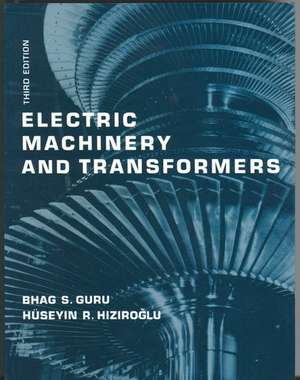
Electric Machinery and Transformers: The Oxford Series in Electrical and Computer Engineering
Autor Bhag S. Guru, Huseyin R. Hizirogluen Limba Engleză Hardback – 2 noi 2000
Din seria The Oxford Series in Electrical and Computer Engineering
- 25%
 Preț: 1585.02 lei
 - 24%
 Preț: 907.51 lei
 - 23%
 Preț: 941.04 lei
 - 25%
 Preț: 1523.93 lei
 - 27%
 Preț: 1539.47 lei
 - 27%
 Preț: 1542.05 lei
 - 27%
 Preț: 730.85 lei
 - 24%
 Preț: 1707.85 lei
 - 24%
 Preț: 1711.28 lei
 - 24%
 Preț: 1706.65 lei
 - 27%
 Preț: 1414.45 lei
 - 25%
 Preț: 1661.09 lei
 - 12%
 Preț: 328.26 lei
 - 27%
 Preț: 1468.82 lei
 - 14%
 Preț: 1221.42 lei
Preț: 1635.92 lei
Preț vechi: 2240.98 lei
-27%
Puncte Express: 2454
Carte tipărită la comandă
Livrare economică 17 noiembrie-01 decembrie
Livrare prin curier în România Termenul estimat este afișat lângă disponibilitate.
Transport gratuit pentru acest produs Plată online sau ramburs, în funcție de opțiunile comenzii.
Retur gratuit în 14 zile Comandă securizată și suport în română.
Specificații
ISBN-13: 9780195138900
ISBN-10: 0195138902
Pagini: 720
Ilustrații: numerous halftones and line figures
Dimensiuni: 194 x 240 x 39 mm
Greutate: 1.4 kg
Ediția:Third.
Editura: Oxford University Press
Colecția OUP USA
Seria The Oxford Series in Electrical and Computer Engineering
Locul publicării:New York, United States
ISBN-10: 0195138902
Pagini: 720
Ilustrații: numerous halftones and line figures
Dimensiuni: 194 x 240 x 39 mm
Greutate: 1.4 kg
Ediția:Third.
Editura: Oxford University Press
Colecția OUP USA
Seria The Oxford Series in Electrical and Computer Engineering
Locul publicării:New York, United States
V-ar putea interesa
-
 Schaum's Outline of Basic Electricity, Second EditionMilton Gussow-9%Preț: 134.50 lei147.13 lei
 -
 Elements of ElectromagneticsMatthew Sadiku-25%Preț: 1585.02 lei2125.72 lei
 -
 Science and Mathematics for EngineeringJohn Bird-8%Preț: 483.66 lei525.72 lei
 -
 Electrical Machines and Their ApplicationsTuran Gonen-20%Preț: 396.34 lei495.43 lei
 -
 Electromagnetism 2eI. S. GrantPreț: 415.87 lei
 -
 Basic ElectricityUnited States Bureau Of Naval Personnel-31%Preț: 104.28 lei151.85 lei
 -
 -19%Preț: 501.18 lei618.74 lei
 -
 -19%Preț: 482.98 lei596.28 lei
 -
 Principles and Applications of Electrical Engineering ISEGiorgio Rizzoni-26%Preț: 386.30 lei519.88 lei
 -
 Electrical Machines, Drives and Power SystemsTheodore Wildi-11%Preț: 689.59 lei774.81 lei
 -
 Electrical EngineeringAllan Hambley-11%Preț: 690.75 lei776.12 lei
 -
 Electrical Power System EssentialsPieter Schavemaker-19%Preț: 600.33 lei741.15 lei
 -
 Analysis of Electric Machinery and Drive SystemsPaul C Krause-23%Preț: 749.55 lei973.45 lei
 -
 Reeds vol 7: Advanced Electrotechnology for Marine EngineersDr. Christopher Lavers-26%Preț: 414.84 lei560.69 lei
 -
 Preț: 81.43 lei
 -
 Hydraulic Machines and EnergyGiorgio Cornetti-15%Preț: 647.88 lei762.21 lei
 -
 -26%Preț: 621.50 lei845.21 lei
 -
 -26%Preț: 663.68 lei900.91 lei
Cuprins
- Preface
- Acknowledgments
- 1 Review of Electric Circuit Theory
- 1.1: Introduction
- 1.2: Direct-Current Ciruit Analysis
- 1.3: Alternating-Current Circuit Analysis
- 1.4: Three-Phase Circuits
- 1.5: Power and Impendance Measurement
- Summary
- Review Questions
- Problems
- 2. Review of Basic Laws of Electromagnetism
- 2.1: Introduction
- 2.2: Maxwell's Equations
- 2.3: Magnetic Materials and Their Properties
- 2.4: Magnetic Circuits
- 2.5: Self- and Mututal Inductances
- 2.6: Magnetically Coupled Coils
- 2.7: Magnetic Losses
- 2.8: Permanent Magnets
- Summary
- Review Questions
- Problems
- 3. Principles of Electromechanical Energy Conversion
- 3.1: Introdcution
- 3.2: Electric Field as a Medium
- 3.3: Magnetic Field as a Medium
- 3.4: A Coil in a Uniform Magnetic Field
- 3.5: A Coil in a Time-Varying Magnetic Field
- 3.6: Synchronous Motor
- 3.7: Reluctance Motor
- 3.8: Electromagnetic Relays
- Summary
- Review Quesitons
- Problems
- 4 Tranformers
- 4.1: Introduction
- 4.2: Construction of a Transformer
- 4.3: An Ideal Transformer
- 4.4: A Nonideal Transformer
- 4.5: Voltage Regulation
- 4.6: Maximum Efficiency Criterion
- 4.7: Determination of Tranformer Parameters
- 4.8: Per-Unit Computations
- 4.9: The Autotransformer
- 4.10: Three-Phase Transformers
- 4.11: The Constant-Current Transformer
- 4.12: Instrument Transformers
- Summary
- Review Questions
- Problems
- 5 Direct-Current Generators
- 5.1: Introduction
- 5.2: Mechanical Construction
- 5.3: Armature Windings
- 5.4: Induced EMF Equations
- 5.5: Developed Torque
- 5.6: Magnetization Charateristic of a DC Machine
- 5.7: Theory of Communication
- 5.8: Armature Reaction
- 5.9: Types of DC Machines
- 5.10: Voltage Regulation
- 5.11: Losses in DC Machines
- 5.12: A Separately Excited DC Generator
- 5.13: A Shunt Generator
- 5.14: A Series Generator
- 5.15: Compound Geneators
- 5.16: Maxiumum Efficiency Criterion
- Summary
- Review Questions
- Problems
- 6 Direct-Current Motors
- 6.1: Introduction
- 6.2: Operation of a DC Motor
- 6.3: Speed Regulation
- 6.4: Losses in a DC Motor
- 6.5: A Series Motor
- 6.6: A Shunt Motor
- 6.7: The Compound Motor
- 6.8: Methods of Speed Control
- 6.9: The Ward-Leonard System
- 6.10: Torque Measurements
- 6.11: Braking or Reversing DC Motors
- Summary
- Review Questions
- Problems
- 7 Synchronous Generators
- 7.1: Introduction
- 7.2: Construction of a Synchronous Machine
- 7.3: Armature Windings
- 7.4: Pitch Factor
- 7.5: Distribution Factor
- 7.6: Winding Connections
- 7.7: Induced EMF Equation
- 7.8: The Equivalent Circuit
- 7.9: Power Relationships
- 7.10: Synchronous Generator Tests
- 7.11: The External Characteristics
- 7.12: Salient-Pole Synchronous Generator
- 7.13: Parallel Operation of Synchronous Generators
- Summary
- Review Questions
- Problems
- 8 Synchronous Motors
- 8.1: Introduction
- 8.2: Construction and Operation of a Synchronous Motor
- 8.3: Equivalent Circuit of a Synchronous motor
- 8.4: Power Expressions
- 8.5: Exact Condition for Maximum Power
- 8.6: Effect of Excitation
- 8.7: Power Fact Correction
- Summary
- Review Questions
- Problems
- 9 Polyphase Induction Motors
- 9.1: Introduction
- 9.2: Construction
- 9.3: Principle of Operation
- 9.4: Development of an Equivalent Circuit
- 9.5: An Approximate Equivalent Circuit
- 9.6: Maximym Power Criterion
- 9.7: Maximum Torque Criterion
- 9.8: Maximum Efficiency Criterion
- 9.9: Some Important Conclusions
- 9.10: Equivalent Circuit Parameters
- 9.11: Starting of Induction Motors
- 9.12: Rotor Impedence Tranformation
- 9.13: Speed Control of Induction Motors
- 9.14: Types of Induction Motors
- Summary
- Review Questions
- Problems
- 10 Single-Phase Motors
- 10.1: Introduction
- 10.2: Singe-Phase Induction Motor
- 10.3: Analysis of a Single-Phase Induction Motor
- 10.4: Types of Single-Phase Induction Motors
- 10.5: Analysis of a Single-Phase Motor Using Both Windings
- 10.6: Testing Single-Phase Motors
- 10.7: Shaded-Pole Motor
- 10,8: Universal Motor
- Summary
- Review Questions
- Problems
- 11 Dynamics of Electricla Machines
- 11.1: Introduction
- 11.2: DC Machines
- 11.3: Synchronous Generator Dynamics
- Summary
- Review Questions
- Problems
- 12 Special-Purpose Electric Machiens
- 12.1: Introduction
- 12.2: Permanent-Magnet Motors
- 12.3: Step Motors
- 12.4: Switched-Reluctance Motors
- 12.5: Brushless DC Motors
- 12.6: Hystersis Motors
- 12.7: Linear Induction Motors
- Summary
- Review Questions
- Problems
- Appendices
- A System of Units
- B The Laplace Transform
- Bibliography
- Index