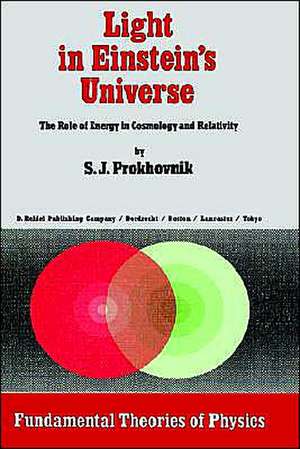
Light in Einstein's Universe: Fundamental Theories of Physics, cartea 16
Autor R. Prokhovniken Limba Engleză Hardback – 30 sep 1985
Din seria Fundamental Theories of Physics
-
 Preț: 439.78 lei
 - 18%
 Preț: 997.97 lei
 - 18%
 Preț: 809.77 lei
 - 18%
 Preț: 990.83 lei
 - 18%
 Preț: 985.37 lei
 - 18%
 Preț: 976.47 lei
 - 18%
 Preț: 1182.53 lei
 - 18%
 Preț: 1276.06 lei
 - 18%
 Preț: 908.76 lei
 -
 Preț: 399.61 lei
 - 18%
 Preț: 989.70 lei
 - 18%
 Preț: 1280.68 lei
 - 18%
 Preț: 984.47 lei
 - 18%
 Preț: 967.29 lei
 - 18%
 Preț: 977.93 lei
 - 15%
 Preț: 670.97 lei
 - 18%
 Preț: 1270.88 lei
 - 18%
 Preț: 962.19 lei
 - 18%
 Preț: 950.63 lei
 - 20%
 Preț: 623.48 lei
 - 15%
 Preț: 662.49 lei
 -
 Preț: 394.22 lei
 - 18%
 Preț: 753.83 lei
 -
 Preț: 380.05 lei
 - 15%
 Preț: 627.14 lei
 -
 Preț: 386.04 lei
 - 24%
 Preț: 639.70 lei
 - 15%
 Preț: 623.88 lei
 - 18%
 Preț: 1265.43 lei
 - 18%
 Preț: 954.64 lei
 - 15%
 Preț: 669.04 lei
 -
 Preț: 381.51 lei
 - 18%
 Preț: 983.40 lei
Preț: 663.17 lei
Preț vechi: 780.20 lei
-15%
Puncte Express: 995
Carte tipărită la comandă
Livrare economică 02-16 decembrie
Livrare prin curier în România Termenul estimat este afișat lângă disponibilitate.
Transport gratuit pentru acest produs Plată online sau ramburs, în funcție de opțiunile comenzii.
Retur gratuit în 14 zile Comandă securizată și suport în română.
Specificații
ISBN-13: 9789027720931
ISBN-10: 9027720932
Pagini: 240
Ilustrații: XIV, 222 p.
Dimensiuni: 160 x 241 x 18 mm
Greutate: 0.48 kg
Ediția:1985
Editura: Springer
Colecția Fundamental Theories of Physics
Seria Fundamental Theories of Physics
Locul publicării:Dordrecht, Netherlands
ISBN-10: 9027720932
Pagini: 240
Ilustrații: XIV, 222 p.
Dimensiuni: 160 x 241 x 18 mm
Greutate: 0.48 kg
Ediția:1985
Editura: Springer
Colecția Fundamental Theories of Physics
Seria Fundamental Theories of Physics
Locul publicării:Dordrecht, Netherlands
V-ar putea interesa
-
 Information, Physics, and ComputationMarc Mézard-30%Preț: 676.71 lei970.50 lei
 -
 -20%Preț: 404.88 lei504.32 lei
 -
 Sociophysics: An IntroductionParongama Sen-24%Preț: 665.30 lei876.47 lei
 -
 Mathematics for PhysicistsBrian R. MartinPreț: 443.98 lei
 -
 Principia: The Authoritative TranslationIsaac NewtonPreț: 146.15 lei
 -
 Quantum GravityCarlo Rovelli-11%Preț: 689.32 lei774.51 lei
 -
 Star Maps for BeginnersTheodore LevittPreț: 89.02 lei
 -
 Groups, Representations and PhysicsH.F Jones-15%Preț: 632.97 lei744.67 lei
 -
 Geometry, Topology and PhysicsMikio Nakahara-18%Preț: 728.00 lei887.81 lei
 -
 Lectures on Quantum MechanicsSteven WeinbergPreț: 470.84 lei
 -
 A Student's Guide to Dimensional AnalysisDon S. LemonsPreț: 229.15 lei
 -
 Mathematical Tools for Physicists 2eM. Grinfeld-9%Preț: 1104.47 lei1213.71 lei
 -
 -33%Preț: 567.40 lei848.57 lei
 -
 A First Course in Mathematical PhysicsCT WhelanPreț: 342.58 lei
 -
 -15%Preț: 442.16 lei520.18 lei
Public țintă
ResearchCuprins
1. The Observable Universe.- 1.1 Introduction.- 1.2 The Origins of Modern Cosmology.- 1.3 The Scale of the Universe.- 1.4 The Large-scale Features of the Universe.- 1.5 Recent Observational Developments.- 1.6 Strange and Wonderful Objects.- Exercises and Problems.- 2. The Bases of Modern Cosmology.- 2.1 The Significance of the Hubble Law.- 2.2 The Interpretation of Cosmological Red-Shifts.- 2.3 The Nature of a Mathematical Model.- 2.4 Basic Assumptions and Definitions.- 2.5 The Case for a Uniform Rate of Expansion.- 2.6 The Puzzle of Light Propagation.- Exercises and Problems.- 3. The Principle of Relativity.- 3.1 Motion According to Galileo.- 3.2 Newton’s System of the World.- 3.3 The Basis of Special Relativity.- 3.4 The Lorentz Transformation and its Implications.- 3.5 The Relativity of Time and Length Observations.- 3.6 The Relativistic Metric.- Exercises and Problems.- 4. Light Propagation in an Expanding Universe.- 4.1 The Cosmological Metric.- 4.2 The Geometry of Light Paths.- 4.3 Astronomical Implications.- 4.4 The Equivalence of Fundamental Observers.- Exercises and Problems.- 5. The Effects of Movement Relative to the Fundamental Frame.- 5.1 The Cosmological Acceleration Field.- 5.2 The Primary Anisotropy Effect.- 5.3 The Retarded Potential Law for ‘Moving’ Bodies.- 5.4 The Effect of Motion on Length and Mass.- Exercises and Problems.- 6. Special Relativity as a Cosmological Theory.- 6.1 The Basic Effects of Anisotropy.- 6.2 Observational Consequences.- 6.3 The Balance of Anisotropy Effects.- 6.4 Some Further Consequences.- Exercises and Problems.- 7. Gravitation in a Unique Universe.- 7.1 A Cosmological Basis for Gravitation.- 7.2 Einstein’s Very General Theory.- 7.3 Fock’s Particular Formulation of General Relativity.- 7.4 The Universe as aMass-Energy System.- Exercises and Problems.- 8. The Space, time and Matter of our Universe.- 8.1 Relative or Absolute?.- 8.2 The Status of the Cosmological Substratum.- 8.3 The Nature of Time.- 8.4 The Matter of our Universe.- 8.5 The Essence and Basis of the Argument.- Exercise and Problems.- Appendices.- Appendix 1: The Steady State Syndrome.- Appendix 2: The Status of Einstein’s Stationary System.- Appendix 3: The Black Hole Deduction.- Appendix 4: The Lorentz-Equivalence of Fundamental Observers — General Proof.- Appendix 5: Derivation of the Retarded Potential Field Law — General Case.- Appendix 6: Synchronisation of Clocks By Slow Transport.- Appendix 7: The Relativistic Doppler and Aberration Furmulae.- Comments on the Exercises and Problems.- 1–1 Movement relative to the cosmic background radiation?.- 1–2 Newtonian black holes?.- 2–1 Why do some galaxies exhibit blue-shifts?.- 2–2(a) The velocity space of a steady-state universe.- 2–2(b) The velocity space of a uniformly-expanding universe.- 2–3 Observational indicators of cosmic time.- 3–1 The practical significance of Einstein’s measurement conventions.- 3–2 Derivation of a transformation involving Einstein co-ordinate measures.- 3–3 The influence of Einstein’s new approach.- 3–4 The velocities transformation and the conditions for its employment.- 3–5 The invariance of the out-and-return journey result.- 3–6 The invariance of the order of events within a time-like interval.- 4–1 Two-dimensional representations of an expanding reference frame.- 4–2 The composition of recession velocities.- 4–3 The extent of the universe?.- 4–4 The limits of observation?.- 4–5 Are there any fundamental observers in the universe?.- 5–1 The speed of light relative to a movingsystem.- 5–2 Derivation of the retarded potential result for a point directly behind the moving source-body.- 5–3 Derivation of the general length-contraction formula.- 6–1 The observation of length contraction.- 6–2 The time-dilation result for arbitrarily-oriented light-clocks.- 6–3 The puzzle of the balanced lever.- 6–4 The group properties of the Lorentz transformation.- 7–1 The universe as a mass-energy system.- 7–2 A changing universe as the source of gravity?.- 8–1 Eddington’s table.- 8–2 The faces of the Moon.- 8–3 The twin tendencies of evolution and dissolution in our universe.- List of References.
Recenzii
`An original, timely and stimulating book: do not miss it.' Foundations of Physics (1986)