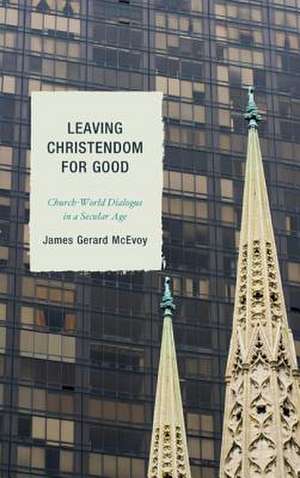
Leaving Christendom for Good: Church-World Dialogue in a Secular Age: Lexington Books
Autor James Gerard McEvoyen Limba Engleză Hardback – mai 2014
Din seria Lexington Books
- 60%
 Preț: 425.77 lei
 - 33%
 Preț: 710.13 lei
 - 19%
 Preț: 419.90 lei
 - 21%
 Preț: 383.46 lei
 - 59%
 Preț: 427.24 lei
 - 27%
 Preț: 354.28 lei
 - 23%
 Preț: 322.75 lei
 - 23%
 Preț: 321.63 lei
 - 35%
 Preț: 560.77 lei
 - 27%
 Preț: 355.41 lei
 - 25%
 Preț: 306.14 lei
 - 23%
 Preț: 333.36 lei
 - 29%
 Preț: 342.63 lei
 - 25%
 Preț: 361.02 lei
 - 22%
 Preț: 338.89 lei
 - 28%
 Preț: 347.76 lei
 - 28%
 Preț: 346.74 lei
 - 23%
 Preț: 318.96 lei
 - 23%
 Preț: 321.63 lei
 - 24%
 Preț: 309.62 lei
 - 25%
 Preț: 306.14 lei
 - 29%
 Preț: 599.98 lei
 - 23%
 Preț: 318.57 lei
 - 24%
 Preț: 369.89 lei
 - 33%
 Preț: 642.37 lei
 - 36%
 Preț: 730.77 lei
 - 35%
 Preț: 593.23 lei
 - 28%
 Preț: 252.34 lei
 - 29%
 Preț: 342.12 lei
 - 22%
 Preț: 332.36 lei
 - 25%
 Preț: 362.03 lei
 - 29%
 Preț: 344.18 lei
 - 23%
 Preț: 319.79 lei
 - 23%
 Preț: 321.53 lei
 - 28%
 Preț: 346.74 lei
 - 24%
 Preț: 308.07 lei
 - 29%
 Preț: 345.71 lei
 - 27%
 Preț: 263.04 lei
 - 37%
 Preț: 660.07 lei
 - 37%
 Preț: 659.90 lei
 - 33%
 Preț: 710.24 lei
 - 22%
 Preț: 341.76 lei
 - 29%
 Preț: 345.71 lei
 - 33%
 Preț: 358.06 lei
 - 27%
 Preț: 354.68 lei
 - 34%
 Preț: 418.63 lei
 - 34%
 Preț: 630.22 lei
Preț: 632.44 lei
Preț vechi: 850.45 lei
-26%
Puncte Express: 949
Carte tipărită la comandă
Livrare economică 16-30 octombrie
Livrare prin curier în România Termenul estimat este afișat lângă disponibilitate.
Transport gratuit pentru acest produs Plată online sau ramburs, în funcție de opțiunile comenzii.
Retur gratuit în 14 zile Comandă securizată și suport în română.
Specificații
ISBN-13: 9780739187326
ISBN-10: 0739187325
Pagini: 189
Dimensiuni: 162 x 234 x 24 mm
Greutate: 0.45 kg
Editura: Bloomsbury Publishing
Colecția Lexington Books
Seria Lexington Books
Locul publicării:New York, United States
ISBN-10: 0739187325
Pagini: 189
Dimensiuni: 162 x 234 x 24 mm
Greutate: 0.45 kg
Editura: Bloomsbury Publishing
Colecția Lexington Books
Seria Lexington Books
Locul publicării:New York, United States
V-ar putea interesa
-
 Ratzinger's Faith: The Theology of Pope Benedict XVITracey Rowland-20%Preț: 96.11 lei119.57 lei
 -
 Catholic Higher Education: A Culture in CrisisMelanie Morey-11%Preț: 379.94 lei425.62 lei
 -
 Signs of LifeScott W. HahnPreț: 93.45 lei
 -
 Beyond BeliefColm O'gorman-6%Preț: 67.41 lei71.57 lei
 -
 Pope John Paul II: An Intimate Life: The Pope I Knew So WellCaroline PigozziPreț: 97.17 lei
 -
 Catholic and CorneredKenneth ParkerPreț: 71.93 lei
 -
 Preț: 138.68 lei
 -
 The Difference God Makes A Catholic Vision of Faith, Communion, and CultureFrancis Cardinal GeorgePreț: 171.01 lei
 -
 Living the MassDominic GrassiPreț: 83.38 lei
 -
 Marthe Robin and the Foyers of CharityMartin BlakePreț: 76.68 lei
 -
 Led by FaithImmaculée IlibagizaPreț: 112.69 lei
 -
 Conscience and Calling: Ethical Reflections on Catholic Women's Church VocationsSister Anne E. Patrick-41%Preț: 125.34 lei213.86 lei
 -
 Consoling the Heart of JesusMichael Gaitley-8%Preț: 100.17 lei109.11 lei
Descriere
Leaving Christendom for Good argues that the solution to some of the most troubling tensions in the life of the Catholic Church since Vatican II can be found in the council's document Gaudium et spes. This text's view of the church's mission and social relationships as dialogical has the capacity to liberate. Part One studies the contemporary place of religion-with particular reference to Charles Taylor's groundbreaking work, A Secular Age-and examines Gaudium et spes's dialogical view of the church-world relationship. Part Two explores what true dialogue entails and how it is best understood theologically, engaging critically with Joseph Ratzinger's view of the church-world relationship. The book's final chapter considers two practical implications of its argument: how evangelization can be best understood today, and how the church can best approach issues in the public sphere.
Cuprins
Table of Contents
Acknowledgements
Introduction: Resolving Present Difficulties
Part I: Church and World Today
Chapter 1: Religion in a Secular Age: From the Sixteenth to the Eighteenth Century
Chapter 2: Religion in a Secular Age: The Explosion into the Present
Chapter 3: The Turn to Dialogue at Vatican II
Part II: Dialogue and its Challenges
Chapter 4: Dialogue, Language, and the Other
Chapter 5: God's Dialogue with Humanity: Word and Spirit in History and Narrative
Chapter 6: A Different Voice: Joseph Ratzinger and the Corruptions of Modernity
Chapter 7: The Church's Dialogue with the World
Bibliography
Index
About the Author
Acknowledgements
Introduction: Resolving Present Difficulties
Part I: Church and World Today
Chapter 1: Religion in a Secular Age: From the Sixteenth to the Eighteenth Century
Chapter 2: Religion in a Secular Age: The Explosion into the Present
Chapter 3: The Turn to Dialogue at Vatican II
Part II: Dialogue and its Challenges
Chapter 4: Dialogue, Language, and the Other
Chapter 5: God's Dialogue with Humanity: Word and Spirit in History and Narrative
Chapter 6: A Different Voice: Joseph Ratzinger and the Corruptions of Modernity
Chapter 7: The Church's Dialogue with the World
Bibliography
Index
About the Author
Recenzii
James McEvoy presents a timely and interesting look at the stance of the contemporary Roman Catholic Church towards the modern world. . . .The work could appeal to a wide audience: Catholics and other laypeople disenchanted with the unhelpful dead-end of the modern liberal-conservative dichotomy (which McEvoy criticizes); Christian clergy interested in the ecclesiological ebb-and-flow of Christianity's largest body; and those interested in the discussions around the work of Charles Taylor. . . .Leaving Christendom for Good is a helpful work that engages several important currents of thought and their representative thinkers, and ends with a reasonable diagnosis for a way forward that could appeal to wide sections of the modern Catholic Church and many sympathetic onlookers, Christian and secular. . . .[O]ne of McEvoy's chief strengths is a deft ability to summarize and synthesize vast amounts of scholarship, while threading through his commentary and expounding a clear thesis. . . .[the book's] prescient reflections on modernity, evangelization, and the courage of belief today has many key pieces in place for later expansion by himself or others of what a dialogical model could mean for Catholicism in the twenty-first century.
In a world of strident voices with fundamentalist convictions, this book speaks in a gentler tone. . . .The reader of this highly recommended book must be ready to do some serious thinking. But the rewards are worth the intellectual journey. McEvoy writes with authority when addressing all aspects of his argument. The book is full of clear explorations into complex issues, with fine syntheses and arguments that give the reader a compelling picture of hope for our contemporary world.
No one in Australia knows the work of Charles Taylor better than James McEvoy. In Leaving Christendom for Good, McEvoy not only manages to present the core arguments of Taylor's A Secular Age he also offers us a rich theology of dialogue and a renewed appreciation of Gaudium et Spes as the turn to dialogue at Vatican II. . . .McEvoy does not disappoint in taking the reader on the journey of the in-depth analysis of cultural change.
McEvoy started working on his book during the academic year 2009-2010, that is, at a time in the life of the Catholic Church when the book's subject was unpopular: the relationship between the church and the modern world in terms of dialogue and the role of the constitution Gaudium et Spes of Vatican II (1965) in this theological debate. Now that the book is published in a Catholic environment quite different from that of 2009-2010, thanks to the election of Pope Francis, McEvoy's book has even more to say.
Leaving Christendom for Good will give vital and urgently needed service to the Church's work of evangelization in contemporary liberal culture. With great insight and careful analysis, it develops and advocates a dialogical understanding of the Church-world relationship. McEvoy transcends the superficial polarities of liberal versus conservative and highlights the rich potential of Vatican II's Gaudium et spes to give the Catholic tradition new life in a changed world.
Leaving Christendom for Good exemplifies first-rate scholarship: it is comprehensive in its research and analysis; it is accessible in its expression; it is generous in its assessments of contrary opinions; and it is thought-provoking in its proposals. In promoting a commitment to "dialogue" as the means by which the church might engage constructively with the contemporary world, James McEvoy develops an argument that is insightful, nuanced, and hope-filled. This is a book that will enrich its readers.
McEvoy helps lay bare the core divisions in the post-conciliar church that continue to plague Catholicism to this day. His incisive study engages not only theological and historical perspectives, but also social analysis, with the work of philosopher Charles Taylor featuring prominently throughout. Leaving Christendom for Good charts the emergence of a new paradigm for church-world relations and commends the dialogical vision of Gaudium et spes as encapsulating the heart of the faith itself and continuing to offer a way forward for the church-world dynamic in our times and beyond. It is a creative, intelligent, and thought-provoking study that will inform discussions in the university, church, and wider society alike.
In a world of strident voices with fundamentalist convictions, this book speaks in a gentler tone. . . .The reader of this highly recommended book must be ready to do some serious thinking. But the rewards are worth the intellectual journey. McEvoy writes with authority when addressing all aspects of his argument. The book is full of clear explorations into complex issues, with fine syntheses and arguments that give the reader a compelling picture of hope for our contemporary world.
No one in Australia knows the work of Charles Taylor better than James McEvoy. In Leaving Christendom for Good, McEvoy not only manages to present the core arguments of Taylor's A Secular Age he also offers us a rich theology of dialogue and a renewed appreciation of Gaudium et Spes as the turn to dialogue at Vatican II. . . .McEvoy does not disappoint in taking the reader on the journey of the in-depth analysis of cultural change.
McEvoy started working on his book during the academic year 2009-2010, that is, at a time in the life of the Catholic Church when the book's subject was unpopular: the relationship between the church and the modern world in terms of dialogue and the role of the constitution Gaudium et Spes of Vatican II (1965) in this theological debate. Now that the book is published in a Catholic environment quite different from that of 2009-2010, thanks to the election of Pope Francis, McEvoy's book has even more to say.
Leaving Christendom for Good will give vital and urgently needed service to the Church's work of evangelization in contemporary liberal culture. With great insight and careful analysis, it develops and advocates a dialogical understanding of the Church-world relationship. McEvoy transcends the superficial polarities of liberal versus conservative and highlights the rich potential of Vatican II's Gaudium et spes to give the Catholic tradition new life in a changed world.
Leaving Christendom for Good exemplifies first-rate scholarship: it is comprehensive in its research and analysis; it is accessible in its expression; it is generous in its assessments of contrary opinions; and it is thought-provoking in its proposals. In promoting a commitment to "dialogue" as the means by which the church might engage constructively with the contemporary world, James McEvoy develops an argument that is insightful, nuanced, and hope-filled. This is a book that will enrich its readers.
McEvoy helps lay bare the core divisions in the post-conciliar church that continue to plague Catholicism to this day. His incisive study engages not only theological and historical perspectives, but also social analysis, with the work of philosopher Charles Taylor featuring prominently throughout. Leaving Christendom for Good charts the emergence of a new paradigm for church-world relations and commends the dialogical vision of Gaudium et spes as encapsulating the heart of the faith itself and continuing to offer a way forward for the church-world dynamic in our times and beyond. It is a creative, intelligent, and thought-provoking study that will inform discussions in the university, church, and wider society alike.