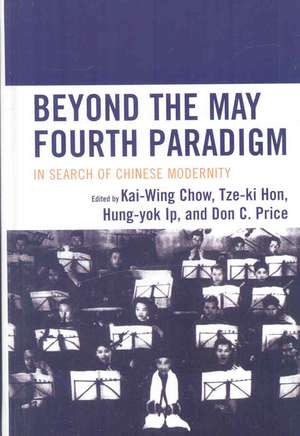
Beyond the May Fourth Paradigm: In Search of Chinese Modernity: Lexington Books
Editat de Kai-wing Chow, Tze-ki Hon, Hung-yok Ip, Don C. Price Contribuţii de Jianhua Chen, Fa-ti Fan, Denise Gimpel, Ted Huters, Frederick Lau, Viren Murthy, Kristin Stapleton, Lung-kee Sun, Xiong Yuezhien Limba Engleză Hardback – 18 apr 2008
Din seria Lexington Books
- 32%
 Preț: 729.63 lei
 - 59%
 Preț: 427.24 lei
 - 35%
 Preț: 574.44 lei
 - 22%
 Preț: 341.76 lei
 - 31%
 Preț: 437.25 lei
 - 28%
 Preț: 352.50 lei
 - 23%
 Preț: 321.53 lei
 - 23%
 Preț: 333.36 lei
 - 23%
 Preț: 327.54 lei
 - 35%
 Preț: 593.04 lei
 - 33%
 Preț: 358.06 lei
 - 26%
 Preț: 363.28 lei
 - 25%
 Preț: 362.03 lei
 - 22%
 Preț: 330.56 lei
 - 28%
 Preț: 346.74 lei
 - 24%
 Preț: 308.07 lei
 - 23%
 Preț: 321.63 lei
 - 27%
 Preț: 263.04 lei
 - 24%
 Preț: 369.89 lei
 - 25%
 Preț: 884.44 lei
 - 29%
 Preț: 345.71 lei
 - 34%
 Preț: 537.45 lei
 - 33%
 Preț: 428.79 lei
 - 34%
 Preț: 616.07 lei
 - 29%
 Preț: 342.12 lei
 - 26%
 Preț: 362.85 lei
 - 22%
 Preț: 338.89 lei
 - 28%
 Preț: 356.18 lei
 - 23%
 Preț: 321.63 lei
 - 28%
 Preț: 346.74 lei
 - 22%
 Preț: 340.40 lei
 - 29%
 Preț: 345.71 lei
 - 23%
 Preț: 318.96 lei
 - 37%
 Preț: 660.07 lei
 - 27%
 Preț: 355.41 lei
 - 32%
 Preț: 727.58 lei
 - 24%
 Preț: 313.51 lei
 - 28%
 Preț: 614.62 lei
 - 24%
 Preț: 309.62 lei
 - 34%
 Preț: 630.22 lei
 - 34%
 Preț: 575.26 lei
 - 34%
 Preț: 607.70 lei
 - 33%
 Preț: 639.19 lei
 - 33%
 Preț: 642.37 lei
 - 33%
 Preț: 640.95 lei
 - 25%
 Preț: 369.74 lei
Preț: 730.77 lei
Preț vechi: 1149.52 lei
-36%
Puncte Express: 1096
Carte tipărită la comandă
Livrare economică 03-17 decembrie
Livrare prin curier în România Termenul estimat este afișat lângă disponibilitate.
Transport gratuit pentru acest produs Plată online sau ramburs, în funcție de opțiunile comenzii.
Retur gratuit în 14 zile Comandă securizată și suport în română.
Specificații
ISBN-13: 9780739111222
ISBN-10: 0739111221
Pagini: 341
Dimensiuni: 161 x 240 x 27 mm
Greutate: 0.64 kg
Editura: Bloomsbury Publishing
Colecția Lexington Books
Seria Lexington Books
Locul publicării:New York, United States
ISBN-10: 0739111221
Pagini: 341
Dimensiuni: 161 x 240 x 27 mm
Greutate: 0.64 kg
Editura: Bloomsbury Publishing
Colecția Lexington Books
Seria Lexington Books
Locul publicării:New York, United States
Descriere
When did China make the decisive turn from tradition to modernity? For decades, the received wisdom would have pointed to the May Fourth movement, with its titanic battles between the champions of iconoclasm and the traditionalists, and its shift to more populist forms of politics. A growing body of recent research has, however, called into question how decisive the turn was, when it happened, and what relation the resulting modernity bore to the agendas of people who might have considered themselves representatives of such an iconoclastic movement. Having thus explicitly or implicitly 'decentered' the May Fourth, such research (augmented by contributions in the present volume) leaves us with the task of accounting for the shape Chinese modernity took, as the product of dialogues and debates between, and the interplay of, a variety of actors and trends, both within and (certainly no less importantly) without the May Fourth camp.
Cuprins
Part 1 Introduction
Part 2 Part One: Commercial Printing and Language Reform
Chapter 3 1. Culture, Capital and the Temptations of the Imagined Market: The Case of the Commercial Press
Chapter 4 2. Canon Formation and Linguistic Turn: Literary Debates in Republican China, 1919-1949
Part 5 Part Two: Gender and Family
Chapter 6 3. The Theory and Practice of Women's Rights in Late Qing Shanghai, 1843-1911
Chapter 7 4. Freeing the Mind through the Body: Women's Thoughts on Physical Education in Late Qing and Early Republican China
Chapter 8 5. Generational and Cultural Fissures in the May Fourth Movement: Wu Yu (1872-1949) and the Politics of Family Reform
Part 9 Part Three: Nation, Science, and Culture
Chapter 10 6. The Politics of Fengjian in Late Qing and Republican China
Chapter 11 7. How Did the Chinese Become Native?: Science and the Search for National Origins in the May Fourth Era
Chapter 12 8. Nationalizing Sound on the Verge of Chinese Modernity
Part 13 Part Four: Modernity and Its Chinese Critics
Chapter 14 9. Buddhism, Literature, and Chinese Modernity: Su Manshu's Imaginings of Love (1911-1916)
Chapter 15 10. From Babbitt to "Bai Bide": Interpretations of New Humanism in Xueheng
Part 16 Epilogue
Chapter 17 11. The Other May Fourth: Twilight of the Old Order
Part 2 Part One: Commercial Printing and Language Reform
Chapter 3 1. Culture, Capital and the Temptations of the Imagined Market: The Case of the Commercial Press
Chapter 4 2. Canon Formation and Linguistic Turn: Literary Debates in Republican China, 1919-1949
Part 5 Part Two: Gender and Family
Chapter 6 3. The Theory and Practice of Women's Rights in Late Qing Shanghai, 1843-1911
Chapter 7 4. Freeing the Mind through the Body: Women's Thoughts on Physical Education in Late Qing and Early Republican China
Chapter 8 5. Generational and Cultural Fissures in the May Fourth Movement: Wu Yu (1872-1949) and the Politics of Family Reform
Part 9 Part Three: Nation, Science, and Culture
Chapter 10 6. The Politics of Fengjian in Late Qing and Republican China
Chapter 11 7. How Did the Chinese Become Native?: Science and the Search for National Origins in the May Fourth Era
Chapter 12 8. Nationalizing Sound on the Verge of Chinese Modernity
Part 13 Part Four: Modernity and Its Chinese Critics
Chapter 14 9. Buddhism, Literature, and Chinese Modernity: Su Manshu's Imaginings of Love (1911-1916)
Chapter 15 10. From Babbitt to "Bai Bide": Interpretations of New Humanism in Xueheng
Part 16 Epilogue
Chapter 17 11. The Other May Fourth: Twilight of the Old Order
Recenzii
The contents of this volume go beyond the usual range of scholarly assessments and reassessments of May Fourth culture and literature. In widening the horizons of the May Fourth movement and its implications to include such diverse topics as language andprinting, gender and family, as well as the larger issues of science, religion, nation, and modernity, this book has made a seminal contribution to scholarship in modern Chinese intellectual and cultural history. Highly recommended for both specialists in the field and interested lay readers...
This volume significantly contributes to the decentering of the May Fourth movement as the defining moment in modern Chinese history. Focusing on the complex interplay between that movement and a rich array of often little-explored trends such as science and Buddhism, it deftly sketches the contours of a historically embedded and culturally layered Chinese modernity.
A collection of well-researched, well-written, and insightful essays.. Beyond the May Fourth Paradigm is an excellent collection of essays that offers many insights and stimuli on how to rethink the complex and contradictory nature of China's modern intellectual and cultural scene.
This volume significantly contributes to the decentering of the May Fourth movement as the defining moment in modern Chinese history. Focusing on the complex interplay between that movement and a rich array of often little-explored trends such as science and Buddhism, it deftly sketches the contours of a historically embedded and culturally layered Chinese modernity.
A collection of well-researched, well-written, and insightful essays.. Beyond the May Fourth Paradigm is an excellent collection of essays that offers many insights and stimuli on how to rethink the complex and contradictory nature of China's modern intellectual and cultural scene.