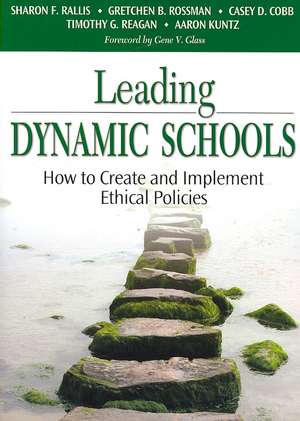
Leading Dynamic Schools
Autor Sharon F. Rallis, Gretchen B. Rossman, Casey D. Cobben Limba Engleză Paperback – 27 iun 2007
Structura volumului Leading Dynamic Schools este construită riguros pe un cadru metodologic tripartit: raționament, acțiune și evaluare. Această abordare transformă conceptul adesea abstract de „politică educațională” într-un proces deliberativ local, accesibil nu doar administratorilor, ci și profesorilor sau consiliilor de părinți. Remarcăm modul în care autorii deconstruiesc mitul conform căruia politicile sunt directive rigide venite de sus, propunând în schimb un model dinamic în care puterea este distribuită și legitimată prin participarea mai multor voci. Materialul este organizat progresiv, începând cu definirea școlilor dinamice și continuând cu aplicarea cadrului propus pe dileme etice concrete. Analizăm capitole dedicate incluziunii, integrării imigranților și gestionării climatului școlar pentru prevenirea bullying-ului. Fiecare dintre aceste secțiuni urmează aceeași logică de investigație, oferind cititorului un instrumentar predictibil pentru rezolvarea conflictelor de valori. Subliniem că această lucrare completează perspectiva oferită de Ethics and Politics in School Leadership de Jeffrey Brierton, adăugând o metodologie specifică de implementare a politicilor etice, dincolo de rezolvarea conflictelor politice cu sindicatele sau consiliile școlare. În contextul operei autorilor, Leading Dynamic Schools reprezintă consolidarea conceptului de „școală dinamică” introdus în lucrările lor anterioare, Principals of Dynamic Schools și Dynamic Teachers. Dacă în volumele precedente accentul cădea pe rolul liderului sau al profesorului ca agent al schimbării, aici accentul se mută pe mecanismele formale și informale care guvernează instituția. De asemenea, temele legate de diversitate sunt explorate în profunzime, continuând direcția de cercetare din Language and Cultural Diversity in U.S. Schools, însă cu un accent sporit pe transformarea acestor provocări în politici de incluziune funcționale.
Preț: 231.46 lei
Carte tipărită la comandă
Livrare economică 28 noiembrie-12 decembrie
Specificații
ISBN-10: 1412915570
Pagini: 144
Dimensiuni: 178 x 254 x 8 mm
Greutate: 0.31 kg
Ediția:1
Editura: Corwin
Locul publicării:Thousand Oaks, United States
V-ar putea interesa
-
 -29%Preț: 136.24 lei191.23 lei
 -
 Preț: 421.21 lei
 -
 Hands Are Not for HittingMartine AgassiPreț: 184.22 lei
 -
 Effective Educational LeadershipNigel D Bennett-18%Preț: 689.10 lei840.36 lei
 -
 Strategic Leadership and Educational ImprovementMaggie Preedy-15%Preț: 601.60 lei707.76 lei
 -
 Educational LeadershipHarry Tomlinson-15%Preț: 620.12 lei729.56 lei
 -
 Leaders of Their Own LearningRon BergerPreț: 186.92 lei
 -
 Teacher's Skills Tests for DummiesColin BeveridgePreț: 172.02 lei
 -
 Standard SettingGregory J. Cizek-18%Preț: 821.70 lei1002.07 lei
 -
 -8%Preț: 420.12 lei456.65 lei
 -
 Assessment of LearningWynne Harlen-15%Preț: 614.74 lei723.22 lei
 -
 Learning PlacesMichael FullanPreț: 316.28 lei
 -
 Essential QuestionsJay MctighePreț: 179.91 lei
De ce să citești această carte
Recomandăm această carte liderilor școlari și cadrelor didactice care doresc să treacă de la simpla aplicare a regulamentelor la crearea unor politici etice autentice. Cititorul câștigă un cadru de lucru testat pentru a gestiona diversitatea și climatul școlar, transformând provocările administrative în oportunități de învățare incluzivă. Este un ghid esențial pentru cei care cred că succesul unei școli depinde de democratizarea procesului decizional.
Despre autor
Sharon F. Rallis este profesor distins de politici educaționale și reformă la University of Massachusetts Amherst, având un doctorat obținut la Harvard Graduate School of Education. Cariera sa academică include poziții de prestigiu la Harvard, University of Connecticut și Vanderbilt University. Specialistă recunoscută în leadership educațional, Rallis s-a concentrat constant pe modul în care școlile se pot adapta schimbării. Expertiza sa în politici educaționale și diversitate culturală fundamentează abordarea etică din Leading Dynamic Schools, oferind o bază teoretică solidă pentru practicile de incluziune discutate în volum.
Descriere scurtă
Policy is an often overused and more often misunderstood concept. The authors bring to life the making and enacting of educational policy in schools, and help readers develop a more sophisticated and complex understanding of the purposes, evaluation, creation, and implementation of school policies at all levels. As in the earlier books, the authors use vignettes and cases, as well as research and relevant theories, to illustrate important concepts.
The theme of power within policy permeates the text. The authors recognize that policy tends to represent dominant voices, and that power can be appropriate and legitimate. Dynamic schools are places where multiple voices contribute to the policy-making and implementing process.
Recenzii
"The authors do an excellent job of recommending practical strategies to help school leaders reason through policy dilemmas. As an academic, a former practitioner, and former member of an educational policy and advocacy organization, I give a ‘hats off’ to the authors for approaching educational policy and school leadership in this way."
"Educators and library collections catering to them receive a survey arranged by key issues that blends vignettes and research with policy reviews and more. A key to designing successful school and community interactions."
Cuprins
Preface
1. The Many Ps of Policy
What Are Dynamic Schools?
Policy, Program, Procedure, or Practice?
What Do School Leaders Say About Policy?
Policy as Local Deliberative Process
2. The Choice to Act: Shaping the Dialogue
Reasoning
Acting
Evaluating
The Framework in Practice
3. Inclusion: From Dilemma to Imperative
Reasoning
Acting
Evaluating
Reviewing the Inquiry Process of This Dynamic School
4. Immigrants and the Schools: Opening or Closing Doors
Reasoning
Acting
Evaluating
5. Meeting the Needs of English Language Learners: More Than One Way
Reasoning
Acting
Evaluating
6. Asset Building and ‘No Pass, No Play’: Considering the Whole Child
Justice in Learning
The Scenario: Part II
Reasoning: Justice in Policy
Acting and Evaluating
The Scenario: Part III
7. School Climate: Preventing Acts of Bullying
Reasoning
Moral Reasoning
Acting
Evaluation
8. Putting the Framework Into Practice
A Dialogue Among Principals
Final Thoughts
References
Index
Notă biografică
A past-president of the American Evaluation Association (2005) and current editor of the American Journal of Evaluation, Professor Rallis has been involved with education and evaluation for more than three decades. She has been a teacher, counselor, principal, researcher, program evaluator, director of a major federal school reform initiative, and an elected school board member. Currently, her teaching includes courses on inquiry, program evaluation, qualitative methodology, and organizational theory. Her research has focused on the local implementation of programs driven by federal, state, or district policies. As external evaluator or principal investigator (PI), she has studied a variety of domestic and international policy and reform efforts, such as alternative professional development for leaders; collaborations between agencies responsible for educating incarcerated or institutionalized youth; initiatives supporting inclusive education for children and youth with disabilities; local school governance and leadership; labor-management relations in school districts; and leadership development. Her work with students on evaluation and qualitative methodology has taken her as far as Afghanistan, Turkey, and Palestine.
Descriere
This invaluable resource brings to life the process of making and enacting educational policy. The authors present a conceptual framework for developing effective and ethical school policies and help educational leaders evaluate, interpret, and analyze the regulations that govern their schools. Organized by key topics such as English Language Learners, inclusion, and bullying, the text incorporates vignettes, research, and relevant theories to illustrate how readers can:
- Create a dialogue that represents the needs of all stakeholders
- Define relevant policies that are ethically sound
- Integrate legally mandated policies with schoolwide resolutions