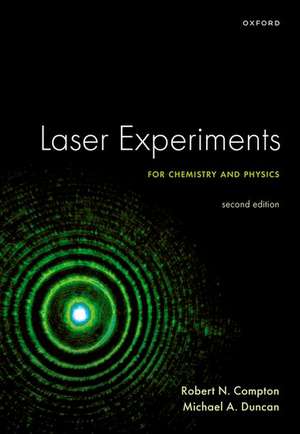
Laser Experiments for Chemistry and Physics, Second Edition
Autor Robert N. Compton, Michael A. Duncanen Limba Engleză Paperback – 27 noi 2024
Preț: 344.03 lei
Preț vechi: 377.13 lei
-9%
Puncte Express: 516
Carte disponibilă
Livrare economică 06-17 noiembrie
Livrare express 23-29 octombrie pentru 91.62 lei
Livrare prin curier în România Termenul estimat este afișat lângă disponibilitate.
Transport gratuit de la 400.00 lei Plată online sau ramburs, în funcție de opțiunile comenzii.
Retur gratuit în 14 zile Comandă securizată și suport în română.
Specificații
ISBN-13: 9780198900832
ISBN-10: 019890083X
Pagini: 464
Ilustrații: 246 illustrations
Dimensiuni: 190 x 245 x 24 mm
Greutate: 0.98 kg
Ediția:2
Editura: OUP OXFORD
Colecția OUP Oxford
Locul publicării:Oxford, United Kingdom
ISBN-10: 019890083X
Pagini: 464
Ilustrații: 246 illustrations
Dimensiuni: 190 x 245 x 24 mm
Greutate: 0.98 kg
Ediția:2
Editura: OUP OXFORD
Colecția OUP Oxford
Locul publicării:Oxford, United Kingdom
V-ar putea interesa
-
 Spectra of Atoms and MoleculesPeter F. Bernath-32%Preț: 686.08 lei1006.30 lei
 -
 Atomic PhysicsC.J. Foot-10%Preț: 382.25 lei424.84 lei
 -
 Quantum Optics: An IntroductionMark Fox-10%Preț: 346.40 lei383.01 lei
 -
 Organic Chemistry: Chimie organicăJonathan Clayden-18%Preț: 570.15 lei694.33 lei
 -
 Instruments and Experimentation in the History of ChemistryFrederic HolmesPreț: 108.56 lei
 -
 -11%Preț: 668.13 lei750.70 lei
 -
 -19%Preț: 532.86 lei657.84 lei
 -
 Introduction to Modern OpticsGrant R. Fowles-18%Preț: 101.51 lei123.52 lei
 -
 Building Scientific ApparatusJohn H. Moore-14%Preț: 908.51 lei1056.41 lei
 -
 Physics of Atoms and MoleculesBrian H. Bransden-9%Preț: 585.28 lei643.17 lei
 -
 -9%Preț: 807.69 lei887.58 lei
 -
 Laser Physics and SpectroscopyPradip Narayan Ghosh-8%Preț: 427.27 lei464.42 lei
 -
 XAFS for EveryoneScott Calvin-9%Preț: 818.20 lei899.12 lei
 -
 -19%Preț: 509.00 lei628.39 lei
 -
 Progress in Ultrafast Intense Laser Science XVIIKaoru Yamanouchi-18%Preț: 734.15 lei895.30 lei
 -
 Basic Sciences in Ophthalmology: Physics and ChemistryJosef Flammer-5%Preț: 1048.71 lei1103.91 lei
 -
 Atoms, Molecules and PhotonsWolfgang Demtröder-18%Preț: 794.68 lei969.13 lei
 -
 MechanicsStefan Roth-11%Preț: 401.93 lei451.60 lei
Recenzii
Review from previous edition Laser Experiments for Chemistry and Physics is a fine resource for experienced physics instructors looking to set up new experiments in advanced lab courses. Compton and Duncan provide both guidance and inspiration in their outstanding collection of laser experiments.
A high-quality and useful book ... instructors and students specially focused on the fields of physical chemistry and spectroscopy will most likely find the highest interest; however, readers interested in broader areas of chemistry and physics should also find this work very useful. If you belong to this potential audience, the purchase of Laser Experiments for Chemistry and Physics will doubtless be a good investment.
A high-quality and useful book ... instructors and students specially focused on the fields of physical chemistry and spectroscopy will most likely find the highest interest; however, readers interested in broader areas of chemistry and physics should also find this work very useful. If you belong to this potential audience, the purchase of Laser Experiments for Chemistry and Physics will doubtless be a good investment.
Notă biografică
Robert N. Compton received degrees in physics from Berea College (BA), the University of Florida (MS), and the University of Tennessee (PhD). He was a Senior Corporate Fellow at the Oak Ridge National Laboratory from 1965 to 1995 and was a Professor of Physics and Zeigler Professor of Chemistry at the University of Tennessee until retirement in 2015. He was a Visiting Professor at the University of Aarhus, the University of Paris, and the FOM Institute in Amsterdam. In 2001, he was an Erskine Fellow at the University of Christchurch, New Zealand. He was a Fellow of the APS, AAAS, and OSA, and received the Beams Award from the American Physical Society, and the Meggers Award from the Optical Society of America. His research interests include negative ions, laser spectroscopy, and molecular chirality. He has published one other book with Nathan I. Hammer, Ethan C. Lambert, and J. Stewart Hager entitled Raman Spectroscopy Under Liquid Nitrogen (RUN).Michael A. Duncan was born in Greenville, SC, and attended Furman University (B.S. 1976). He received his Ph.D. (1982) at Rice University with Richard Smalley, working on laser photoionization mass spectrometry. He held an NRC Postdoctoral Fellowship at the Joint Institute for Laboratory Astrophysics (Boulder, CO) with Stephen Leone in 1981-1983. He joined the University of Georgia faculty in 1983 and is now Franklin Professor and Regents' Professor. He is a Fellow of the American Physical Society, the American Chemical Society, and the American Association for the Advancement of Science. He was Senior Editor for the Journal of Physical Chemistry (1998-2015).
Cuprins
- 1.: Elementary Properties of Light
- 2.: Basic Optics
- 3.: General Characteristics of Lasers
- 4.: Laboratory Lasers
- 5.: Nonlinear Optics
- 6.: Laser Safety
- 7.: The Speed of Light
- 8.: The Speed of Sound in Gases, Liquids, and Solids
- 9.: Thermal Lens Calorimetry
- 10.: Laser Refractometry
- 11.: Laser-Induced Breakdown Spectroscopy
- 12.: Laser Desorption Time-of-Flight Mass Spectrometry
- 13.: Multiphoton Ionization Mass Spectrometry of Metal Carbonyls
- 14.: Optical Spectroscopy
- 15.: Quantum Chemistry Calculations
- 16.: Multiphoton Ionization and Third Harmonic Generation in Alkali Atoms
- 17.: Electronic Absorption Spectroscopy of Molecular Iodine
- 18.: Electronic Spectroscopy of Iodine Using REMPI
- 19.: Raman Spectroscopy Under Liquid Nitrogen
- 20.: Raman Spectroscopy of Carbon Nanomaterials
- 21.: Optical Rotary Dispersion of a Chiral Liquid (a-pinene)
- 22.: Faraday Rotation
- 23.: Fermi Resonance in CO2
- 24.: Photoacoustic Spectroscopy of Methane
- 25.: Optogalvanic Spectroscopy
- 26.: Diode Laser Atomic Spectroscopy
- 27.: Raman Shifting and Stimulated Electronic Raman Scattering (SERS)
- 28.: Fluorescence Lifetime of Iodine Vapor
- 29.: Semiconductor Quantum Dots
- 30.: Raman Spectroscopy Applied to Molecular Conformational Analysis
- 31.: Diffraction of Light from Blood Cells
- 32.: Laser Induced Crystal Growth