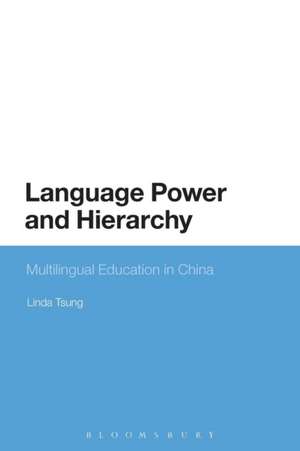
Language Power and Hierarchy: Multilingual Education in China
Autor Dr Linda Tsungen Limba Engleză Paperback – 21 apr 2016
The PRC promotes itself as a harmonious, stable multicultural mosaic, with over 50 distinct ethnic groups striving for common prosperity. Beneath this rhetoric, there is also inter-ethnic discord, with scenes of ethnic violence in Lhasa and Urumqi over the last few years.
China has a complex system of multilingual education - with dual-pathway curricula, bilingual and trilingual instruction, specialised ethnic schools. This education system is a lynchpin in the Communist party state's efforts to keep a lid on simmering tensions and transform a rhetoric of harmony into a critical pluralistic harmonious multiculturalism. This book examines this supposed lynchpin.
Preț: 283.01 lei
Preț vechi: 335.06 lei
-16%
Puncte Express: 425
Carte tipărită la comandă
Livrare economică 05-19 decembrie
Livrare prin curier în România Termenul estimat este afișat lângă disponibilitate.
Transport gratuit de la 400.00 lei Plată online sau ramburs, în funcție de opțiunile comenzii.
Retur gratuit în 14 zile Comandă securizată și suport în română.
Specificații
ISBN-13: 9781474283441
ISBN-10: 1474283446
Pagini: 264
Dimensiuni: 156 x 234 x 14 mm
Greutate: 0.38 kg
Ediția:NIPPOD
Editura: Bloomsbury Publishing
Colecția Bloomsbury Academic
Locul publicării:London, United Kingdom
ISBN-10: 1474283446
Pagini: 264
Dimensiuni: 156 x 234 x 14 mm
Greutate: 0.38 kg
Ediția:NIPPOD
Editura: Bloomsbury Publishing
Colecția Bloomsbury Academic
Locul publicării:London, United Kingdom
V-ar putea interesa
-
 Phraseology: Theory, Analysis, and ApplicationsA. P. Cowie-28%Preț: 432.35 lei603.12 lei
 -
 Phonological Knowledge: Conceptual and Empirical IssuesNoel Burton-Roberts-27%Preț: 373.93 lei511.31 lei
 -
 23: The Transition to LanguageAlison Wray-26%Preț: 358.40 lei487.32 lei
 -
 -27%Preț: 359.00 lei491.65 lei
 -
 Foundations of Language: Brain, Meaning, Grammar, EvolutionRay Jackendoff-9%Preț: 386.84 lei425.43 lei
 -
 Child Language: The Parametric ApproachWilliam Snyder-19%Preț: 358.15 lei442.87 lei
 -
 -27%Preț: 356.51 lei490.22 lei
 -
 Language Development and Learning to ReadDiane McguinnessPreț: 325.25 lei
 -
 Before Writing: Rethinking the Paths to LiteracyGunther KressPreț: 445.81 lei
 -
 How Children Learn LanguageWilliam O'GradyPreț: 287.03 lei
 -
 -23%Preț: 445.39 lei578.42 lei
 -
 -27%Preț: 969.47 lei1328.05 lei
 -
 -23%Preț: 550.45 lei714.86 lei
 -
 Second Language AcquisitionArchibald-23%Preț: 475.06 lei616.96 lei
 -
 Preț: 522.91 lei
 -
 -15%Preț: 442.34 lei520.39 lei
 -
 Cognate Vocabulary in Language Acquisition and UseAgnieszka OtwinowskaPreț: 409.09 lei
 -
 -27%Preț: 898.40 lei1230.68 lei
Cuprins
List of maps and figures
List of tables
Foreword
Preface
Abbreviations
1. Introduction
2. Multilingualism in China: diversity, hierarchy and power
3. Maintaining Mongolian language in Inner Mongolia
4. Becoming bilingual and trilingual in Xinjiang
5. The debate on Tibetan education in Qinghai
6. Harnessing multilingualism: linguistic vitality in Yunnan
7. Rethinking multilingualism: the new literacy in Guangxi
8. Challenges and barriers for multilingualism and multilingual education
Bibliography
Index
List of tables
Foreword
Preface
Abbreviations
1. Introduction
2. Multilingualism in China: diversity, hierarchy and power
3. Maintaining Mongolian language in Inner Mongolia
4. Becoming bilingual and trilingual in Xinjiang
5. The debate on Tibetan education in Qinghai
6. Harnessing multilingualism: linguistic vitality in Yunnan
7. Rethinking multilingualism: the new literacy in Guangxi
8. Challenges and barriers for multilingualism and multilingual education
Bibliography
Index
Recenzii
Tsung's book is an important resource, a ground-breaking study that fills a gap in our understanding of multilingualism, language policy, social change and education in China. The country now requires improved multilingual education in order to create a harmonious society, and this book can be a catalyst for change.
In addition to its data-rich survey of Mongolian, Uighur, Tibetan and other minority language instruction across China, Linda Tsung's brilliant new study casts new light on theoretical and practical issues surrounding multilingualism as a global phenomenon and its impact on social, cultural, social and political life in contemporary China.
Linda Tsung's book is a ground-breaking study of the complex issue of multilingualism in contemporary China. Backed by primary sources and years of extensive fieldwork in vast Chinese ethnic minority regions, the author reveals the challenges that all stakeholders must face in negotiating the tension among the diverse forces of globalization, nationalization, language maintenance, social development, among others. It is as theoretically fascinating for linguists as practically valuable for policy makers.
Linda Tsung does what few linguists do well: she takes us into a mysterious world and shows us what the sociolinguistic reality is like there. This is the first book that has empirically and systematically examined the multilingual norms and multilingual education in China, a nation now standing at the crossroads with confusion, and hesitation.
This book is both an empirically rich account and theoretically significant critique of China's policies and practices of multilingualism and multilingual education Skilfully navigating amongst several different ethnic minority languages and communities in China, Linda Tsung directs us to the opportunities and challenges of multilingualism. The book is of relevance to a wide range of people interested in language policy, education, and social change in China.
In addition to its data-rich survey of Mongolian, Uighur, Tibetan and other minority language instruction across China, Linda Tsung's brilliant new study casts new light on theoretical and practical issues surrounding multilingualism as a global phenomenon and its impact on social, cultural, social and political life in contemporary China.
Linda Tsung's book is a ground-breaking study of the complex issue of multilingualism in contemporary China. Backed by primary sources and years of extensive fieldwork in vast Chinese ethnic minority regions, the author reveals the challenges that all stakeholders must face in negotiating the tension among the diverse forces of globalization, nationalization, language maintenance, social development, among others. It is as theoretically fascinating for linguists as practically valuable for policy makers.
Linda Tsung does what few linguists do well: she takes us into a mysterious world and shows us what the sociolinguistic reality is like there. This is the first book that has empirically and systematically examined the multilingual norms and multilingual education in China, a nation now standing at the crossroads with confusion, and hesitation.
This book is both an empirically rich account and theoretically significant critique of China's policies and practices of multilingualism and multilingual education Skilfully navigating amongst several different ethnic minority languages and communities in China, Linda Tsung directs us to the opportunities and challenges of multilingualism. The book is of relevance to a wide range of people interested in language policy, education, and social change in China.