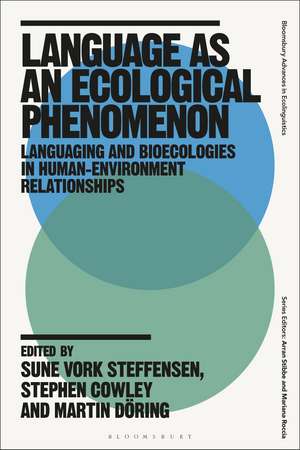
Language as an Ecological Phenomenon: Languaging and Bioecologies in Human-Environment Relationships: Bloomsbury Advances in Ecolinguistics
Editat de Sune Vork Steffensen, Stephen Cowley, Martin Döringen Limba Engleză Hardback – 27 iun 2024
Exploring this conceptual change in the field, the book presents a process view in which language is substituted by languaging, emphasising the bioecologies that we cohabit with numerous other species. It puts forward this perspective by looking at the theoretical considerations behind the understanding of languaging as bioecological, and through examining languaging in various contexts and places. Drawing on examples from across the world, it addresses topics such as climate catastrophes, corporate narratives, questions of ecological leadership, the bioecological implications of the COVID pandemic, and relational landscapes. It also makes use of data from across multiple bioecological settings, including the dairy and agricultural industries.
Din seria Bloomsbury Advances in Ecolinguistics
- 28%
 Preț: 208.89 lei
 - 26%
 Preț: 212.90 lei
 - 28%
 Preț: 208.20 lei
 - 26%
 Preț: 206.34 lei
 - 25%
 Preț: 212.72 lei
 - 32%
 Preț: 615.96 lei
 - 33%
 Preț: 614.73 lei
 - 26%
 Preț: 207.35 lei
 - 26%
 Preț: 210.86 lei
 - 33%
 Preț: 615.16 lei
 - 33%
 Preț: 615.16 lei
 - 33%
 Preț: 614.65 lei
 - 32%
 Preț: 628.99 lei
 - 33%
 Preț: 588.11 lei
 - 33%
 Preț: 625.15 lei
 - nou
 Preț: 629.80 lei
Preț: 615.52 lei
Preț vechi: 911.80 lei
-32%
Puncte Express: 923
Carte tipărită la comandă
Livrare economică 27 noiembrie-11 decembrie
Livrare prin curier în România Termenul estimat este afișat lângă disponibilitate.
Transport gratuit pentru acest produs Plată online sau ramburs, în funcție de opțiunile comenzii.
Retur gratuit în 14 zile Comandă securizată și suport în română.
Specificații
ISBN-13: 9781350304482
ISBN-10: 1350304484
Pagini: 272
Ilustrații: 20 bw illus
Dimensiuni: 162 x 236 x 22 mm
Greutate: 0.56 kg
Editura: Bloomsbury Publishing
Colecția Bloomsbury Academic
Seria Bloomsbury Advances in Ecolinguistics
Locul publicării:London, United Kingdom
ISBN-10: 1350304484
Pagini: 272
Ilustrații: 20 bw illus
Dimensiuni: 162 x 236 x 22 mm
Greutate: 0.56 kg
Editura: Bloomsbury Publishing
Colecția Bloomsbury Academic
Seria Bloomsbury Advances in Ecolinguistics
Locul publicării:London, United Kingdom
Cuprins
List of Figures
List of Tables
List of Contributors
Acknowledgements
1. Ecolinguistics: Living and Languaging United, Sune Vork Steffensen, Martin Döring (Hamburg University, Germany) and Stephen Cowley (University of Southern Denmark, Slagelse, Denmark)
Part I: Energising Ecolinguistics
2. How (Dairy) Cows and Human Intertwine Languaging Practices: Recurrent Vocalizations are not the same, Leonie Cornips
3. Ecolinguistics and the Cognitive Ecology of Global Warming, Sune Vork Steffensen and Ed Baggs (University of Southern Denmark, Denmark)
4. Regeneration: From Language to Languaging, Stephen Cowley (University of Southern Denmark, Denmark)
5. The Epistemological Conundrum of Language: Humans as Ecologically Special and Ecologically Destructive, Alexander Kravchenko (Baikal State University, Siberia)
6. Varieties of Expression and Enlanguaged Cognition in the Context of a Radicalized Ecolinguistics, Rasmus Gahrn-Andersen (University of Southern Denmark, Denmark)
Part II: From Discourse to Worldly Action
7. Ecolinguistics for Ethical Leadership, Arran Stibbe (University of Gloucestershire, UK)
8. Landscape Sentience, Elizabeth Oriel (University of London, UK), Deepta Sateesh (Manipal Academy of Higher Education, India), and Amal Dissanayaka (Hector Kobbekaduwa Agrarian Research and Training Institute, Sri Lanka)
9. Considering Cows in Australian Dairy Discourse, Alison Moore (University of Wollongong, Australia)
10. Learning about, Learning from, Learning with: Towards a Critical Practice and Theory of Situated Language Sciences, Chris Sinha and Vera da Silva Sinha
Index
List of Tables
List of Contributors
Acknowledgements
1. Ecolinguistics: Living and Languaging United, Sune Vork Steffensen, Martin Döring (Hamburg University, Germany) and Stephen Cowley (University of Southern Denmark, Slagelse, Denmark)
Part I: Energising Ecolinguistics
2. How (Dairy) Cows and Human Intertwine Languaging Practices: Recurrent Vocalizations are not the same, Leonie Cornips
3. Ecolinguistics and the Cognitive Ecology of Global Warming, Sune Vork Steffensen and Ed Baggs (University of Southern Denmark, Denmark)
4. Regeneration: From Language to Languaging, Stephen Cowley (University of Southern Denmark, Denmark)
5. The Epistemological Conundrum of Language: Humans as Ecologically Special and Ecologically Destructive, Alexander Kravchenko (Baikal State University, Siberia)
6. Varieties of Expression and Enlanguaged Cognition in the Context of a Radicalized Ecolinguistics, Rasmus Gahrn-Andersen (University of Southern Denmark, Denmark)
Part II: From Discourse to Worldly Action
7. Ecolinguistics for Ethical Leadership, Arran Stibbe (University of Gloucestershire, UK)
8. Landscape Sentience, Elizabeth Oriel (University of London, UK), Deepta Sateesh (Manipal Academy of Higher Education, India), and Amal Dissanayaka (Hector Kobbekaduwa Agrarian Research and Training Institute, Sri Lanka)
9. Considering Cows in Australian Dairy Discourse, Alison Moore (University of Wollongong, Australia)
10. Learning about, Learning from, Learning with: Towards a Critical Practice and Theory of Situated Language Sciences, Chris Sinha and Vera da Silva Sinha
Index
Recenzii
Language as an Ecological Phenomenon offers a groundbreaking interdisciplinary perspective . The book's innovative approach not only deepens understanding of the interconnections between language and ecology but also equips readers with practical frameworks for addressing real-world environmental challenges.
[The] volume makes a compelling case for transitioning from a theoretical discourse on ecolinguistics to a practice-oriented approach to languaging in a world increasingly threatened by the destruction of ecosystems and climate change.
Forwarding a theoretical innovation that aims to both extend and unify ecolinguistics, this thought-provoking volume challenges ecolinguists to seek a deeper understanding of how languages and languaging influence ecosystems and life-sustaining relations. - Robert Poole, Associate Professor, University of Alabama, USA.
."activities involving language are ecological" - This is the basic tenet of the articles in this innovative volume. It takes ecolinguistic theory radically further by arguing that language, or rather languaging, is a "coordinative activity embedded in practice" which impacts the life-sustaining relations that uphold human living and its ecosphere - Hermine Penz, Professor, University of Graz, Austria.
[The] volume makes a compelling case for transitioning from a theoretical discourse on ecolinguistics to a practice-oriented approach to languaging in a world increasingly threatened by the destruction of ecosystems and climate change.
Forwarding a theoretical innovation that aims to both extend and unify ecolinguistics, this thought-provoking volume challenges ecolinguists to seek a deeper understanding of how languages and languaging influence ecosystems and life-sustaining relations. - Robert Poole, Associate Professor, University of Alabama, USA.
."activities involving language are ecological" - This is the basic tenet of the articles in this innovative volume. It takes ecolinguistic theory radically further by arguing that language, or rather languaging, is a "coordinative activity embedded in practice" which impacts the life-sustaining relations that uphold human living and its ecosphere - Hermine Penz, Professor, University of Graz, Austria.