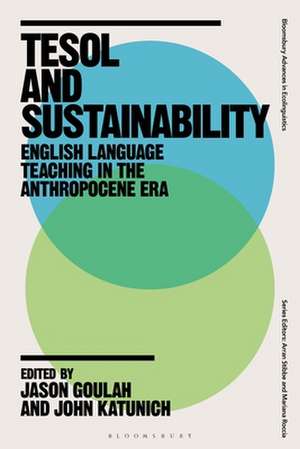
TESOL and Sustainability: English Language Teaching in the Anthropocene Era: Bloomsbury Advances in Ecolinguistics
Editat de Dr Jason Goulah, Dr John Katunichen Limba Engleză Paperback – 18 noi 2021
Covering a diverse range of topics, including anthropogenic climate change, habitat loss, food insecurity and mass migration, chapters argue that such crises require not only technological innovation, but also cultural changes in how human beings relate to each other and their environment. Arguing that it is incumbent upon the field of English language teaching to reckon with such cultural changes in how and what we teach, TESOL and Sustainability addresses the ways in which discourses such as eco-pedagogy, the critique of neo-liberalism, non-Western philosophy and post-humanist thought can and must inform how and what is taught in ESL and EFL classrooms.
Din seria Bloomsbury Advances in Ecolinguistics
- 28%
 Preț: 208.89 lei
 - 28%
 Preț: 208.20 lei
 - 26%
 Preț: 206.34 lei
 - 25%
 Preț: 212.72 lei
 - 32%
 Preț: 615.96 lei
 - 33%
 Preț: 614.73 lei
 - 26%
 Preț: 207.35 lei
 - 26%
 Preț: 210.86 lei
 - 33%
 Preț: 615.16 lei
 - 33%
 Preț: 615.16 lei
 - 33%
 Preț: 614.65 lei
 - 33%
 Preț: 614.37 lei
 - 33%
 Preț: 588.11 lei
 - 33%
 Preț: 625.15 lei
 - nou
 Preț: 626.45 lei
Preț: 212.90 lei
Preț vechi: 287.61 lei
-26%
Puncte Express: 319
Carte tipărită la comandă
Livrare economică 23 noiembrie-07 decembrie
Livrare prin curier în România Termenul estimat este afișat lângă disponibilitate.
Transport gratuit de la 400.00 lei Plată online sau ramburs, în funcție de opțiunile comenzii.
Retur gratuit în 14 zile Comandă securizată și suport în română.
Specificații
ISBN-13: 9781350294516
ISBN-10: 1350294519
Pagini: 216
Dimensiuni: 230 x 154 x 12 mm
Greutate: 0.3 kg
Editura: Bloomsbury Publishing
Colecția Bloomsbury Academic
Seria Bloomsbury Advances in Ecolinguistics
Locul publicării:London, United Kingdom
ISBN-10: 1350294519
Pagini: 216
Dimensiuni: 230 x 154 x 12 mm
Greutate: 0.3 kg
Editura: Bloomsbury Publishing
Colecția Bloomsbury Academic
Seria Bloomsbury Advances in Ecolinguistics
Locul publicării:London, United Kingdom
Cuprins
List of Contributors
Foreword, Suresh Canagarajah (Edwin Erle Sparks Professor of Applied Linguistics, English, and Asian Studies, Penn State University, USA)
Introduction: TESOL and Sustainability, John Katunich (Dickinson College, USA) & Jason Goulah (DePaul University, USA)
Part I. Foundations for Sustainability in TESOL: Cultural Perspectives, Products, and Practices
1. Earth Democracy as Empowerment for TESOL Students and Educators: Though the Crisis Speaks English, englishes Can Become a Commons Language of Sustainability, M. Garrett Delavan (California State University, San Marcos, USA)
2. Re-orienting Language as a Commons: Dispositions for English Language Teaching in the "Second Watershed", John Katunich (Dickinson College, USA)
3. Post-Truth Pedagogy for TESOL: Our Collective Responsibility for the Two-Legged, the Four-Legged, the Flyers, the Swimmers, the Multi-Legged and the Stationary, Sandra Kouritzin (University of Manitoba, Canada)
Part II. Climate Change and Place as TESOL Curriculum and Pedagogy
4. TESOL into the Anthropocene: Climate Migration as Curriculum and Pedagogy in ESL, Jason Goulah (DePaul University, USA)
5. A Place-Based Ecopedagogy for an English for Academic Purposes Program, Kevin Eyraud (Utah Valley University, USA)
6. Cross-Cultural Communication in Tourism Encounters and Implications for Sustainable TESOL, Bal Krishna Sharma (University of Idaho, USA)
7. Saving the World without (Eco)Justice? English-Language Voluntourism, Rural Education, and Root Metaphors of Success, Cori Jakubiak (Grinnell College, USA) & Alan Hastings (Central College, USA)
Coda: The Incommensurability of English Language Pedagog[uer]y and Sustainability: Spirits and Protein, Satoru Nakagawa (University of Manitoba, Canada)
Index
Foreword, Suresh Canagarajah (Edwin Erle Sparks Professor of Applied Linguistics, English, and Asian Studies, Penn State University, USA)
Introduction: TESOL and Sustainability, John Katunich (Dickinson College, USA) & Jason Goulah (DePaul University, USA)
Part I. Foundations for Sustainability in TESOL: Cultural Perspectives, Products, and Practices
1. Earth Democracy as Empowerment for TESOL Students and Educators: Though the Crisis Speaks English, englishes Can Become a Commons Language of Sustainability, M. Garrett Delavan (California State University, San Marcos, USA)
2. Re-orienting Language as a Commons: Dispositions for English Language Teaching in the "Second Watershed", John Katunich (Dickinson College, USA)
3. Post-Truth Pedagogy for TESOL: Our Collective Responsibility for the Two-Legged, the Four-Legged, the Flyers, the Swimmers, the Multi-Legged and the Stationary, Sandra Kouritzin (University of Manitoba, Canada)
Part II. Climate Change and Place as TESOL Curriculum and Pedagogy
4. TESOL into the Anthropocene: Climate Migration as Curriculum and Pedagogy in ESL, Jason Goulah (DePaul University, USA)
5. A Place-Based Ecopedagogy for an English for Academic Purposes Program, Kevin Eyraud (Utah Valley University, USA)
6. Cross-Cultural Communication in Tourism Encounters and Implications for Sustainable TESOL, Bal Krishna Sharma (University of Idaho, USA)
7. Saving the World without (Eco)Justice? English-Language Voluntourism, Rural Education, and Root Metaphors of Success, Cori Jakubiak (Grinnell College, USA) & Alan Hastings (Central College, USA)
Coda: The Incommensurability of English Language Pedagog[uer]y and Sustainability: Spirits and Protein, Satoru Nakagawa (University of Manitoba, Canada)
Index
Recenzii
The climate crisis is far too important to be ignored by any profession or occupation. This book challenges TESOLers to understand our profession's role in the climate crisis and to act forcefully and effectively to make that role a positive one.
TESOL and Sustainability is poetically articulated, politically conceived, and darefully envisioned. For those who are interested in how Mother Earth is 'talking' to us, this is a must read. The urgency of the moment, made extremely clearly in this book, makes an earth-centred pedagogical approach to English language teaching and learning more pressing than ever. If we cannot imagine what we do not know, this is a compass pointing to a new and hopeful direction.
The question of sustainability is much more than a conversation topic for ESL classes. Rather it is an issue for discussion among all of us involved in English language education. Is English language teaching itself a sustainable enterprise within the Anthropocene? How do we understand our complicity as English language educators with the human and non-human changes now convulsing the planet? This book urges us to consider the interconnectedness of language, commons, place and eco-ethical consciousness.
TESOL and Sustainability is poetically articulated, politically conceived, and darefully envisioned. For those who are interested in how Mother Earth is 'talking' to us, this is a must read. The urgency of the moment, made extremely clearly in this book, makes an earth-centred pedagogical approach to English language teaching and learning more pressing than ever. If we cannot imagine what we do not know, this is a compass pointing to a new and hopeful direction.
The question of sustainability is much more than a conversation topic for ESL classes. Rather it is an issue for discussion among all of us involved in English language education. Is English language teaching itself a sustainable enterprise within the Anthropocene? How do we understand our complicity as English language educators with the human and non-human changes now convulsing the planet? This book urges us to consider the interconnectedness of language, commons, place and eco-ethical consciousness.