
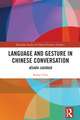
Language and Gesture in Chinese Conversation: Bǐshǒu-shuōhuà: Routledge Studies in Chinese Discourse Analysis
Autor Kawai Chuien Limba Engleză Hardback – 30 mar 2022
The study addresses two central issues:
• How do language and gesture represent the semantic information of various types of ideas?
• How do the linguistic representation and gestural depiction pattern temporally in the communication of cross-modal information?
The intended audience of this book are scholars in many academic fields, including linguistics, language and gesture, human communication, cognition, cognitive neuroscience, social psychology, sociology, linguistic anthropology, speech pathology, and speech therapy.
| Toate formatele și edițiile | Preț | Express |
|---|---|---|
| Paperback (1) | 368.59 lei 6-8 săpt. | |
| Taylor & Francis – 25 sep 2023 | 368.59 lei 6-8 săpt. | |
| Hardback (1) | 1014.21 lei 6-8 săpt. | |
| Taylor & Francis – 30 mar 2022 | 1014.21 lei 6-8 săpt. |
Din seria Routledge Studies in Chinese Discourse Analysis
-
 Preț: 381.19 lei
 -
 Preț: 368.59 lei
 -
 Preț: 401.43 lei
 -
 Preț: 355.82 lei
 -
 Preț: 385.26 lei
 -
 Preț: 365.29 lei
 -
 Preț: 368.79 lei
 -
 Preț: 380.99 lei
 -
 Preț: 383.49 lei
 -
 Preț: 386.81 lei
 -
 Preț: 365.65 lei
 - 18%
 Preț: 1014.21 lei
Preț: 1014.21 lei
Preț vechi: 1236.84 lei
-18% Nou
Puncte Express: 1521
Preț estimativ în valută:
179.52€ • 209.03$ • 156.78£
179.52€ • 209.03$ • 156.78£
Carte tipărită la comandă
Livrare economică 21 ianuarie-04 februarie 26
Preluare comenzi: 021 569.72.76
Specificații
ISBN-13: 9781138367708
ISBN-10: 1138367702
Pagini: 206
Ilustrații: 176
Dimensiuni: 156 x 234 x 13 mm
Greutate: 0.47 kg
Ediția:1
Editura: Taylor & Francis
Colecția Routledge
Seria Routledge Studies in Chinese Discourse Analysis
Locul publicării:Oxford, United Kingdom
ISBN-10: 1138367702
Pagini: 206
Ilustrații: 176
Dimensiuni: 156 x 234 x 13 mm
Greutate: 0.47 kg
Ediția:1
Editura: Taylor & Francis
Colecția Routledge
Seria Routledge Studies in Chinese Discourse Analysis
Locul publicării:Oxford, United Kingdom
Cuprins
Contents
Tables
Figures
Preface
1 Language and Gesture in Conversation
1.1 Introduction
1.2 Are gestures informative?
1.3 Do gestures synchronize with speech?
1.4 Overview of the study
2 Speech-Gesture Cases in Conversation 2.1 Introduction
2.2 The selection of cross-modal cases
2.3 Gesture phases and temporal demarcation
2.4 Gestural configuration and types of ideas
2.5 A corpus of data for study
3 Language, Gesture, and Semantic Relationship 3.1 Introduction
3.2 Entity
3.3 Motion, manner, and path
3.4 Action and manner
3.5 General discussion
3.6 Conclusion
4 Metaphors in Language and Gesture 4.1 Introduction
4.2 The entity metaphor
4.3 Motion metaphors
4.4 Orientation metaphors
4.5 Action metaphors
4.6 General discussion
4.7 Conclusion
5 Time in Language and Gesture 5.1 Introduction
5.2 Temporal span
5.3 Deictic time
5.4 Sequence time
5.5 General discussion
5.6 Conclusion
6 Language, Gesture, and Temporal Relationship 6.1 Introduction
6.2 Preparation onsets, speech onsets, and fluent speech
6.3 Stroke onsets, speech onsets, and fluent speech
6.4 Gesture onsets, speech onsets, and disrupted speech
6.5 General discussion
6.6 Conclusion
7 Perspectives on Production of Gestures in Speech Communication 7.1 Use profile of gestures in conversation
7.2 The lexical-retrieval view
7.3 The action-system view
7.4 The growth-point view
7.5 General discussion
7.6 Conclusion
References
Appendices
Index
Tables
Figures
Preface
1 Language and Gesture in Conversation
1.1 Introduction
1.2 Are gestures informative?
1.3 Do gestures synchronize with speech?
1.4 Overview of the study
2 Speech-Gesture Cases in Conversation 2.1 Introduction
2.2 The selection of cross-modal cases
2.3 Gesture phases and temporal demarcation
2.4 Gestural configuration and types of ideas
2.5 A corpus of data for study
3 Language, Gesture, and Semantic Relationship 3.1 Introduction
3.2 Entity
3.3 Motion, manner, and path
3.4 Action and manner
3.5 General discussion
3.6 Conclusion
4 Metaphors in Language and Gesture 4.1 Introduction
4.2 The entity metaphor
4.3 Motion metaphors
4.4 Orientation metaphors
4.5 Action metaphors
4.6 General discussion
4.7 Conclusion
5 Time in Language and Gesture 5.1 Introduction
5.2 Temporal span
5.3 Deictic time
5.4 Sequence time
5.5 General discussion
5.6 Conclusion
6 Language, Gesture, and Temporal Relationship 6.1 Introduction
6.2 Preparation onsets, speech onsets, and fluent speech
6.3 Stroke onsets, speech onsets, and fluent speech
6.4 Gesture onsets, speech onsets, and disrupted speech
6.5 General discussion
6.6 Conclusion
7 Perspectives on Production of Gestures in Speech Communication 7.1 Use profile of gestures in conversation
7.2 The lexical-retrieval view
7.3 The action-system view
7.4 The growth-point view
7.5 General discussion
7.6 Conclusion
References
Appendices
Index
Notă biografică
Kawai Chui is Professor of Linguistics and a research fellow at the Research Center for Mind, Brain, and Learning, and the Research Center for Chinese Cultural Subjectivity, National Chengchi University, Taipei. Her main research interests include the use of language and gesture in discourse, the neurocognitive processing of gestures in speech communication, and the gesture development in children with typical development and children with language delay. She is also engaged in a cross-language investigation of linguistic universality and specificity across Mandarin Chinese, Russian, and Czech.
Descriere
Language, Gesture, and Context of Use in Mandarin Chinese is a study of quantitative-qualitative analysis of linguistic-gestural instances from conversations among adult native speakers of Taiwan Mandarin.