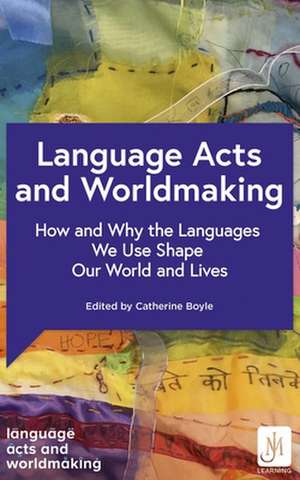
Language Acts and Worldmaking: How and Why the Languages We Use Shape Our World and Our Lives: Language Acts and Worldmaking
Contribuţii de Variousen Limba Engleză Paperback – 17 feb 2022
Focusing on the key research strands, this volume looks at the role of the language teacher as a mediator between languages and cultures, worldmaking in modern languages, translation and the imagination, languages and hospitality, digital mediations, and how words change and make worlds. Critically, it analyses the impact on communities of living in multilingual cities, and the ways in which learning a first language, and then a second, and so on, plays a crucial role in our ability to understand our culture in relation to others and to appreciate the ways in which they are intertwined.
Specific aims are to:
· propose new ways of bridging the gaps between those who teach and research languages and those who learn and use them in everyday contexts from the professional to the personal
· put research into the hands of wider audiences
· share a philosophy, policy and practice of language teaching and learning which turns research into action
· provide the research, experience and data to enable informed debates on current issues and attitudes in language learning, teaching and research
· share knowledge across and within all levels and experiences of language learning and teaching
· showcase exciting new work that derives from different types of community activity and is of practical relevance to its audiences
· disseminate new research in languages that engages with diverse communities of language practitioners.




Preț: 216.94 lei
Preț vechi: 305.53 lei
-29%
Puncte Express: 325
Carte disponibilă
Livrare economică 17 noiembrie-01 decembrie
Livrare prin curier în România Termenul estimat este afișat lângă disponibilitate.
Transport gratuit de la 400.00 lei Plată online sau ramburs, în funcție de opțiunile comenzii.
Retur gratuit în 14 zile Comandă securizată și suport în română.
Specificații
ISBN-13: 9781529372304
ISBN-10: 1529372305
Pagini: 304
Dimensiuni: 134 x 214 x 22 mm
Greutate: 0.28 kg
Editura: John Murray Press
Colecția John Murray Languages
Seria Language Acts and Worldmaking
Locul publicării:London, United Kingdom
ISBN-10: 1529372305
Pagini: 304
Dimensiuni: 134 x 214 x 22 mm
Greutate: 0.28 kg
Editura: John Murray Press
Colecția John Murray Languages
Seria Language Acts and Worldmaking
Locul publicării:London, United Kingdom
V-ar putea interesa
-
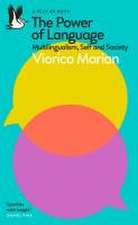 The Power of LanguageViorica Marian-19%Preț: 63.97 lei78.87 lei
 -
 Decolonizing Language and Other Revolutionary IdeasNgugi Wa Thiong'OPreț: 164.89 lei
 -
 Preț: 133.08 lei
 -
 Exophony: Voyages Outside the Mother TongueYoko Tawada-27%Preț: 88.11 lei120.49 lei
 -
 Preț: 346.91 lei
 -
 Living LanguageLaura M. AhearnPreț: 343.00 lei
 -
 Cultural Tasks for Digital Language LearningDr Müge Satar-32%Preț: 633.60 lei929.96 lei
 -
 Language Teacher Education Beyond Borders: Multilingualism, Transculturalism, and Critical ApproachesProfessor Fernando Zolin Vesz-26%Preț: 206.34 lei278.33 lei
 -
 -23%Preț: 207.79 lei268.32 lei
 -
 -36%Preț: 597.04 lei927.22 lei
 -
 -25%Preț: 182.66 lei244.42 lei
 -
 Action Research Communities for Language TeachersDr Angela Gallagher-Brett-31%Preț: 573.93 lei833.00 lei
 -
 Preț: 215.28 lei
 -
 -29%Preț: 218.34 lei306.34 lei
 -
 A Comprehensive Language Coaching HandbookGabriella KovácsPreț: 423.13 lei
 -
 Secondary Languages in ActionNatascia Servini-13%Preț: 120.87 lei138.94 lei
 -
 University-Community Partnerships for Transformative EducationMara Welsh MahmoodPreț: 319.21 lei
 -
 Literatures, Communities, WorldsChunjie ZhangPreț: 258.47 lei
 -
 Prepositionsunknown author-15%Preț: 306.05 lei361.11 lei