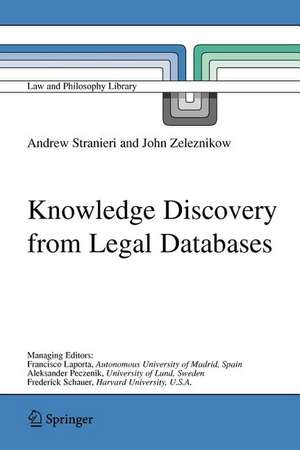
Knowledge Discovery from Legal Databases: Law and Philosophy Library, cartea 69
Autor Andrew Stranieri, John Zeleznikowen Limba Engleză Paperback – 28 oct 2010
Din seria Law and Philosophy Library
- 24%
 Preț: 780.75 lei
 - 24%
 Preț: 955.38 lei
 - 18%
 Preț: 1263.20 lei
 - 18%
 Preț: 978.99 lei
 - 18%
 Preț: 907.10 lei
 - 15%
 Preț: 645.59 lei
 - 15%
 Preț: 614.64 lei
 - 18%
 Preț: 897.06 lei
 - 9%
 Preț: 846.30 lei
 - 15%
 Preț: 557.51 lei
 - 15%
 Preț: 618.29 lei
 - 18%
 Preț: 864.32 lei
 - 15%
 Preț: 648.99 lei
 - 47%
 Preț: 565.46 lei
 - 15%
 Preț: 617.25 lei
 - 18%
 Preț: 1269.74 lei
 - 18%
 Preț: 1177.29 lei
 - 15%
 Preț: 659.30 lei
 - 18%
 Preț: 891.27 lei
 - 18%
 Preț: 1033.04 lei
 -
 Preț: 392.29 lei
 - 18%
 Preț: 1151.64 lei
 - 18%
 Preț: 1142.79 lei
 - 15%
 Preț: 612.85 lei
 - 18%
 Preț: 806.60 lei
 - 24%
 Preț: 913.22 lei
 - 18%
 Preț: 789.28 lei
 - 18%
 Preț: 806.60 lei
 - 18%
 Preț: 724.45 lei
 - 18%
 Preț: 704.06 lei
 - 15%
 Preț: 556.71 lei
 -
 Preț: 370.46 lei
Preț: 1220.09 lei
Preț vechi: 1525.11 lei
-20%
Puncte Express: 1830
Carte tipărită la comandă
Livrare economică 18 noiembrie-02 decembrie
Livrare prin curier în România Termenul estimat este afișat lângă disponibilitate.
Transport gratuit pentru acest produs Plată online sau ramburs, în funcție de opțiunile comenzii.
Retur gratuit în 14 zile Comandă securizată și suport în română.
Specificații
ISBN-13: 9789048167715
ISBN-10: 904816771X
Pagini: 312
Ilustrații: XII, 298 p.
Dimensiuni: 160 x 240 x 17 mm
Greutate: 0.5 kg
Ediția:Softcover reprint of hardcover 1st edition 2005
Editura: Springer
Colecția Law and Philosophy Library
Seria Law and Philosophy Library
Locul publicării:Dordrecht, Netherlands
ISBN-10: 904816771X
Pagini: 312
Ilustrații: XII, 298 p.
Dimensiuni: 160 x 240 x 17 mm
Greutate: 0.5 kg
Ediția:Softcover reprint of hardcover 1st edition 2005
Editura: Springer
Colecția Law and Philosophy Library
Seria Law and Philosophy Library
Locul publicării:Dordrecht, Netherlands
V-ar putea interesa
-
 -20%Preț: 89.95 lei112.23 lei
 -
 -11%Preț: 465.17 lei522.65 lei
 -
 Computer VisionSimon J. D. Prince-20%Preț: 574.23 lei717.78 lei
 -
 Machine LearningPeter Flach-20%Preț: 386.84 lei483.55 lei
 -
 Multi-Agent Machine LearningSchwartz-20%Preț: 658.33 lei822.91 lei
 -
 Wavelet Neural NetworksAntonis K Alexandridis-20%Preț: 615.48 lei769.35 lei
 -
 Practical Introduction to CompDawson-Howe-20%Preț: 501.15 lei626.44 lei
 -
 Computer Vision Using Local Binary PatternsMatti PietikäinenPreț: 370.80 lei
 -
 Machine Learning: An Algorithmic Perspective, Second EditionStephen Marsland-20%Preț: 614.34 lei767.93 lei
 -
 -20%Preț: 1038.88 lei1298.60 lei
 -
 Data Segmentation and Model Selection for Computer VisionAlireza Bab-Hadiashar-20%Preț: 318.94 lei398.67 lei
 -
 -18%Preț: 1037.31 lei1265.01 lei
 -
 -9%Preț: 987.33 lei1084.98 lei
 -
 Man-Machine Interactions 3Aleksandra Gruca-20%Preț: 1269.23 lei1586.53 lei
 -
 The Next Generation of Information Systems: From Data to KnowledgeMichael P. Papazoglou-20%Preț: 323.39 lei404.23 lei
 -
 -20%Preț: 1225.27 lei1531.59 lei
 -
 Intelligent Open Learning SystemsPrzemys¿aw Ró¿ewski-20%Preț: 623.13 lei778.92 lei
 -
 Believable BotsPhilip Hingston-20%Preț: 656.24 lei820.30 lei
 -
 Evolution, Complexity and Artificial LifeStefano Cagnoni-20%Preț: 327.99 lei409.99 lei
 -
 Flexible Query Answering SystemsHenrik Legind Larsen-20%Preț: 356.98 lei446.22 lei
 -
 Intelligent Robotics and ApplicationsJangmyung Lee-20%Preț: 360.15 lei450.18 lei
Public țintă
ResearchCuprins
Legal Issues in the Data Selection Phase.- Legal Issues in the Data Pre-Processing Phase.- Legal Issues in the Data Transformation Phase.- Data Mining with Rule Induction.- Uncertain and Statistical Data Mining.- Data Mining Using Neural Networks.- Information Retrieval and Text Mining.- Evaluation, Deployment and Related Issues.- Conclusion.
Textul de pe ultima copertă
Knowledge Discovery from Legal Databases is the first text to describe data mining
techniques as they apply to law. Law students, legal academics and applied information technology specialists are guided thorough all phases of the knowledge discovery from databases process with clear explanations of numerous data mining algorithms including rule induction, neural networks and association rules. Throughout the text, assumptions that make data mining in law quite different to mining other data are made explicit. Issues such as the selection of commonplace cases, the use of discretion as a form of open texture, transformation using argumentation concepts and evaluation and deployment approaches are discussed at length.
techniques as they apply to law. Law students, legal academics and applied information technology specialists are guided thorough all phases of the knowledge discovery from databases process with clear explanations of numerous data mining algorithms including rule induction, neural networks and association rules. Throughout the text, assumptions that make data mining in law quite different to mining other data are made explicit. Issues such as the selection of commonplace cases, the use of discretion as a form of open texture, transformation using argumentation concepts and evaluation and deployment approaches are discussed at length.