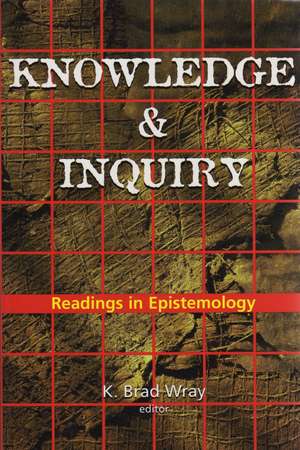
Knowledge and Inquiry: Readings in Epistemology
Editat de K. Brad Wrayen Limba Engleză Paperback – 23 mai 2002
Preț: 421.26 lei
Preț vechi: 556.54 lei
-24%
Puncte Express: 632
Carte disponibilă
Livrare economică 17 noiembrie-01 decembrie
Livrare express 31 octombrie-06 noiembrie pentru 97.19 lei
Livrare prin curier în România Termenul estimat este afișat lângă disponibilitate.
Transport gratuit pentru acest produs Plată online sau ramburs, în funcție de opțiunile comenzii.
Retur gratuit în 14 zile Comandă securizată și suport în română.
Specificații
ISBN-13: 9781551114132
ISBN-10: 1551114135
Pagini: 480
Dimensiuni: 152 x 229 x 22 mm
Greutate: 0.72 kg
Editura: BROADVIEW PR
Colecția Broadview Press
Locul publicării:Peterborough, Canada
ISBN-10: 1551114135
Pagini: 480
Dimensiuni: 152 x 229 x 22 mm
Greutate: 0.72 kg
Editura: BROADVIEW PR
Colecția Broadview Press
Locul publicării:Peterborough, Canada
V-ar putea interesa
-
 -15%Preț: 119.27 lei139.99 lei
 -
 -11%Preț: 453.95 lei510.05 lei
 -
 Reasoning: A Social PictureAnthony Simon Laden-19%Preț: 314.21 lei387.89 lei
 -
 Epistemological DisjunctivismDuncan PritchardPreț: 214.71 lei
 -
 Knowledge on TrustPaul Faulkner-19%Preț: 283.37 lei349.61 lei
 -
 Knowing Right From WrongKieran Setiya-17%Preț: 277.59 lei335.91 lei
 -
 Free: Why Science Hasn't Disproved Free WillAlfred R. Mele-22%Preț: 108.85 lei139.26 lei
 -
 -19%Preț: 362.27 lei449.83 lei
 -
 Scepticism and Perceptual JustificationDylan Dodd-30%Preț: 721.08 lei1027.32 lei
 -
 Knowledge: A Very Short IntroductionJennifer Nagel-19%Preț: 57.72 lei71.12 lei
 -
 Quitting Certainties: A Bayesian Framework Modeling Degrees of BeliefMichael G. Titelbaum-17%Preț: 336.63 lei407.60 lei
 -
 TruthChase WrennPreț: 193.94 lei
 -
 Groups as AgentsDeborah Perron TollefsenPreț: 170.64 lei
 -
 The Magic of Unknowing: An East-West SoliloquyMervyn Sprung-22%Preț: 274.38 lei351.27 lei
 -
 Kuhn's Evolutionary Social EpistemologyK. Brad WrayPreț: 347.06 lei
 -
 The Blackwell Companion to HermeneuticsNiall Keane-9%Preț: 1275.76 lei1401.93 lei
 -
 Yes, But How Do You Know?: Introducing Philosophy Through Sceptical IdeasStephen Hetherington-14%Preț: 253.68 lei296.45 lei
 -
 -18%Preț: 316.77 lei386.18 lei
 -
 Introducing Philosophy: Knowledge and RealityJack S. Crumley, II-9%Preț: 329.41 lei362.24 lei
 -
 Tentacles Longer Than NightEugene ThackerPreț: 85.46 lei
Recenzii
This anthology focuses on three areas in the theory of knowledge: epistemic justification; analyses of knowledge and scepticism; and recent developments in epistemology. Each of the three sections includes a brief introduction to the readings, a series of study questions, and a list of suggested readings. Section 1 deals with coherentism, foundationalism, reliabilism, and includes articles by Chisholm, BonJour, Audi, Goldman, and Fumerton. Section 2 deals with the analysis of knowledge and Gettier problems, and a variety of forms and responses to scepticism; it includes articles by Gettier, Conee, Feldman, Putnam, Nagel, and Stroud. Section 3 introduces the reader to recent developments in naturalized, feminist, and social epistemology, and includes articles by Quine, Almeder, Putnam, Anderson, Harding, Longino, Hardwig, Rorty, and Kitcher.
“Knowledge and Inquiry covers the most important topics in contemporary epistemology, including some topics that are typically neglected in undergraduate-level epistemology anthologies (e.g. social epistemology). The selections are well-chosen for their accessibility as well as their importance. This is a wonderful textbook for anyone teaching an undergraduate course in contemporary epistemology!” — Ram Neta, University of North Carolina, Chapel Hill
“This anthology captures the key developments in contemporary epistemology—from theories of justification and Gettier problems, to naturalized epistemology and feminist epistemology. Sections are well-organized, with well-chosen readings set in relation to each other to encourage epistemological dialogue. An excellent text!” — Heidi Grasswick, Middlebury College
“Knowledge and Inquiry covers the most important topics in contemporary epistemology, including some topics that are typically neglected in undergraduate-level epistemology anthologies (e.g. social epistemology). The selections are well-chosen for their accessibility as well as their importance. This is a wonderful textbook for anyone teaching an undergraduate course in contemporary epistemology!” — Ram Neta, University of North Carolina, Chapel Hill
“This anthology captures the key developments in contemporary epistemology—from theories of justification and Gettier problems, to naturalized epistemology and feminist epistemology. Sections are well-organized, with well-chosen readings set in relation to each other to encourage epistemological dialogue. An excellent text!” — Heidi Grasswick, Middlebury College
Cuprins
Acknowledgements
Preface
Section 1: Epistemic Justification
Introductory Remarks
Additional Readings
Section 2: Knowledge and Scepticism
Introductory Remarks
Additional Readings
Section 3: New Developments in Epistemology
Introductory Remarks
Additional Readings
Preface
Section 1: Epistemic Justification
Introductory Remarks
- The Myth of the Given
Roderick Chisholm - Can Empirical Knowledge Have a Foundation?
Laurence BonJour - The Coherence Theory of Empirical Knowledge
Laurence BonJour - The Foundationalism-Coherentism Controversy
Robert Audi - What is Justified Belief?
Alvin Goldman - The Internalism/Externalism Controversy
Richard Fumerton
Additional Readings
Section 2: Knowledge and Scepticism
Introductory Remarks
- Is Justified True Belief Knowledge?
Edmund Gettier - Why Solve the Gettier Problem?
Earl Conee - An Alleged Defect in Gettier Counter-Examples
Richard Feldman - Brains in a Vat
Hilary Putnam - Knowledge
Thomas Nagel - Skepticism and the Possibility of Knowledge
Barry Stroud
Additional Readings
Section 3: New Developments in Epistemology
Introductory Remarks
- Epistemology Naturalized
W.V. Quine - On Naturalizing Epistemology
Robert Almeder - Why Reason Can’t Be Naturalized
Hilary Putnam - Feminist Epistemology
Elizabeth Anderson - Rethinking Standpoint Epistemology
Sandra Harding - Subjects, Power, and Knowledge
Helen Longino - The Role of Trust in Knowledge
John Hardwig - Solidarity or Objectivity?
Richard Rorty - Contrasting Conceptions of Social Epistemology
Philip Kitcher
Additional Readings