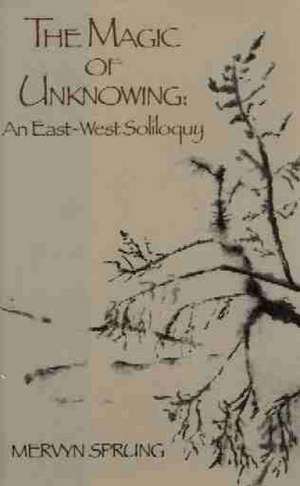
The Magic of Unknowing: An East-West Soliloquy
Autor Mervyn Sprungen Limba Engleză Paperback – 31 mai 1995
The dialogue dramatises the erosion in modern times of Aristotelian rationality under the pressures of its own logic. The two eastern thinkers throw the weight of their own skepticism into the discussion at the critical point.
In the end the brothers realize that they have moved away from Western philosophy’s faith in the singular power of reason to establish truth and sense in the human world. They discover the magic of unknowing that lies in the reciprocal penetration of knowledge and behavior, each receiving its sense from the other. They discover that philosophies are not the issue of reasoning alone but are themselves already inseparably thought and action. And they realise that this entails an unheard-of future for philosophy.
Preț: 274.38 lei
Preț vechi: 351.27 lei
-22%
Puncte Express: 412
Carte disponibilă
Livrare economică 16-30 noiembrie
Livrare express 30 octombrie-05 noiembrie pentru 104.92 lei
Livrare prin curier în România Termenul estimat este afișat lângă disponibilitate.
Transport gratuit de la 400.00 lei Plată online sau ramburs, în funcție de opțiunile comenzii.
Retur gratuit în 14 zile Comandă securizată și suport în română.
Specificații
ISBN-13: 9780921149088
ISBN-10: 0921149085
Pagini: 160
Dimensiuni: 140 x 216 x 14 mm
Greutate: 0.25 kg
Editura: BROADVIEW PR
Colecția Broadview Press
Locul publicării:Peterborough, Canada
ISBN-10: 0921149085
Pagini: 160
Dimensiuni: 140 x 216 x 14 mm
Greutate: 0.25 kg
Editura: BROADVIEW PR
Colecția Broadview Press
Locul publicării:Peterborough, Canada
V-ar putea interesa
-
 Experiences: An Inquiry into Some AmbiguitiesJ. M. Hinton-28%Preț: 372.05 lei519.35 lei
 -
 -30%Preț: 848.01 lei1213.64 lei
 -
 On ReflectionHilary Kornblith-20%Preț: 255.70 lei319.17 lei
 -
 A Naturalistic Epistemology: Selected PapersHilary Kornblith-28%Preț: 525.14 lei733.94 lei
 -
 Epistemic Norms: New Essays on Action, Belief, and AssertionClayton Littlejohn-31%Preț: 577.67 lei836.27 lei
 -
 The Aim of BeliefTimothy Chan-31%Preț: 727.11 lei1048.64 lei
 -
 Hermeneutics: A Very Short IntroductionJens Zimmermann-20%Preț: 57.15 lei71.12 lei
 -
 Knowledge and PresuppositionsMichael Blome-Tillmann-29%Preț: 522.72 lei732.53 lei
 -
 Ignorance and Moral ObligationMichael J. Zimmerman-28%Preț: 498.13 lei687.98 lei
 -
 Unruly Words: A Study of Vague LanguageDiana Raffman-28%Preț: 437.34 lei604.03 lei
 -
 Preț: 256.32 lei
 -
 The Creativity of ActionHans JoasPreț: 264.41 lei
 -
 ComplexitiesAnnemarie MolPreț: 246.34 lei
 -
 Critical Thinking 2EDavid A Hunter-8%Preț: 454.18 lei493.67 lei
 -
 A Guide Through the Theory of KnowledgeAdam MortonPreț: 294.35 lei
 -
 -31%Preț: 78.41 lei114.43 lei
Recenzii
The Magic of Unknowing is a unique philosophical and literary work. Cast in the dialogue form, it unfolds in the mood of soliloquy. Mervyn Sprung has created an imaginative meeting of the minds of great western philosophers: Aristotle, Descartes, Kant, Hume, Nietzsche, Wittgenstein and Pyrrho. All are brothers, the more skeptical sons of Aristotle. Later they hear as well from Chang, a Taoist, and Nagaraj, a Buddhist, both lately adopted into the family.
The dialogue dramatises the erosion in modern times of Aristotelian rationality under the pressures of its own logic. The two eastern thinkers throw the weight of their own skepticism into the discussion at the critical point.
In the end the brothers realize that they have moved away from Western philosophy’s faith in the singular power of reason to establish truth and sense in the human world. They discover the magic of unknowing that lies in the reciprocal penetration of knowledge and behavior, each receiving its sense from the other. They discover that philosophies are not the issue of reasoning alone but are themselves already inseparably thought and action. And they realise that this entails an unheard-of future for philosophy.
“An ingenious piece of work; a brilliant essay in comparative philosophy. The whole presentation is delightful.” — Prof. Paul Seligman, author of The aperion of Anaximander and Being and Not-Being: An Introduction to Plato’s Sophist
“A work of intrinsic merit; competent and philosophically adept. The general public, as well as academics, will enjoy reading this book, and will profit from doing so.” — Prof. Robert Carter, Trent University, author of The Dimensions of Moral Education (U of Toronto Press)
“The book addresses issues of central and critical importance. It is well written and concieved … it is unorthodox in its approach … it is a pleasure to read.” — Prof. Alan R. Dregson, University of Victoria
“The thesis is clear; the demonstration is convincing. The scholarship is impeccable, and the author displays a well articulated understanding of the various [philosophical positions] he evokes through the characters of the dialogue.” — Claude Lagadec, University of Montreal
“ … an exceptionally well-written book, on a subject of fundamental importance.” — Canadian Philosophical Reviews
The dialogue dramatises the erosion in modern times of Aristotelian rationality under the pressures of its own logic. The two eastern thinkers throw the weight of their own skepticism into the discussion at the critical point.
In the end the brothers realize that they have moved away from Western philosophy’s faith in the singular power of reason to establish truth and sense in the human world. They discover the magic of unknowing that lies in the reciprocal penetration of knowledge and behavior, each receiving its sense from the other. They discover that philosophies are not the issue of reasoning alone but are themselves already inseparably thought and action. And they realise that this entails an unheard-of future for philosophy.
“An ingenious piece of work; a brilliant essay in comparative philosophy. The whole presentation is delightful.” — Prof. Paul Seligman, author of The aperion of Anaximander and Being and Not-Being: An Introduction to Plato’s Sophist
“A work of intrinsic merit; competent and philosophically adept. The general public, as well as academics, will enjoy reading this book, and will profit from doing so.” — Prof. Robert Carter, Trent University, author of The Dimensions of Moral Education (U of Toronto Press)
“The book addresses issues of central and critical importance. It is well written and concieved … it is unorthodox in its approach … it is a pleasure to read.” — Prof. Alan R. Dregson, University of Victoria
“The thesis is clear; the demonstration is convincing. The scholarship is impeccable, and the author displays a well articulated understanding of the various [philosophical positions] he evokes through the characters of the dialogue.” — Claude Lagadec, University of Montreal
“ … an exceptionally well-written book, on a subject of fundamental importance.” — Canadian Philosophical Reviews
Cuprins
The Soliloquy
Afternoon — Erosion From Within
Afternoon — Erosion From Within
- Aristos of Gnosis
René
Immanuel
David
Friedrich
Ludwig
The Brother From Elis
- Chang
Nagaraj
- René
Immanuel
David
Friedrich
Ludwig
Chang
The Brother From Elis
- The Common Brooding