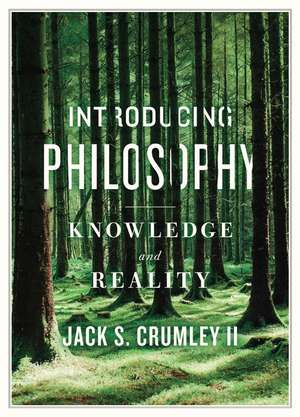
Introducing Philosophy: Knowledge and Reality
Autor Jack S. Crumley, IIen Limba Engleză Paperback – 8 aug 2016
Preț: 329.41 lei
Preț vechi: 362.24 lei
-9%
Puncte Express: 494
Carte disponibilă
Livrare economică 28 octombrie-11 noiembrie
Livrare prin curier în România Termenul estimat este afișat lângă disponibilitate.
Transport gratuit de la 400.00 lei Plată online sau ramburs, în funcție de opțiunile comenzii.
Retur gratuit în 14 zile Comandă securizată și suport în română.
Specificații
ISBN-13: 9781554811298
ISBN-10: 1554811295
Pagini: 330
Dimensiuni: 165 x 229 x 16 mm
Greutate: 0.46 kg
Editura: BROADVIEW PR
Colecția Broadview Press
Locul publicării:Peterborough, Canada
ISBN-10: 1554811295
Pagini: 330
Dimensiuni: 165 x 229 x 16 mm
Greutate: 0.46 kg
Editura: BROADVIEW PR
Colecția Broadview Press
Locul publicării:Peterborough, Canada
V-ar putea interesa
-
 -35%Preț: 570.17 lei872.58 lei
 -
 Normativity and ControlDavid Owens-31%Preț: 527.18 lei762.17 lei
 -
 -18%Preț: 282.26 lei343.91 lei
 -
 Contextualising Knowledge: Epistemology and SemanticsJonathan Jenkins Ichikawa-28%Preț: 542.20 lei756.31 lei
 -
 Ignorance: How It Drives ScienceStuart Firestein-25%Preț: 143.87 lei193.08 lei
 -
 The Magic of Unknowing: An East-West SoliloquyMervyn Sprung-23%Preț: 267.79 lei346.49 lei
 -
 THE MASKThomas B PryorPreț: 127.28 lei
 -
 Die Stellung Des Menschen Im KosmosMax SchelerPreț: 55.86 lei
 -
 Risen from the AshesBobby R. SimondsPreț: 50.68 lei
 -
 Matter and MemoryHenri BergsonPreț: 68.39 lei
 -
 Square OneSteve PattersonPreț: 86.82 lei
 -
 Jiddu KrishnamurtiMilo AvicennaPreț: 73.47 lei
 -
 Knowledge and Inquiry: Readings in EpistemologyK. Brad Wray-24%Preț: 421.26 lei556.54 lei
 -
 Yes, But How Do You Know?: Introducing Philosophy Through Sceptical IdeasStephen Hetherington-14%Preț: 253.68 lei296.45 lei
 -
 -18%Preț: 316.77 lei386.18 lei
 -
 Preț: 399.97 lei
 -
 Preț: 92.42 lei
Recenzii
This book introduces the central issues of metaphysics and epistemology, from skepticism, justification, and perception to universals, personal identity, and free will. Though topically organized, the book integrates positions and examples from the history of philosophy. Plato, Descartes, and Leibniz are discussed alongside Quine, Kripke, and Haslanger. Peripheral ideas and related historical asides are offered in boxes interspersed within the text, providing further depth without disrupting the author’s lucid explanations of central themes and arguments. Original illustrations by Gillian Wilson are included throughout, giving interesting and clear visual representations of many of the book’s examples and thought experiments.
“Jack Crumley’s Introducing Philosophy: Knowledge and Reality hits the sweet spot for an introduction to metaphysics and epistemology. Engagingly written, the book provides an accessible overview of the field for the unfamiliar; yet there’s enough detailed discussion to complement many of the typical primary readings in a first-year or sophomore course. The book merits serious consideration as a textbook for university instructors.” — Phil Corkum, University of Alberta
“This is one of the best introductory philosophy books currently on the market. The primary goal is to help novices understand complex philosophical issues. However, Professor Crumley does not hesitate to stimulate the interests of experts with his fascinating examples, written in an extremely engaging manner. I wish I had such a book when I was an undergraduate student.” — Prasanta S. Bandyopadhyay, Montana State University
“Jack Crumley has written an excellent introduction to epistemology and metaphysics. It is very well organized and clearly and attractively written, covering the main topics from both historical and contemporary angles with great competence and deep learning. The text is graced with vivid examples, wonderful visual illustrations and insightful implications for domains other than philosophy. It is a book to be enjoyed not only by students and their teachers but also by a larger public. Even professional philosophers have a lot to learn from its pages, as I have. I recommend this text very enthusiastically.” — Radu J. Bogdan, Tulane University
“Introducing Philosophy is beautifully written. Among its virtues is the delicate balance it presents between contemporary problems and their history. This leaves plenty of room for instructors to contribute with their own emphases and perspectives. I predict it will be widely used.” — Alirio Rosales, University of British Columbia and University of the Fraser Valley
“Jack Crumley’s Introducing Philosophy: Knowledge and Reality hits the sweet spot for an introduction to metaphysics and epistemology. Engagingly written, the book provides an accessible overview of the field for the unfamiliar; yet there’s enough detailed discussion to complement many of the typical primary readings in a first-year or sophomore course. The book merits serious consideration as a textbook for university instructors.” — Phil Corkum, University of Alberta
“This is one of the best introductory philosophy books currently on the market. The primary goal is to help novices understand complex philosophical issues. However, Professor Crumley does not hesitate to stimulate the interests of experts with his fascinating examples, written in an extremely engaging manner. I wish I had such a book when I was an undergraduate student.” — Prasanta S. Bandyopadhyay, Montana State University
“Jack Crumley has written an excellent introduction to epistemology and metaphysics. It is very well organized and clearly and attractively written, covering the main topics from both historical and contemporary angles with great competence and deep learning. The text is graced with vivid examples, wonderful visual illustrations and insightful implications for domains other than philosophy. It is a book to be enjoyed not only by students and their teachers but also by a larger public. Even professional philosophers have a lot to learn from its pages, as I have. I recommend this text very enthusiastically.” — Radu J. Bogdan, Tulane University
“Introducing Philosophy is beautifully written. Among its virtues is the delicate balance it presents between contemporary problems and their history. This leaves plenty of room for instructors to contribute with their own emphases and perspectives. I predict it will be widely used.” — Alirio Rosales, University of British Columbia and University of the Fraser Valley
Cuprins
Introduction
Chapter 1: Skepticism
Chapter 2: Knowledge
Chapter 3: Theories of Justification
Chapter 4: New Directions in Epistemology
Chapter 5: Perception
Chapter 6: Universals
Chapter 7: Things
Chapter 8: The Nature of Mind
Chapter 9: Personal Identity
Chapter 10: Free Will
Chapter 11: God’s Nature & Existence
Chapter 1: Skepticism
Chapter 2: Knowledge
Chapter 3: Theories of Justification
Chapter 4: New Directions in Epistemology
Chapter 5: Perception
Chapter 6: Universals
Chapter 7: Things
Chapter 8: The Nature of Mind
Chapter 9: Personal Identity
Chapter 10: Free Will
Chapter 11: God’s Nature & Existence