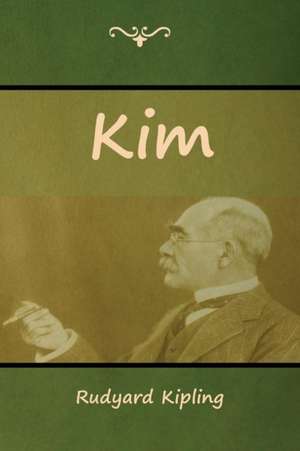
Kim
Autor Rudyard Kiplingen Limba Engleză Paperback – 8 mai 2019
În India efervescentă a anilor 1890, pe străzile din Lahore și de-a lungul celebrului Grand Trunk Road, se desfășoară o poveste despre identitate și supraviețuire care depășește granițele unui simplu roman de aventuri. Alegerea acestui cadru spațio-temporal nu este întâmplătoare; ea reflectă apogeul tensiunilor geopolitice cunoscute sub numele de „Marele Joc”, oferind un contrast fascinant între spionajul britanic și căutarea spirituală a Orientului. Remarcăm cum Rudyard Kipling construiește un portret vibrant al unei populații diverse, unde superstiția și religia se împletesc cu realitatea dură a colonialismului.
Pe același raft cu Treasure Island de Robert Louis Stevenson, cartea se distinge prin profunzimea sa mistică și prin refuzul de a fi doar o lectură pentru copii. Dacă în The Jungle Book autorul explora legile naturii prin ochii lui Mowgli, în Kim el plasează un „copil al lumii” în centrul unei rețele complexe de interese politice și filozofice. Structura narativă urmărește dubla evoluție a lui Kimball O’Hara: pe de o parte, ucenic al unui lama tibetan aflat în căutarea „Râului Săgeții”, iar pe de altă parte, agent operativ recrutat pentru serviciile secrete britanice.
Această ediție de la Wordsworth Classics este organizată meticulos, oferind nu doar textul original, ci și o serie de apendice esențiale. Cuprinsul relevă o abordare academică ce include corespondență istorică din epoca „Marelui Joc” și reacții critice contemporane, elemente care ajută la decodarea straturilor subtile ale prozei lui Kipling. Este un roman al contrastelor, unde ritmul alert al spionajului întâlnește momente de contemplare profundă asupra „Roții Lucrurilor”.
Preț: 108.06 lei
Carte tipărită la comandă
Livrare economică 27 noiembrie-11 decembrie
Specificații
ISBN-10: 1618954865
Pagini: 208
Dimensiuni: 152 x 229 x 12 mm
Greutate: 0.35 kg
Editura: Bibliotech Press
V-ar putea interesa
-
 The Adventures of Sherlock HolmesArthur Conan DoylePreț: 28.01 lei
 -
 Treasure IslandRobert Louis StevensonPreț: 28.01 lei
 -
 Preț: 28.01 lei
 -
 The Continuity of MindMichael Spivey-28%Preț: 396.46 lei549.94 lei
 -
 The History of King Lear: The Oxford ShakespeareWilliam ShakespearePreț: 70.76 lei
 -
 Three Men in a Boat and Three Men on the BummelJerome K. Jerome-17%Preț: 48.72 lei58.69 lei
 -
 Beyond Order: 12 More Rules for LifeJordan B. Peterson-23%Preț: 150.95 lei195.27 lei
 -
 Play, Dreams And Imitation In ChildhoodJean Piaget-15%Preț: 427.17 lei502.55 lei
 -
 Preț: 147.69 lei
 -
 The Great EscapeAngus DeatonPreț: 109.86 lei
 -
 Thinking In BetsAnnie Duke-24%Preț: 161.12 lei213.19 lei
 -
 The Goldfish BoyLisa ThomsonPreț: 52.77 lei
 -
 Danny's Doodles: The Squirting DonutsDavid AdlerPreț: 59.52 lei
 -
 The Goldfish BoyLisa ThomsonPreț: 59.09 lei
 -
 The Day I Was ErasedLisa ThomsonPreț: 57.54 lei
 -
 Murder in the Middle PastureJohn R. EricksonPreț: 50.18 lei
 -
 The Wounded Buzzard on Christmas EveJohn R. EricksonPreț: 55.68 lei
 -
 OWEN & SOLDIERLisa ThomsonPreț: 56.65 lei
 -
 Treasure IslandRobert Louis StevensonPreț: 36.56 lei
 -
 The Adventures of Sherlock HolmesArthur Conan DoylePreț: 46.07 lei
 -
 English Fairy TalesFlora Annie SteelPreț: 36.82 lei
De ce să citești această carte
Recomandăm acest roman cititorilor care doresc să exploreze India colonială dincolo de clișee. Prin povestea lui Kim, câștigați o perspectivă rară asupra modului în care identitatea culturală se modelează la intersecția dintre două lumi. Este o oportunitate de a descoperi de ce Kipling a fost cel mai tânăr laureat al Premiului Nobel, într-o ediție critică ce explică magistral contextul istoric al spionajului victorian.
Despre autor
Joseph Rudyard Kipling (1865–1936) a fost un prozator și poet englez, născut în India Britanică, spațiu care i-a marcat profund întreaga operă. Recunoscut ca un inovator al povestirii scurte, Kipling a captivat publicul prin capacitatea sa de a reda atmosfera exotică și complexitatea vieții de garnizoană sau de bazar. În 1907, la vârsta de 41 de ani, a devenit primul scriitor de limbă engleză care a primit Premiul Nobel pentru Literatură. Deși reputația sa a fost subiectul multor dezbateri postcoloniale, opera sa rămâne fundamentală pentru înțelegerea literaturii universale, fiind înmormântat în Colțul Poeților din Westminster Abbey.
Descriere scurtă
Notă biografică
Recenzii
Appendices include contemporary reviews of the novel and historical documents on Britain’s and Russia’s struggle for control of Asia, Indian colonization, and the writing of Kim.
“Máire ní Fhlathúin’s new edition of Kim is a welcome event. The substantial and scholarly, yet accessible, introduction contextualises the novel in important new ways. This is complemented by a diverse range of supplementary material, which allows the reader to appreciate more clearly some of the debates, texts, and contexts by which Kipling was influenced as he wrote his masterpiece. This is an edition that will appeal alike to the student, scholar, and general reader.” — Bart Moore-Gilbert, Goldsmiths College, University of London
Descriere
"Kimball O'Hara, the orphaned son of an Irish soldier, spends his childhood on the bustling streets of Lahore, begging and running errands in order to survive. One day he meets an old Tibetan lama, and he decides to accompany him on his travels across the Indian Subcontinent. After falling into the hands of his father's old regiment, however, Kim is separated from the lama and sent away to school. There, his natural flair for espionage is spotted, and he soon finds himself among the majestic peaks of the Himalayas, playing a crucial part in the secret service's confrontation with
Russia known as the "Great Game".
With its peerless evocation of the teeming cities, breathtaking landscapes and diverse cultures of late-nineteenth-century India, Kim is widely considered to be Kipling's masterpiece and one of the greatest novels written in the English language."
Cuprins
Introduction
Rudyard Kipling: A Brief Chronology
A Note on the Text
Kim
Appendix A: The Writing of Kim
- From Rudyard Kipling, Something of Myself (1937)
- Rudyard Kipling, “Lispeth” (1890)
- From Rudyard Kipling, “Kim o’ the ’Rishti”
- From Blackwood’s Edinburgh Magazine (December 1901)
- From George Moore, “Avowals V: Kipling and Loti,” Pall Mall Magazine (July 1904)
- From Dixon Scott, “Rudyard Kipling,” Bookman (December 1912)
- From Robert Baden-Powell, Scouting for Boys (1910)
- From the Correspondence of Arthur Conolly (1889)
- From G.B. Malleson, The Russo-Afghan Question and the Invasion of India (1885)
- From Archibald R. Colquhoun, Russia against India: The Struggle for Asia (1900)
- From Charles E.D. Black, A Memoir on the Indian Surveys, 1875-1890 (1891)
- From Evelyn Baring, Earl of Cromer, Modern Egypt (1908)
- From Archibald R. Colquhoun, Russia against India: The Struggle for Asia (1900)
- From F. Anstey, Baboo Jabberjee B.A. (1897)
- From T.B. Macaulay, “The Necessity of English Education” (1835)
- From William Wilson Hunter, The Indian Empire (1882)
- Rudyard Kipling, “Buddha at Kamakura” (1892)
- From Edwin Arnold, The Light of Asia (1908)
Extras
Oh ye who tread the Narrow Way
By Tophet-flare to Judgment Day,
Be gentle when the heathen pray
To Buddha at Kamakura!
He sat, in defiance of municipal orders, astride the gun Zam- Zammah on her brick platform opposite the old Ajaib-Gher—the Wonder House, as the natives call the Lahore Museum. Who hold Zam-Zammah, that “fire-breathing dragon,” hold the Punjab; for the great green-bronze piece is always first of the conqueror’s loot.
There was some justification for Kim,—he had kicked Lala Dinanath’s boy off the trunnions,—since the English held the Punjab and Kim was English. Though he was burned black as any native; though he spoke the vernacular by preference, and his mother-tongue in a clipped uncertain sing-song; though he consorted on terms of perfect equality with the small boys of the bazar; Kim was white—a poor white of the very poorest. The half-caste woman who looked after him (she smoked opium, and pretended to keep a second-hand furniture shop by the square where the cheap cabs wait) told the missionaries that she was Kim’s mother’s sister; but his mother had been nursemaid in a colonel’s family and had married Kimball O’Hara, a young colour-sergeant of the Mavericks, an Irish regiment. He afterwards took a post on the Sind, Punjab, and Delhi railway, and his regiment went home without him. The wife died of cholera in Ferozepore, and O’Hara fell to drink and loafing up and down the line with the keen-eyed three-year-old baby. Societies and chaplains anxious for the child, tried to catch him, but O’Hara drifted away, till he came across the woman who took opium and learned the taste from her, and died as poor whites die in India. His estate at death consisted of three papers—one he called his “ne varietur” because those words were written below his signature thereon, and another his “clearance-certificate.” The third was Kim’s birth-certificate. Those things, he was used to say, in his glorious opium hours, would yet make little Kimball a man. On no account was Kim to part with them, for they belonged to a great piece of magic—such magic as men practised over yonder behind the Museum, in the big blue and white Jadoo-Gher—the Magic House, as we name the Masonic Lodge. It would, he said, all come right some day, and Kim’s horn would be exalted between pillars—monstrous pillars—of beauty and strength. The Colonel himself, riding on a horse, at the head of the finest regiment in the world, would attend to Kim,—little Kim that should have been better off than his father. Nine hundred first-class devils, whose god was a Red Bull on a green field, would attend to Kim, if they had not forgotten O’Hara—poor O’Hara that was gang-foreman on the Ferozepore line. Then he would weep bitterly in the broken rush chair on the verandah. So it came about after his death that the woman sewed parchment, paper, and birth-certificate into a leather amulet-case which she strung round Kim’s neck.
“And some day,” she said, confusedly remembering O’Hara’s prophecies, “there will come for you a great Red Bull on a green field, and the Colonel riding on his tall horse, yes, and”—dropping into English—“nine hundred devils.”
“Ah,” said Kim, “I shall remember. A Red Bull and a Colonel on a horse will come, but first, my father said, come the two men making ready the ground for these matters. That is how, my father said, they always did; and it is always so when men work magic.”
If the woman had sent Kim up to the local Jadoo-Gher with those papers, he would, of course, have been taken over by the Provincial Lodge and sent to the Masonic Orphanage in the Hills; but what she had heard of magic she distrusted. Kim, too, held views of his own. As he reached the years of indiscretion, he learned to avoid missionaries and white men of serious aspect who asked who he was, and what he did. For Kim did nothing with an immense success. True, he knew the wonderful walled city of Lahore from the Delhi Gate to the outer Fort Ditch; was hand in glove with men who led lives stranger than anything Haroun al Raschid dreamed of; and he lived in a life wild as that of the Arabian Nights, but missionaries and secretaries of charitable societies could not see the beauty of it. His nickname through the wards was “Little Friend of all the World”; and very often, being lithe and inconspicuous, he executed commissions by night on the crowded housetops for sleek and shiny young men of fashion. It was intrigue, of course,—he knew that much, as he had known all evil since he could speak,—but what he loved was the game for its own sake—the stealthy prowl through the dark gullies and lanes, the crawl up a water-pipe, the sights and sounds of the women’s world on the flat roofs, and the headlong flight from housetop to housetop under cover of the hot dark. Then there were holy men, ash-smeared faquirs by their brick shrines under the trees at the riverside, with whom he was quite familiar—greeting them as they returned from begging-tours, and, when no one was by, eating from the same dish. The woman who looked after him insisted with tears that he should wear European clothes—trousers, a shirt, and a battered hat. Kim found it easier to slip into Hindu or Mohammedan garb when engaged on certain businesses. One of the young men of fashion—he who was found dead at the bottom of a well on the night of the earthquake—had once given him a complete suit of Hindu kit, the costume of a low-caste street boy, and Kim stored it in a secret place under some baulks in Nila Ram’s timber-yard, beyond the Punjab High Court, where the fragrant deodar logs lie seasoning after they have driven down the Ravee. When there was business or frolic afoot, Kim would use his properties, returning at dawn to the verandah, all tired out from shouting at the heels of a marriage procession, or yelling at a Hindu festival. Sometimes there was food in the house, more often there was not, and Kim went out again to eat with his native friends.
As he drummed his heels against Zam-Zammah he turned now and again from his king-of-the-castle game with little Chota Lal and Abdullah the sweetmeat-seller’s son, to make a rude remark to the native policeman on guard over rows of shoes at the Museum door. The big Punjabi grinned tolerantly: he knew Kim of old. So did the water-carrier, sluicing water on the dry road from his goat-skin bag. So did Jawahir Singh, the Museum carpenter, bent over new packing-cases. So did everybody in sight except the peasants from the country, hurrying up to the Wonder House to view the things that men made in their own province and elsewhere. The Museum was given up to Indian arts and manufactures, and anybody who sought wisdom could ask the curator to explain.
“Off! Off! Let me up!” cried Abdullah, climbing up Zam- Zammah’s wheel.
“Thy father14 was a pastry-cook, Thy mother stole the ghi,” sang Kim. “All Mussalmans fell off Zam-Zammah long ago!”
“Let me up!” shrilled little Chota Lal in his gilt-embroidered cap. His father was worth perhaps half a million sterling, but India is the only democratic land in the world.
“The Hindus fell off Zam-Zammah too. The Mussalmans pushed them off. Thy father was a pastry-cook——”
He stopped; for there shuffled round the corner, from the roaring Motee Bazar,16 such a man as Kim, who thought he knew all castes, had never seen. He was nearly six feet high, dressed in fold upon fold of dingy stuff like horse-blanketing, and not one fold of it could Kim refer to any known trade or profession. At his belt hung a long open-work iron pencase and a wooden rosary such as holy men wear. On his head was a gigantic sort of tam-o’-shanter. His face was yellow and wrinkled, like that of Fook Shing, the Chinese bootmaker in the bazar. His eyes turned up at the corners and looked like little slits of onyx.
“Who is that?” said Kim to his companions.
“Perhaps it is a man,” said Abdullah, finger in mouth, staring.
“Without doubt,” returned Kim; “but he is no man of India that I have ever seen.”
“A priest, perhaps,” said Chota Lal, spying the rosary. “See! He goes into the Wonder House!”
“Nay, nay,” said the policeman, shaking his head. “I do not understand your talk.” The constable spoke Punjabi. “Oh, The Friend of all the World, what does he say?”
“Send him hither,” said Kim, dropping from Zam-Zammah, flourishing his bare heels. “He is a foreigner, and thou art a buffalo.”
The man turned helplessly and drifted towards the boys. He was old, and his woollen gaberdine still reeked of the stinking artemisia of the mountain passes.
“O Children, what is that big house?” he said in very fair Urdu.
“The Ajaib-Gher, the Wonder House!” Kim gave him no title—such as Lala or Mian. He could not divine the man’s creed.
“Ah! The Wonder House! Can any enter?”
“It is written above the door—all can enter.”
“Without payment?”
“I go in and out. I am no banker,” laughed Kim.
“Alas! I am an old man. I did not know.” Then, fingering his rosary, he half turned to the Museum.
“What is your caste? Where is your house? Have you come far?” Kim asked.
“I came by Kulu—from beyond the Kailas—but what know you? From the hills where”—he sighed—“the air and water are fresh and cool.”
“Aha! Khitai (a Chinaman),” said Abdullah proudly. Fook Shing had once chased him out of his shop for spitting at the joss above the boots.
“Pahari (a hillman),” said little Chota Lal.
“Aye, child—a hillman from hills thou’lt never see. Didst hear of Bhotiyal (Tibet)? I am no Khitai, but a Bhotiya (Tibetan), since you must know—a lama—or, say a guru in your tongue.”
“A guru from Tibet,” said Kim. “I have not seen such a man. They be Hindus in Tibet, then?”
“We be followers of the Middle Way, living in peace in our lamasseries, and I go to see the Four Holy Places before I die. Now do you, who are children, know as much as I do who am old.” He smiled benignantly on the boys.
“Hast thou eaten?”
He fumbled in his bosom and drew forth a worn wooden begging-bowl. The boys nodded. All priests of their acquaintance begged.
“I do not wish to eat yet.” He turned his head like an old tortoise in the sunlight. “Is it true that there are many images in the Wonder House of Lahore?” He repeated the last words as one making sure of an address.
“That is true,” said Abdullah. “It is full of heathen b¯uts. Thou also art an idolator.”
“Never mind him,” said Kim. “That is the Government’s house and there is no idolatry in it, but only a Sahib with a white beard. Come with me and I will show.”
“Strange priests eat boys,” whispered Chota Lal.
“And he is a stranger and a b¯ut-parast (idolator),” said Abdullah, the Mohammedan.
Kim laughed. “He is new. Run to your mothers’ laps, and be safe. Come!”
From the Trade Paperback edition.