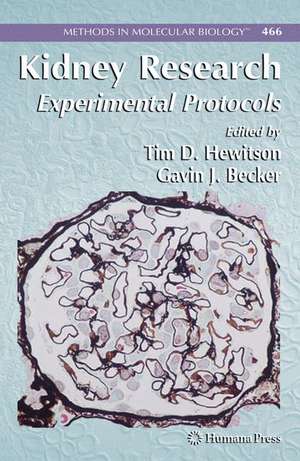
Kidney Research
Editat de Tim D Hewitson, Gavin J Beckeren Limba Engleză Hardback – 4 dec 2008
Observăm că cercetarea nefrologică s-a confruntat mult timp cu o lacună în ceea ce privește existența unor protocoale standardizate care să navigheze complexitatea fiziologică și diversitatea celulară a rinichiului. Volumul Kidney Research, editat de Tim D Hewitson și Gavin J Becker, vine să completeze această lipsă, oferind o resursă tehnică riguroasă pentru studiul mecanismelor bolilor renale. Publicată în prestigioasa serie Methods in Molecular Biology, această ediție din 2009 se distinge prin abordarea practică a investigației de laborator, de la izolarea celulelor primare până la modelarea in vivo. Structura volumului este organizată logic pentru a sprijini fluxul de lucru în cercetare: primele secțiuni sunt dedicate izolării și propagării populațiilor celulare specifice, cum ar fi celulele mezangiale glomerulare și tubulare umane, urmate de o analiză critică a modelelor animale. Remarcăm includerea unor tehnici de înaltă precizie, precum microdisecția prin captură laser și analiza expresiei genice cantitative, esențiale pentru medicina regenerativă și moleculară actuală. Comparabil cu Renal Disease de Michael S. Goligorsky în rigurozitate, acest volum este actualizat pentru nevoile specifice ale protocoalelor de biologie moleculară, punând un accent mai mare pe reproductibilitatea pașilor experimentali. Poziționarea lucrării în contextul operei lui Tim D Hewitson este firească; după succesul volumului Histology Protocols, autorul extinde expertiza sa de la histologia generală către aplicațiile ultra-specializate ale nefrologiei. Apreciem în mod deosebit secțiunile de „tips and tricks” și depanare (troubleshooting) incluse în fiecare capitol, elemente care transformă descrierile teoretice în instrumente de lucru veritabile pentru cercetători.
Preț: 652.10 lei
Preț vechi: 767.18 lei
-15%
Carte disponibilă
Livrare economică 11-25 noiembrie
Specificații
ISBN-10: 1588299457
Pagini: 276
Ilustrații: XVI, 276 p. 52 illus., 28 illus. in color.
Dimensiuni: 160 x 243 x 21 mm
Greutate: 0.62 kg
Ediția:2009 edition
Editura: Humana Press Inc.
Locul publicării:Totowa, NJ, United States
V-ar putea interesa
-
 Kidney ResearchTim D. Hewitson-5%Preț: 754.59 lei794.30 lei
 -
 Thermodynamic Dissipation Theory of the Origin and Evolution of LifeMichaelian, Dr KaroPreț: 146.15 lei
 -
 Histology ProtocolsTim D Hewitson-15%Preț: 672.27 lei790.91 lei
 -
 A Primer for the Exercise and Nutrition SciencesChristopher B Scott-5%Preț: 742.68 lei781.76 lei
 -
 In Situ Hybridization ProtocolsIan A. Darby-15%Preț: 606.67 lei713.73 lei
 -
 Nitrogen FixationMarkus W Ribbe-15%Preț: 678.08 lei797.73 lei
 -
 Single Molecule EnzymologyGregory I. Mashanov-18%Preț: 1122.78 lei1369.24 lei
 -
 Chemical Genomics and ProteomicsEdward D. Zanders-15%Preț: 671.73 lei790.26 lei
 -
 Lipases and PhospholipasesGeorgina Sandoval-18%Preț: 1289.69 lei1572.79 lei
 -
 Clinical Applications of Capillary ElectrophoresisTerry M. Phillips-15%Preț: 676.81 lei796.25 lei
 -
 Preț: 252.01 lei
 -
 Actividad de la DAGK en terminales sinápticosSandra Edith ZulianPreț: 395.42 lei
 -
 Dominios funcionales de Apolipoproteína A-I humanaMarina Cecilia GonzalezPreț: 378.31 lei
 -
 Extracción de compuestos antioxidantes en plantas autóctonasDiana Carolina Rondon RamirezPreț: 190.56 lei
 -
 Preț: 333.63 lei
 -
 Preț: 279.00 lei
 -
 Biotecnología de los alimentosLuis OjedaPreț: 311.50 lei
 -
 -8%Preț: 523.12 lei568.61 lei
 -
 Preț: 250.92 lei
 -
 Preț: 182.81 lei
 -
 Preț: 384.95 lei
 -
 -19%Preț: 455.33 lei562.14 lei
 -
 Preț: 279.00 lei
 -
 Caractérisation du safou de Kinshasa par la statistique multivariéeVan Emery TshiombePreț: 278.47 lei
 -
 -19%Preț: 639.90 lei790.00 lei
 -
 Applied ChemistryBagavathi Sundari, K.Preț: 193.34 lei
 -
 Preț: 130.79 lei
Public țintă
Professional/practitionerDe ce să citești această carte
Recomandăm această lucrare cercetătorilor și clinicienilor care doresc să implementeze tehnici de ultimă oră în studiul patologiei renale. Cititorul câștigă acces la protocoale verificate pentru cultura celulară și imagistica avansată, esențiale pentru prevenția și tratamentul bolilor de rinichi în stadiu terminal. Este un ghid metodologic indispensabil care elimină ambiguitatea din experimentele complexe de biologie moleculară renală.
Cuprins
Recenzii
“This book details research methodologies especially relevant for nephrological studies. … Researchers in the field of nephrology are the intended audience. The book covers research methodologies used in renal studies (as well as in other studies), including proteomics, micro-RNA work, and other cutting-edge approaches. … This is a unique book that has no competitors.” (Jens Goebel, Doody’s Book Reviews, December, 2011)
Textul de pe ultima copertă
Essential and cutting-edge, Kidney Research: Experimental Protocols delivers invaluable guidance to new and experienced laboratory researchers delving into the sophisticated study of the kidney.