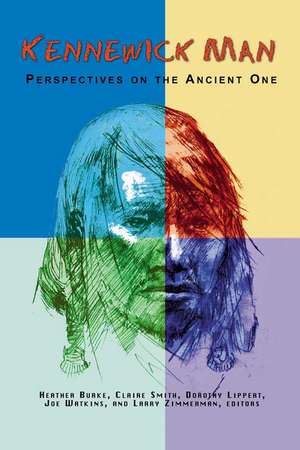
Kennewick Man: Perspectives on the Ancient One
Editat de Heather Burke, Claire E Smith, Dorothy Lippert, Joe E. Watkins, Larry J Zimmermanen Limba Engleză Paperback – 15 iun 2009
| Toate formatele și edițiile | Preț | Express |
|---|---|---|
| Paperback (1) | 373.03 lei 43-57 zile | |
| Taylor & Francis – 15 iun 2009 | 373.03 lei 43-57 zile | |
| Hardback (1) | 1120.67 lei 43-57 zile | |
| Left Coast Press Inc – 14 noi 2008 | 1120.67 lei 43-57 zile |
Preț: 373.03 lei
Nou
Puncte Express: 560
Preț estimativ în valută:
66.01€ • 77.40$ • 57.97£
66.01€ • 77.40$ • 57.97£
Carte tipărită la comandă
Livrare economică 09-23 februarie 26
Preluare comenzi: 021 569.72.76
Specificații
ISBN-13: 9781598743487
ISBN-10: 1598743481
Pagini: 298
Ilustrații: 5
Dimensiuni: 152 x 229 x 25 mm
Greutate: 0.41 kg
Ediția:1
Editura: Taylor & Francis
Colecția Routledge
Locul publicării:Oxford, United Kingdom
ISBN-10: 1598743481
Pagini: 298
Ilustrații: 5
Dimensiuni: 152 x 229 x 25 mm
Greutate: 0.41 kg
Ediția:1
Editura: Taylor & Francis
Colecția Routledge
Locul publicării:Oxford, United Kingdom
V-ar putea interesa
-
 Environmental PhysicsClare SmithPreț: 388.30 lei
 -
 -15%Preț: 421.62 lei496.03 lei
 -
 Native American History for DummiesDorothy LippertPreț: 101.32 lei
 -
 Preț: 199.51 lei
 -
 Ojibwa: People of Forests and PrairiesMICHAEL JOHNSONPreț: 290.64 lei
 -
 The Forest PeopleColin M Turnbull-21%Preț: 92.22 lei116.25 lei
 -
 Johnson, R: True to Their SaltRob Johnson-22%Preț: 167.89 lei214.61 lei
Notă biografică
Dorothy Lippert, Heather Burke, Claire E Smith, Joe E Watkins, Larry J. Zimmerman
Cuprins
1: Perspectives on the Ancient One 1; Background; 2: Kennewick: A Timeline of Events, 1996–2007 1; 3: A Review of Stability in Plateau Culture Area Burial Practices; Voices of the Tribal Coalition 1; 4: Ancient One / Kennewick Man: (Former) Tribal Chair Questions Scientists' Motives and Credibility 1; 5: Human Remains Should Be Reburied?; The Appeal Decision and the Construction of Heritage; 6: Introduction to the Reprint of An Anthropological Perspective on Magistrate Jelderks's Kennewick Man Decision; 7: Law and Bones and What the Meaning of “Is” Is 1; 8: Kennewick Man, the Native American Graves Protection and Repatriation Act, and the World Archaeological Congress: A Matter of Heritage Law; 9: Kennewick Man: A Virtual Political Object “Under Construction”; 10: Are These My People?; 11: A voice Must Be Heard; Voices of the Tribal Coalition 2; 12: Respect and Honor; 13: The Ancient One; After Kennewick: The Wider Repercussions of Nagpra; 14: Owning Indians: Nagpra Redux 1; 15: Colonizing America: Paleoamericans in the New World; 16: The Law Is an Ass: A Perspective on the Ancient One; 17: My Mother Married a White Man; 18: Whose Family? Negotiating Stewardship of the Ancestors; Voices of the Tribal Coalition 3; 19: Comments Regarding the Ancient One; 20: An Interview with Adeline Fredin 1; Learning from Kennewick 1: The Case for Science; 21: Exploring the Kennewick Connection; 22: Kennewick Man and Assessments of “Race” Using a Variety of Research Methods; 23: Ancestors, Anthropology, and Knowledge; Voices of the Tribal Coalition 4; 24: An Interview with Joe Pakootas 1; The Practice of Archaeology (and Archaeologists); 25: Governing Kennewick; 26: Kennewick Man/the Ancient One: Critical Whiteness and the Practice of Archaeology; 27: Ownership or Stewardship? Cultural Affiliation and Archaeological Ethics as Social Ethics; 28: Archaeology as Activism; 29: My Own Personal “Kennewick Man”; 30: Kennewick Man: What Does the Future Hold? 1; 31: Archaeology the Tribal Way: Reestablishing the Boundaries of Culture; Voices of the Tribal Coalition 5; 32: An Interview with Connie Johnston 1; 33: An Interview with Mary A. Marchand 1; Learning From Kennewick 2: Comparative Case Studies; 34: Cultural Return, Restitution, and the Limits of Possibility; 35: Moving Beyond Kennewick: Other Native American Perspectives on Bioarchaeological Data and Intellectual Property Rights; 36: Voices of the Future: A View from Outside the United States; 37: Learning from Our 1 Old People and the Politics of Being Indigenous: A Ngarrindjeri Response to the Ancient One Case; 38: Listening and Responding across Generations and beyond Borders: The Ancient One and Kumarangk (Hindmarsh Island); 39: Law or Lore? Speaking Sovereignty in the Kennewick Case; 40: Body and Soul: Crossing a Great Distance; Epilog; 41: Those Funfunfunnybones
Descriere
Presents multiple viewpoints on the Kennewick Man case, a lightning rod for conflict between archaeologists and Native Americans over the control of indigenous remains.
Recenzii
"Much relevant scholarship on American Indians today is taking a new approach toward collaborative processes. In the best scenario tribal voices are leading the discussion, no longer treated by outside scholars as subjects of interest but as scholars themselves and as partners in the discourse. No recent case seems to have had a need for these collaborative processes and thoughtful voices to lend themselves to more than that of the case of the Ancient One. The contents of this book reveal a connected series of voices, all of which have either a personal stake in or a well-thought-out and meaningful take on the plight and fate of this nine-thousand-year-old figure. Readers can view this book, with its short, palatable essays, metaphorically as a conversation among friends and interested parties who are perhaps sitting around a virtual coffee table where serious discussion is taking place, with all of the urgency of life, death, and the spiritual realm at stake. The importance of the fact that repatriation is continuing along, progressing from a movement to a wellpracticed implementation of tribal rights and sovereignty, is well emphasized among these pages."
-Jennifer Karson Engum, American Indian Quarterly
-Jennifer Karson Engum, American Indian Quarterly