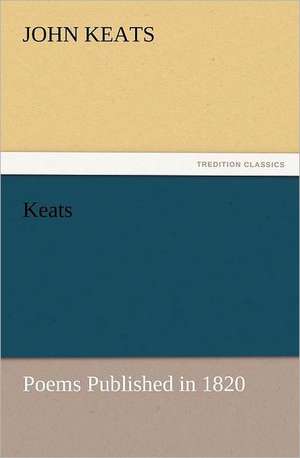
Keats: Poems Published in 1820
Autor John Keatsen Limba Engleză Paperback – 31 ian 2012
Preț: 142.57 lei
Puncte Express: 214
Carte tipărită la comandă
Livrare economică 30 noiembrie-14 decembrie
Livrare prin curier în România Termenul estimat este afișat lângă disponibilitate.
Transport gratuit de la 400.00 lei Plată online sau ramburs, în funcție de opțiunile comenzii.
Retur gratuit în 14 zile Comandă securizată și suport în română.
Specificații
ISBN-13: 9783847231790
ISBN-10: 3847231790
Pagini: 166
Dimensiuni: 133 x 203 x 10 mm
Greutate: 0.2 kg
Editura: TREDITION CLASSICS
ISBN-10: 3847231790
Pagini: 166
Dimensiuni: 133 x 203 x 10 mm
Greutate: 0.2 kg
Editura: TREDITION CLASSICS
V-ar putea interesa
-
 Bright StarJohn Keats-35%Preț: 61.87 lei94.91 lei
 -
 The Eve of St AgnesJohn Keats-21%Preț: 16.18 lei20.47 lei
 -
 -34%Preț: 51.59 lei77.99 lei
 -
 John Keats and the Perils of PosterityNicholas Roe-9%Preț: 243.19 lei266.11 lei
 -
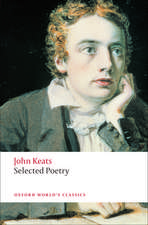 Selected PoetryJohn Keats-19%Preț: 52.70 lei64.76 lei
 -
 Selected LettersJohn KeatsPreț: 73.79 lei
 -
 Keats's Odes: A Lover's DiscourseProfessor Anahid NersessianPreț: 82.34 lei
 -
 Selected Poems and ProsePercy Bysshe Shelley-33%Preț: 84.29 lei126.16 lei
 -
 -19%Preț: 74.87 lei92.81 lei
 -
 John Keats: A New LifeNicholas RoePreț: 123.65 lei
 -
 Keats's Poetry and ProseJohn KeatsPreț: 157.02 lei
 -
 Heinemann Poetry Bookshelf: Keats Selected Poems and LettersRobert GittingsPreț: 189.04 lei
 -
 John KeatsJohn KeatsPreț: 70.55 lei
 -
 The Poems of John KeatsJohn KeatsPreț: 190.83 lei
 -
 Selected PoemsJohn Keats-35%Preț: 50.19 lei77.15 lei
 -
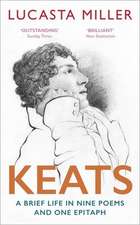 KeatsLucasta Miller-19%Preț: 76.30 lei93.66 lei
 -
 Preț: 77.80 lei
 -
 Complete Poems of John KeatsJohn KeatsPreț: 33.00 lei
 -
 Keats Selected PoemsJohn Keats-19%Preț: 68.55 lei85.13 lei
Textul de pe ultima copertă
The only things more miraculous than Keats's career--he began writing at the age of eighteen, and by the time he died, seven years later in 1821, he had produced a substantial number of the greatest poems in English--are those poems themselves. Nowhere has the pressure of human imagination been brought more powerfully to bear on our mortal condition than in his great narratives and narrative fragments, his sonnets of discovery, and his six magnificent odes, culminating in 'To Autumn.'
Notă biografică
John Keats was born in October 1795, son of the manager of a livery stable in Moorfields. His father died in 1804 and his mother, of tuberculosis, in 1810. By then he had received a good education at John Clarke’s Enfield private school. In 1811 he was apprenticed to a surgeon, completing his professional training at Guy’s Hospital in 1816. His decision to commit himself to poetry rather than a medical career was a courageous one, based more on a challenge to himself than any actual achievement.His genius was recognized and encouraged by early Mends like Charles Cowden Clarke and J. H. Reynolds, and in October 1816 he met Leigh Hunt, whose Examiner had already published Keats’s first poem. Only seven months later Poems (1817) appeared. Despite the high hopes of the Hunt circle, it was a failure. By the time Endymion was published in 1818 Keats’s name had been identified with Hunt’s "Cockney School," and the Tory Blackwood’s Magazine delivered a violent attack on Keats as a lower-class vulgarian, with no right to aspire to ‘poetry’.
But for Keats fame lay not in contemporary literary politics but with posterity. Spenser, Shakespeare, Milton, and Wordsworth were his inspiration and challenge. The extraordinary speed with which Keats matured is evident from his letters. In 1818 he had worked on the powerful epic fragment Hyperion, and in 1819 he wrote The Eve of St Agnes, La Belle Dame sans Merci, The Major Odes, Lamia, and the deeply exploratory Fall of Hyperion. Keats was already unwell when preparing the 1820 volume for the press; by the time it appeared in July he was desperately ill. He died in Rome in 1821. Keats’s final volume did receive some contemporary critical recognition, but it was not until the latter part of the nineteenth century that his place in English Romanticism began to be recognized, and not until this century that it became fully recognized.
But for Keats fame lay not in contemporary literary politics but with posterity. Spenser, Shakespeare, Milton, and Wordsworth were his inspiration and challenge. The extraordinary speed with which Keats matured is evident from his letters. In 1818 he had worked on the powerful epic fragment Hyperion, and in 1819 he wrote The Eve of St Agnes, La Belle Dame sans Merci, The Major Odes, Lamia, and the deeply exploratory Fall of Hyperion. Keats was already unwell when preparing the 1820 volume for the press; by the time it appeared in July he was desperately ill. He died in Rome in 1821. Keats’s final volume did receive some contemporary critical recognition, but it was not until the latter part of the nineteenth century that his place in English Romanticism began to be recognized, and not until this century that it became fully recognized.