
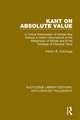
Kant on Absolute Value: A Critical Examination of Certain Key Notions in Kant's 'Groundwork of the Metaphysic of Morals' and of his Ontology of Personal Value: Routledge Library Editions: 18th Century Philosophy
Autor Patrick Æ. Hutchingsen Limba Engleză Hardback – 2 mai 2019
| Toate formatele și edițiile | Preț | Express |
|---|---|---|
| Paperback (1) | 325.70 lei 6-8 săpt. | |
| Taylor & Francis – 15 noi 2020 | 325.70 lei 6-8 săpt. | |
| Hardback (1) | 811.44 lei 6-8 săpt. | |
| Taylor & Francis – 2 mai 2019 | 811.44 lei 6-8 săpt. |
Din seria Routledge Library Editions: 18th Century Philosophy
-
 Preț: 160.53 lei
 - 40%
 Preț: 6316.69 lei
 -
 Preț: 316.28 lei
 -
 Preț: 325.70 lei
 -
 Preț: 317.74 lei
 -
 Preț: 321.98 lei
 -
 Preț: 325.70 lei
 -
 Preț: 317.74 lei
 -
 Preț: 319.41 lei
 -
 Preț: 324.02 lei
 -
 Preț: 327.53 lei
 -
 Preț: 323.86 lei
 -
 Preț: 321.62 lei
 -
 Preț: 323.86 lei
 -
 Preț: 317.54 lei
 -
 Preț: 323.86 lei
 -
 Preț: 325.70 lei
 -
 Preț: 326.63 lei
Preț: 811.44 lei
Preț vechi: 989.57 lei
-18% Nou
Puncte Express: 1217
Preț estimativ în valută:
143.56€ • 168.78$ • 125.74£
143.56€ • 168.78$ • 125.74£
Carte tipărită la comandă
Livrare economică 28 ianuarie-11 februarie 26
Preluare comenzi: 021 569.72.76
Specificații
ISBN-13: 9780367135850
ISBN-10: 036713585X
Pagini: 348
Dimensiuni: 156 x 234 x 21 mm
Greutate: 0.66 kg
Ediția:1
Editura: Taylor & Francis
Colecția Routledge
Seria Routledge Library Editions: 18th Century Philosophy
Locul publicării:Oxford, United Kingdom
ISBN-10: 036713585X
Pagini: 348
Dimensiuni: 156 x 234 x 21 mm
Greutate: 0.66 kg
Ediția:1
Editura: Taylor & Francis
Colecția Routledge
Seria Routledge Library Editions: 18th Century Philosophy
Locul publicării:Oxford, United Kingdom
Cuprins
1. Kant, Harris and the Absolute Value 2. Kant, Harris and the Absolute or Sovereign Good 3. The Argument in Kant: I 4. The Argument in Kant: II 5. The Strange New Doctrine 6. The Ends of Reason, of Life and of Duty 7. Virtue and Rewards 8. Interest or Disinterestedness at the Root of Moral Conduct? 9. Kant’s Ontology of Personal Value: A False Absolute 10. Rationality as Value: Towards a Humanistic Ontology
Descriere
The thesis of this book, first published in 1972, is that Kant’s notions of ‘absolute worth’, the ‘unconditioned’ and ‘unconditioned worth’ are rationalistic and confused, and that they spoil his ontology of personal value and tend to subvert his splendid idea of the person as an End in himself.