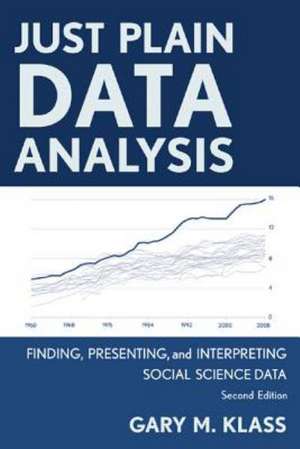
Just Plain Data Analysis: Finding, Presenting, and Interpreting Social Science Data
Autor Gary M. Klassen Limba Engleză Paperback – 13 apr 2012
Preț: 255.93 lei
Preț vechi: 334.45 lei
-23%
Puncte Express: 384
Carte tipărită la comandă
Livrare economică 30 noiembrie-14 decembrie
Livrare prin curier în România Termenul estimat este afișat lângă disponibilitate.
Transport gratuit de la 400.00 lei Plată online sau ramburs, în funcție de opțiunile comenzii.
Retur gratuit în 14 zile Comandă securizată și suport în română.
Specificații
ISBN-13: 9781442215085
ISBN-10: 1442215089
Pagini: 181
Ilustrații: black & white illustrations, black & white tables, figures, graphs
Dimensiuni: 154 x 230 x 13 mm
Greutate: 0.32 kg
Ediția:2 Rev ed.
Editura: Bloomsbury Publishing
Colecția Rowman & Littlefield
Locul publicării:New York, United States
ISBN-10: 1442215089
Pagini: 181
Ilustrații: black & white illustrations, black & white tables, figures, graphs
Dimensiuni: 154 x 230 x 13 mm
Greutate: 0.32 kg
Ediția:2 Rev ed.
Editura: Bloomsbury Publishing
Colecția Rowman & Littlefield
Locul publicării:New York, United States
V-ar putea interesa
-
 Measuring Data Quality for Ongoing Improvement: A Data Quality Assessment FrameworkLaura Sebastian-Coleman-19%Preț: 267.62 lei331.21 lei
 -
 Algorithms and Data Structures: An Approach in CCharles F. Bowman-27%Preț: 1072.42 lei1469.06 lei
 -
 Creative research communicationClare WilkinsonPreț: 227.44 lei
 -
 Focus Groups for the Social Science ResearcherJennifer CyrPreț: 212.59 lei
 -
 -30%Preț: 510.73 lei733.20 lei
 -
 -32%Preț: 583.22 lei863.99 lei
 -
 Statistical Modelling of Complex Correlated and Clustered Data Household Surveys in AfricaNgianga-Bakwin Kandala PhD-26%Preț: 1279.70 lei1739.96 lei
 -
 Computational Data Analysis Techniques in Economics & FinanceMichael Doumpos-27%Preț: 1331.88 lei1813.83 lei
 -
 Data Analytics and PsychometricsHong JiaoPreț: 420.51 lei
 -
 Learning Analytics in EducationDavid NiemiPreț: 391.42 lei
 -
 Transforming Research Methods in the Social SciencesAngelo Flynn-19%Preț: 513.31 lei633.71 lei
 -
 Present SenseSteve MorlidgePreț: 235.52 lei
 -
 Preț: 211.43 lei
 -
 Preț: 430.60 lei
 -
 Preț: 305.22 lei
 -
 Preț: 204.48 lei
Cuprins
Preface
Chapter 1: Measuring Political, Social and Economic Conditions
Chapter 2: Measuring Racial and Ethnic Inequality
Chapter 3: Statistical Fallacies, Paradoxes and Threats to Validity
Chapter 4: Examining a Relationship: New York City Crime Rates
Chapter 5: Tabulating the Data and Writing about the Numbers
Chapter 6: The Graphical Display of Data
Chapter 7: Voting and Elections
Chapter 8: Measuring Educational Achievement
Chapter 9: Measuring Poverty and Inequality
Chapter 1: Measuring Political, Social and Economic Conditions
Chapter 2: Measuring Racial and Ethnic Inequality
Chapter 3: Statistical Fallacies, Paradoxes and Threats to Validity
Chapter 4: Examining a Relationship: New York City Crime Rates
Chapter 5: Tabulating the Data and Writing about the Numbers
Chapter 6: The Graphical Display of Data
Chapter 7: Voting and Elections
Chapter 8: Measuring Educational Achievement
Chapter 9: Measuring Poverty and Inequality
Recenzii
This short book is a useful supplement to traditional statistics and research method texts....Recommended.
In Just Plain Data Analysis, Gary Klass analyzes simple statistics that involve sophisticated reasoning. This book cuts through paradoxes, fallacies and socially-constructed statistics to uncover the basic elements of data analysis. A must-read for anyone interested in statistical literacy.
As a teacher of research methods, I have been waiting for a book like Just Plain Data Analysis. By focusing on finding, presenting and interpreting data, Klass encourages students to develop the critical thinking skills that they will need once they leave the university. The writing is clear and the examples are excellent. The discussion of reliability, validity, and ecological fallacy is the best I have read in an undergraduate text. The many table and chart examples will help students improve their skills.
With humor and political balance, Just Plain Data Analysis offers a pithy guide to finding, presenting and interpreting social science data ranging from crime to elections. Recommended for students, teachers and policymakers who want to understand where the data comes from and how to use it responsibly.
Just Plain Data Analysis: Finding, Presenting, and Interpreting Social Science by Gary M. Klass is an exploration of the types of quantitative research (which is rooted in data and statistical analysis) that can be used to draw conclusions about such social science issues as crime rates and measuring educational achievement. Klass uses examples of statistical claims to demonstrate how changing the time frame for data collection or looking at different correlations can result in varying or misleading statements. He also has chapters to how to tabulate and display numbers and how to use graphical presentation effectively.
In Just Plain Data Analysis, Gary Klass analyzes simple statistics that involve sophisticated reasoning. This book cuts through paradoxes, fallacies and socially-constructed statistics to uncover the basic elements of data analysis. A must-read for anyone interested in statistical literacy.
As a teacher of research methods, I have been waiting for a book like Just Plain Data Analysis. By focusing on finding, presenting and interpreting data, Klass encourages students to develop the critical thinking skills that they will need once they leave the university. The writing is clear and the examples are excellent. The discussion of reliability, validity, and ecological fallacy is the best I have read in an undergraduate text. The many table and chart examples will help students improve their skills.
With humor and political balance, Just Plain Data Analysis offers a pithy guide to finding, presenting and interpreting social science data ranging from crime to elections. Recommended for students, teachers and policymakers who want to understand where the data comes from and how to use it responsibly.
Just Plain Data Analysis: Finding, Presenting, and Interpreting Social Science by Gary M. Klass is an exploration of the types of quantitative research (which is rooted in data and statistical analysis) that can be used to draw conclusions about such social science issues as crime rates and measuring educational achievement. Klass uses examples of statistical claims to demonstrate how changing the time frame for data collection or looking at different correlations can result in varying or misleading statements. He also has chapters to how to tabulate and display numbers and how to use graphical presentation effectively.