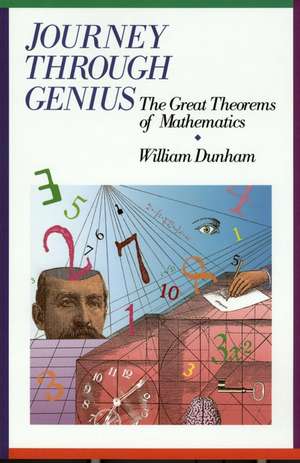
Journey Through Genius
Autor William Dunhamen Limba Engleză Hardback – 16 ian 1991
În volumul Journey Through Genius, William Dunham propune o abordare distinctă față de manualele cronologice standard, transformând istoria matematicii într-o galerie de artă a intelectului uman. Remarcăm faptul că autorul nu se limitează la a enumera descoperiri, ci reconstruiește pas cu pas demonstrațiile originale, oferind cititorului șansa de a urmări logica exactă a unor minți precum Euclid sau Arhimede. Această lucrare aduce nou o structură tripartită riguroasă pentru fiecare capitol: o introducere în epoca și viața matematicianului, analiza detaliată a „Marii Teoreme” și un epilog care evaluează impactul pe termen lung al descoperirii. Considerăm această carte o alternativă pedagogică excelentă la History Mathematics 3e de Carl B. Boyer pentru cursurile de istoria științei. În timp ce volumul lui Boyer oferă o privire de ansamblu enciclopedică și exhaustivă, Journey Through Genius are avantajul unei focalizări profunde pe momentele de „iluminare”, permițând parcurgerea demonstrațiilor matematice fără a necesita o pregătire academică avansată. În contextul operei sale, această lucrare stabilește fundația pe care Dunham a construit ulterior în The Calculus Gallery, unde a explorat tranziția către analiza modernă a lui Newton și Leibniz. Organizarea cărții este cronologică, începând cu primele demonstrații demonstrative din Grecia Antică și ajungând până la soluționarea ecuațiilor cubice de către Cardano în secolul al XVI-lea. Progresia capitolelor evidențiază evoluția de la geometrie pură către teoria numerelor și algebră, oferind o perspectivă clară asupra modului în care rigoarea matematică s-a rafinat de-a lungul mileniilor. Stilul este precis, dar accesibil, reușind să păstreze eleganța demonstrațiilor originale într-un format modern.
Preț: 231.31 lei
Carte disponibilă
Livrare economică 09-23 noiembrie
Livrare express 23-29 octombrie pentru 43.35 lei
Specificații
ISBN-10: 0471500305
Pagini: 320
Ilustrații: illustrations; portraits
Dimensiuni: 157 x 235 x 23 mm
Greutate: 0.67 kg
Editura: Wiley
Locul publicării:Hoboken, United States
V-ar putea interesa
-
 God Created the IntegersStephen Hawking-15%Preț: 120.30 lei142.12 lei
 -
 CHAOS : Making a New ScienceJames GleickPreț: 134.57 lei
 -
 Sum Stories: Equations and Their OriginsRobin Wilson-15%Preț: 188.09 lei220.69 lei
 -
 The Secret Lives of NumbersKate KitagawaPreț: 93.02 lei
 -
 A Little History of MathematicsSnezana LawrencePreț: 155.08 lei
 -
 Godel, Escher, Bach: An Eternal Golden BraidDouglas HofstadterPreț: 165.47 lei
 -
 Revolutions in GeometryO'Leary-9%Preț: 977.94 lei1074.67 lei
 -
 History Mathematics 3eCarl B. BoyerPreț: 263.04 lei
 -
 -24%Preț: 146.90 lei192.22 lei
 -
 -36%Preț: 96.36 lei151.43 lei
 -
 -34%Preț: 149.68 lei227.27 lei
 -
 Preț: 234.90 lei
 -
 ChaosJames Gleick-19%Preț: 76.25 lei93.64 lei
 -
 -35%Preț: 109.81 lei167.83 lei
 -
 Here's Looking at EuclidAlex BellosPreț: 112.17 lei
 -
 The Math Book: From Pythagoras to the 57th DimensionClifford Pickover A-30%Preț: 153.28 lei218.60 lei
 -
 -33%Preț: 79.92 lei119.99 lei
 -
 -25%Preț: 43.18 lei57.95 lei
 -
 Atwood, M: Handmaid's TaleMargaret Atwood-19%Preț: 84.53 lei104.45 lei
 -
 The Mathematicians' LibraryThomas K. Briggs-21%Preț: 173.70 lei221.10 lei
 -
 Professor Stewart's Cabinet of Mathematical CuriositiesProfessor Ian Stewart-19%Preț: 64.58 lei79.25 lei
 -
 Introducing MathematicsJerry RavetzPreț: 64.47 lei
De ce să citești această carte
Recomandăm această carte oricărui pasionat de științe care dorește să înțeleagă nu doar „ce” s-a descoperit, ci mai ales „cum”. Cititorul câștigă o perspectivă rară asupra frumuseții logice a matematicii, văzută prin ochii geniilor care au creat-o. Este un instrument valoros pentru studenți și profesori, oferind contextul istoric și uman adesea ignorat în manualele tehnice, într-un format care transformă demonstrația matematică într-o narațiune captivantă.
Despre autor
William Dunham este un cercetător și profesor de matematică distins, absolvent al University of Pittsburgh și doctor în matematică la Ohio State University. Cariera sa a fost marcată de un interes profund pentru pedagogia istoriei matematicii, fiind coordonatorul unor seminare prestigioase finanțate de National Endowment for the Humanities. Expertiza sa în a face concepte complexe accesibile publicului larg este reflectată în lucrările sale de referință, precum The Mathematical Universe și The Calculus Gallery, volume care consolidează statutul său de narator de excepție al evoluției gândirii umane.
Descriere scurtă
"It is a captivating collection of essays of major mathematical achievements brought to life by the personal and historical anecdotes which the author has skillfully woven into the text. This is a book which should find its place on the bookshelf of anyone interested in science and the scientists who create it." ?R. L. Graham, AT&T Bell Laboratories
"Come on a time-machine tour through 2,300 years in which Dunham drops in on some of the greatest mathematicians in history. Almost as if we chat over tea and crumpets, we get to know them and their ideas?ideas that ring with eternity and that offer glimpses into the often veiled beauty of mathematics and logic. And all the while we marvel, hoping that the tour will not stop." ?Jearl Walker, Physics Department, Cleveland State University Author of The Flying Circus of Physics
Cuprins
Acknowledgments
Chapter 1. Hippocrates' Quadrature of the Lune (ca. 440 B.C.)
The Appearance of Demonstrative Mathematics
Some Remarks on Quadrature
Great Theorem
Epilogue
Chapter 2. Euclid's Proof of the Pythagorean Theorem (ca. 300 B.C.)
The Elements of Euclid
Book I: Preliminaries
Book I: The Early Propositions
Book I: Parallelism and Related Topics
Great Theorem
Epilogue
Chapter 3. Euclid and the Infinitude of Primes (ca. 300 B.C.)
The Elements, Books II-VI
Number Theory in Euclid
Great Theorem
The Final Books of the Elements
Epilogue
Chapter 4. Archimedes' Determination of Circular Area (ca. 225 B.C.)
The Life of Archimedes
Great Theorem
Archimedes' Masterpiece: On the Sphere and the Cylinder
Epilogue
Chapter 5. Heron's Formula for Triangular Area (ca. A.D. 75)
Classical Mathematics after Archimedes
Great Theorem
Epilogue
Chapter 6. Cardano and the Solution of the Cubic (1545)
A Horatio Algebra Story
Great Theorem
Further Topics on Solving Equations
Epilogue
Chapter 7. A Gem from Isaac Newton (Late 1660s)
Mathematics of the Heroic Century
A Mind Unleashed
Newton's Binomial Theorem
Great Theorem
Epilogue
Chapter 8. The Bernoullis and the Harmonic Series (1689)
The Contributions of Leibniz
The Brothers Bernoulli
Great Theorem
The Challenge of the Brachistochrone
Epilogue
Chapter 9. The Extraordinary Sums of Leonhard Euler (1734)
The Master of All Mathematical Trades
Great Theorem
Epilogue
Chapter 10. A Sampler of Euler's Number Theory (1736)
The Legacy of Fermat
Great Theorem
Epilogue
Chapter 11. The Non-Denumerability of the Continuum (1874)
Mathematics of the Nineteenth Century
Cantor and the Challenge of the Infinite
Great Theorem
Epilogue
Chapter 12. Cantor and the Transfinite Realm (1891)
The Nature of Infinite Cardinals
Great Theorem
Epilogue
Afterword
Chapter Notes
References
Index
Recenzii
— Los Angeles Times
“It is mathematics presented as a series of works of art; a fascinating lingering over individual examples of ingenuity and insight. It is mathematics by lightning flash.”
— Isaac Asimov
“Dunham deftly guides the reader through the verbal and logical intricacies of major mathematical questions, conveying a splendid sense of how the greatest mathematicians from ancient to modern times presented their arguments.”
—Ivars Peterson, author of The Mathematical Tourist