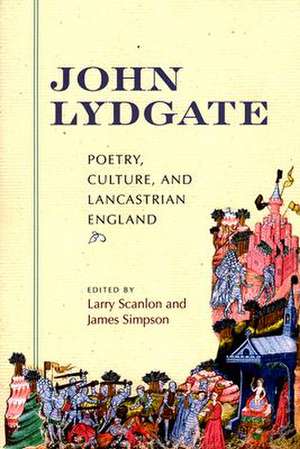
John Lydgate
Autor James Simpson Editat de Larry Scanlonen Limba Engleză Paperback – 24 feb 2006
Preț: 228.33 lei
Puncte Express: 342
Carte tipărită la comandă
Livrare economică 28 noiembrie-12 decembrie
Livrare prin curier în România Termenul estimat este afișat lângă disponibilitate.
Transport gratuit de la 400.00 lei Plată online sau ramburs, în funcție de opțiunile comenzii.
Retur gratuit în 14 zile Comandă securizată și suport în română.
Specificații
ISBN-13: 9780268041168
ISBN-10: 0268041164
Pagini: 322
Dimensiuni: 152 x 229 x 19 mm
Greutate: 0.53 kg
Ediția:1
Editura: University of Notre Dame Press
ISBN-10: 0268041164
Pagini: 322
Dimensiuni: 152 x 229 x 19 mm
Greutate: 0.53 kg
Ediția:1
Editura: University of Notre Dame Press
V-ar putea interesa
-
 Critical Studies: The Great GatsbyKathleen ParkinsonPreț: 32.57 lei
 -
 -33%Preț: 1325.58 lei1977.04 lei
 -
 -25%Preț: 362.95 lei484.90 lei
 -
 -12%Preț: 350.79 lei398.10 lei
 -
 -27%Preț: 401.84 lei553.08 lei
 -
 Literature and the Great War 1914-1918Randall Stevenson-13%Preț: 286.36 lei329.24 lei
 -
 Anthology of Beowulf Criticism, TheLewis E. NicholsonPreț: 311.44 lei
 -
 Victorian ReformationsMiriam Elizabeth BursteinPreț: 370.07 lei
 -
 Clandestine EncountersKevin HartPreț: 298.88 lei
 -
 Writing the Irish WestEamonn WallPreț: 220.24 lei
 -
 The Celtic UnconsciousRichard BarlowPreț: 377.39 lei
 -
 Conflicts of DevotionDaniel R. GibbonsPreț: 448.23 lei
 -
 Modern Arabic PoetryWaed AthamnehPreț: 534.99 lei
 -
 Piers Plowman and the Poetics of EnigmaCurtis A. Gruenler-15%Preț: 498.52 lei586.50 lei
 -
 Irish Dramatic MovementM. FitzgeraldPreț: 458.59 lei
 -
 -18%Preț: 101.80 lei123.96 lei
 -
 Narrative, Authority and PowerLarry ScanlonPreț: 444.77 lei
 -
 Preț: 253.98 lei
 -
 Preț: 242.96 lei
 -
 Mary ShelleyEmily W SunsteinPreț: 163.65 lei
 -
 Reynard the FoxJames SimpsonPreț: 166.49 lei
 -
 -30%Preț: 693.25 lei991.17 lei
 -
 Translation and the Making of Modern Russian LiteratureProfessor Brian James BaerPreț: 296.18 lei
 -
 L'Autobiographie Entre Autres: Ecrire La Vie Aujourd'huiFabien Arribert-Narce-9%Preț: 333.72 lei366.37 lei
 -
 -15%Preț: 519.34 lei610.99 lei
Notă biografică
Growing up in the aftermath of the Video Nasties, during the late eighties and early nineties, James Simpson is from a small town in the North East of England where talking about grisly horror flicks was the norm in his school playground. For the last few years, he has written about cult cinema for several magazines and websites as well as running his own-now-defunct site: Infernal Cinema. He has interviewed horror stars Emily Booth, Barbie Wilde, and the legendary Lloyd Kaufman, amongst others, during this time. He appears in the Jason Impey documentary: VIPCO: The Untold Story. This is his first book. His favourite VIPCO movie is Spookies.
Descriere
Reassesses better-known works and themes in the field of Lydgate studies, including Lydgate's unofficial laureateship, his relationship to his patrons, and his relationship to Chaucer. This book makes an important contribution to medieval scholarship and it will be welcomed by scholars and students alike.
Recenzii
“Larry Scanlon and James Simpson, the editors of John Lydgate: Poetry, Culture, and Lancastrian England, come right out and say it: ‘We propose to take Lydgate seriously as a major poet.’ Their essay collection steers away from the longest poems in favour of (more) neglected texts, and it thus enriches our sense of the vast range of Lydgate’s output and his multiple roles as a poet.” —Times Literary Supplement, March 23, 2007
“This impressive and significant collection situates itself at the forefront of the current whirlwind rehabilitation of the Monk of Bury that was kick-started so decisively by David Lawton in his 1987 essay 'Dullness and the fifteenth century.'” —Medium Aevum, vol. LXXVI, 2007
“The collection's goal is to remedy the neglect into which Lydgate has fallen, 'by taking [him] seriously as a major poet' and in so doing to fill a gaping hole in our understanding of Middle English literary history. This well-conceived and timely collection takes us a long stride toward understanding and doing justice to an undeservedly overlooked writer and will no doubt spur future revisionist efforts with it powerful example.” —Speculum, April 2007