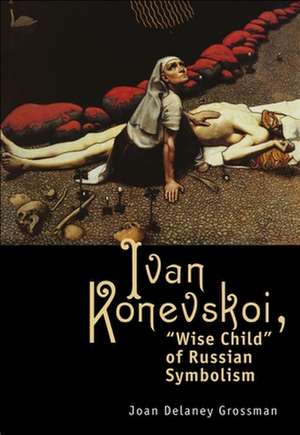
Ivan Konevskoi
Autor Joan Delaney Grossmanen Limba Engleză Hardback – mar 2010
Preț: 675.93 lei
Preț vechi: 834.49 lei
-19%
Puncte Express: 1014
Carte tipărită la comandă
Livrare economică 16-30 iunie
Specificații
ISBN-13: 9781934843895
ISBN-10: 193484389X
Pagini: 276
Dimensiuni: 161 x 240 x 19 mm
Greutate: 0.6 kg
Ediția:New.
Editura: Academic Studies Press
ISBN-10: 193484389X
Pagini: 276
Dimensiuni: 161 x 240 x 19 mm
Greutate: 0.6 kg
Ediția:New.
Editura: Academic Studies Press
V-ar putea interesa
-
 The Poets DaughtersKatie WaldegravePreț: 118.70 lei
 -
 -14%Preț: 659.40 lei766.74 lei
 -
 -34%Preț: 723.82 lei1089.11 lei
 -
 Robert Browning: 21st-Century Oxford AuthorsRichard Cronin-30%Preț: 1079.29 lei1544.05 lei
 -
 -28%Preț: 783.97 lei1086.89 lei
 -
 Clare's Lyric: John Clare and Three Modern PoetsStephanie Kuduk Weiner-34%Preț: 733.31 lei1110.40 lei
 -
 La Folie BaudelaireRoberto CalassoPreț: 89.53 lei
 -
 Irish Dramatic MovementM. FitzgeraldPreț: 441.29 lei
 -
 The American Short Story HandbookJames NagelPreț: 324.95 lei
 -
 RomanticismFrederick Burwick-23%Preț: 587.71 lei763.26 lei
 -
 Teaching Nineteenth-Century Russian LiteratureDeborah Martinsen-23%Preț: 746.14 lei969.02 lei
 -
 Russian Silver Age Poetry: Texts and ContextsSibelan ForresterPreț: 260.91 lei
 -
 From the Bible to ShakespeareAndrii Danylenko-19%Preț: 630.22 lei778.05 lei
 -
 First Words: On Dostoevsky's IntroductionsLewis Bagby-19%Preț: 615.27 lei759.60 lei
 -
 Exotic Moscow Under Western EyesIrene Masing-Delic-19%Preț: 672.77 lei830.58 lei
 -
 Vladimir Soloviev and the Spiritualization of MatterOliver Smith-23%Preț: 696.94 lei905.11 lei
Cuprins
Introduction; The Drive for Life; Chronicle of My Travels; A Love Affair with the World's Waters; Two Meetings; "Dreams and Meditations"; The Power of the Word; "Abolishing Death" (1); Finland, Novgorod, St Petersburg; Abolishing Death (2); Afterword.
Descriere
Descriere de la o altă ediție sau format:
Ivan Konevskoi: “Wise Child” of Russian Symbolism is the first study in any language of Ivan Konevskoi –— poet, thinker, mystic— – for many decades the “lost genius” of Russian modernism. A fresh and compelling figure, Konevskoi plunged deeply into the currents of modern mystical thought and art in the 1890s. A passionate searcher for immortality, he developed his own version of pantheism meant to guard his unique persona from dissolution in the All-One. The poetry of Tiutchev, Vladimir Solov’ev Soloviev and Rossetti, William James’s psychology, paintings of Pre-Raphaelites and Arnold Boecklin, Old Russian historical myth, the Finnish Kalevala: all engaged him during his brief life. His worldview grew more audacious, his confidence in the magical power of the word grew more assured. Drowning in 1901 at 23, Konevskoi left a legacy unfinished, rich, and intriguing.
Ivan Konevskoi: “Wise Child” of Russian Symbolism is the first study in any language of Ivan Konevskoi –— poet, thinker, mystic— – for many decades the “lost genius” of Russian modernism. A fresh and compelling figure, Konevskoi plunged deeply into the currents of modern mystical thought and art in the 1890s. A passionate searcher for immortality, he developed his own version of pantheism meant to guard his unique persona from dissolution in the All-One. The poetry of Tiutchev, Vladimir Solov’ev Soloviev and Rossetti, William James’s psychology, paintings of Pre-Raphaelites and Arnold Boecklin, Old Russian historical myth, the Finnish Kalevala: all engaged him during his brief life. His worldview grew more audacious, his confidence in the magical power of the word grew more assured. Drowning in 1901 at 23, Konevskoi left a legacy unfinished, rich, and intriguing.
Recenzii
“Ivan Konevskoi (1877-1901) strove throughout his tragically brief earthly life to "abolish death" by penetrating the mystic core of the universe. His earthly survival has now been notably enhanced by Joan Grossman's splendid book, a comprehensive account of the poet's life, thought, and accomplishments. Deeply sympathetic but always clear-eyed and sensible, Grossman's narrative is exhaustively researched but never pedantic, engagingly written and rich in illuminations derived from the author's lifelong study of Russian poetry, especially of the Symbolist era.”
“Joan Grossman’s spiritual biography of “poet-mystic-thinker” Ivan Konevskoi (Oreus) fills a large gap in the scholarship on early Russian modernism. Although never entirely forgotten, Konevskoi was largely ignored by scholars in both Russia and in the West, before the appearance of this substantial monograph. With the superb knowledge of her subject-matter that years of painstaking and engaged research have given her, Grossman guides us through the poet’s short, but intense, quest for immortality through his own brand of pantheism. As Grossman shows, Konevskoi’s spiritual journey, which ended prematurely by accidental drowning, has many intriguing stops along the way. Grossman makes this journey entertaining and informative. This is a major work by a distinguished scholar, which is bound to stimulate further research of this elusive poet.”
"Grossman (Slavic languages and literatures, U. of California at Berkeley) offers the first study of the life, ideas, and achievements of Russian modernist poet, thinker, and mystic Ivan Konevskoi (1877-1901). Focusing on his inner life (rather than all aspects of his biography), she examines its representation in his poetry, his exploration of pantheism, mystical encounters during his European travels, the influence of painter Arnold Böcklin, his affair with Anna Nikolaevna Gippius, his friend and posthumous publisher Valerii Briusov, his poetry collection Dreams and Meditations, his desire to abolish death through mysticism, the influence of Nietzsche, and his accidental drowning at the age of twenty-three. Selected poems are provided in Russian."
“Joan Grossman’s spiritual biography of “poet-mystic-thinker” Ivan Konevskoi (Oreus) fills a large gap in the scholarship on early Russian modernism. Although never entirely forgotten, Konevskoi was largely ignored by scholars in both Russia and in the West, before the appearance of this substantial monograph. With the superb knowledge of her subject-matter that years of painstaking and engaged research have given her, Grossman guides us through the poet’s short, but intense, quest for immortality through his own brand of pantheism. As Grossman shows, Konevskoi’s spiritual journey, which ended prematurely by accidental drowning, has many intriguing stops along the way. Grossman makes this journey entertaining and informative. This is a major work by a distinguished scholar, which is bound to stimulate further research of this elusive poet.”
"Grossman (Slavic languages and literatures, U. of California at Berkeley) offers the first study of the life, ideas, and achievements of Russian modernist poet, thinker, and mystic Ivan Konevskoi (1877-1901). Focusing on his inner life (rather than all aspects of his biography), she examines its representation in his poetry, his exploration of pantheism, mystical encounters during his European travels, the influence of painter Arnold Böcklin, his affair with Anna Nikolaevna Gippius, his friend and posthumous publisher Valerii Briusov, his poetry collection Dreams and Meditations, his desire to abolish death through mysticism, the influence of Nietzsche, and his accidental drowning at the age of twenty-three. Selected poems are provided in Russian."