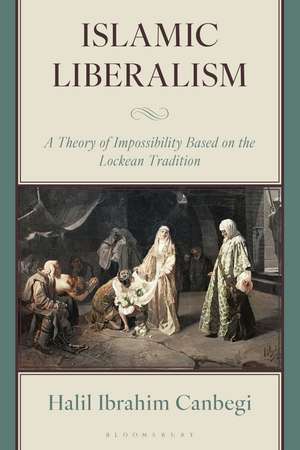
Islamic Liberalism: A Theory of Impossibility Based on the Lockean Tradition
Autor Halil Ibrahim Canbegien Limba Engleză Paperback – 18 mar 2027
Preț: 216.48 lei
Preț vechi: 284.88 lei
-24% Precomandă
Puncte Express: 325
Carte nepublicată încă
Livrare prin curier în România Precomanda se expediază când titlul devine disponibil.
Transport gratuit de la 400.00 lei Plată online sau ramburs, în funcție de opțiunile comenzii.
Retur gratuit în 14 zile Comandă securizată și suport în română.
Doresc să fiu notificat când acest titlu va fi disponibil:
Se trimite...
Specificații
ISBN-13: 9781666967005
ISBN-10: 1666967009
Pagini: 252
Ilustrații: 0 tables
Dimensiuni: 152 x 229 x 25 mm
Greutate: 0.45 kg
Editura: Bloomsbury Publishing
Colecția Bloomsbury Academic
Locul publicării:New York, United States
ISBN-10: 1666967009
Pagini: 252
Ilustrații: 0 tables
Dimensiuni: 152 x 229 x 25 mm
Greutate: 0.45 kg
Editura: Bloomsbury Publishing
Colecția Bloomsbury Academic
Locul publicării:New York, United States
Cuprins
Chapter 1: The Seeds of Liberalism: Natural Law Tradition
Chapter 2: Locke's Liberalism and Natural Rights
Chapter 3: Islamic Natural Law: A Rudimentary Quest for Reason
Chapter 4: Lockean Rights in Islam and Islamic Liberalism
Chapter 5: Is Islamic Liberalism Sufficiently Islamic and Liberal?
Chapter 2: Locke's Liberalism and Natural Rights
Chapter 3: Islamic Natural Law: A Rudimentary Quest for Reason
Chapter 4: Lockean Rights in Islam and Islamic Liberalism
Chapter 5: Is Islamic Liberalism Sufficiently Islamic and Liberal?
Recenzii
A Theory of Impossibility Based on the Lockean Tradition undertakes a challenging task: refuting the possibility of Islamic liberalism. Canbegi argues that the Islamic political tradition lacks the Lockean foundation that underpins Western liberalism. According to Canbegi, 'Islamic liberalism stands only as a juxtaposition of Islam and liberalism; it does not represent something distinct from Islam or liberalism.' This impossibility, he contends, stems from fundamental differences between the Western and Islamic traditions in their conceptions of natural law.
This book warrants attention for two main reasons. First, it boldly challenges the emerging intellectual consensus that supports the compatibility of Islam and liberalism. Second, it transcends practical legal debates by addressing the structural concepts-such as natural law-that define the relationship between these two traditions.
This book warrants attention for two main reasons. First, it boldly challenges the emerging intellectual consensus that supports the compatibility of Islam and liberalism. Second, it transcends practical legal debates by addressing the structural concepts-such as natural law-that define the relationship between these two traditions.