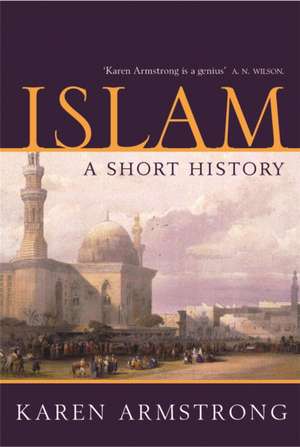
Islam: UNIVERSAL HISTORY
Autor Karen Armstrongen Limba Engleză Paperback – 3 dec 2001
Adresăm acest volum studenților la istorie sau teologie, cercetătorilor fenomenului religios și publicului larg care dorește să depășească clișeele mediatice despre una dintre cele mai neînțelese credințe ale lumii. Islam oferă o sinteză istorică riguroasă, menită să clarifice bazele teologice și politice ale unei religii care domină frecvent agenda geopolitică actuală. Subliniem faptul că abordarea lui Karen Armstrong nu este una pur dogmatică, ci una care plasează credința musulmană în contextul mai larg al „religiilor cărții”, demonstrând legăturile organice cu iudaismul și creștinismul. Textul urmărește evoluția credinței de la figura Profetului Muhammad până la provocările secolului XXI. Apreciem în mod deosebit modul în care autoarea demontează percepția Islamului ca fiind o religie inerent opresivă, arătând că, în perioadele sale de înflorire, acesta a fost un motor al iluminismului, științei și drepturilor civile. Volumul acoperă aceeași arie tematică precum The Islam Book de la DK, însă acolo unde titlul de la DK mizează pe o prezentare vizuală și enciclopedică, Karen Armstrong oferă o analiză narativă profundă, axată pe cauzalitate istorică și evoluție spirituală. De asemenea, spre deosebire de No god but God de Reza Aslan, care se concentrează pe o perspectivă mai degrabă reformistă și personală, lucrarea de față rămâne o monografie istorică esențială pentru înțelegerea destinului colectiv al lumii islamice. Această ediție din seria UNIVERSAL HISTORY consolidează tema centrală a operei lui Armstrong — regăsită și în The Lost Art of Scripture sau Fields of Blood — anume că religia nu este o sursă de conflict prin definiție, ci un sistem complex care reacționează la presiunile politice și economice ale modernității.

Preț: 57.98 lei
Preț vechi: 78.87 lei
-26%
Carte disponibilă
Livrare economică 14-28 noiembrie
Livrare express 31 octombrie-06 noiembrie pentru 40.25 lei
Specificații
ISBN-10: 1842125834
Pagini: 224
Ilustrații: maps
Dimensiuni: 132 x 196 x 18 mm
Greutate: 0.2 kg
Editura: Orion Publishing Group
Colecția W&N
Seria UNIVERSAL HISTORY
Locul publicării:London, United Kingdom
V-ar putea interesa
-
 The Battle for GodKaren ArmstrongPreț: 106.74 lei
 -
 Black Mamba BoyNadifa MohamedPreț: 64.10 lei
 -
 The Great GatsbyF. Scott FitzgeraldPreț: 28.01 lei
 -
 The Same SeaAmos OzPreț: 99.13 lei
 -
 Scenes from Village LifeAmos Oz-19%Preț: 62.37 lei77.46 lei
 -
 In the BeginningKaren ArmstrongPreț: 92.78 lei
 -
 Song of SolomonToni Morrison-24%Preț: 61.12 lei80.42 lei
 -
 Where The Jackals HowlAmos Oz-50%Preț: 60.42 lei121.63 lei
 -
 Lords of the HorizonsJason Goodwin-18%Preț: 77.03 lei93.66 lei
 -
 Authentic Gospel of JesusGeza Vermes-29%Preț: 77.33 lei108.16 lei
 -
 A History of ChristianityDiarmaid MacCulloch-18%Preț: 122.99 lei150.25 lei
 -
 Christian BeginningsGeza Vermes-31%Preț: 62.76 lei91.33 lei
 -
 JesusGeza VermesPreț: 125.33 lei
 -
 The Oxford Book of Jewish StoriesIlan Stavans-18%Preț: 305.61 lei372.42 lei
 -
 -18%Preț: 398.20 lei483.43 lei
 -
 The Edge of the WorldMichael Pye-19%Preț: 87.83 lei107.94 lei
 -
 The Forty Rules of LoveElif ShafakPreț: 72.39 lei
 -
 The Evolution Of God: The origins of our beliefsRobert Wright-24%Preț: 83.94 lei109.99 lei
 -
 Slaughterhouse-FiveKurt VonnegutPreț: 59.40 lei
 -
 The BrothersAsko Sahlberg-20%Preț: 67.21 lei84.03 lei
 -
 The Jesus Discovery - Another Look at Christ's Missing YearsAdam Timothy BradfordPreț: 163.91 lei
 -
 Paul and JesusJames D TaborPreț: 111.17 lei
 -
 Preț: 107.26 lei
 -
 The BibleKaren Armstrong-17%Preț: 77.70 lei94.06 lei
 -
 Invisible Women: Exposing Data Bias in a World Designed for MenCaroline Criado Perez-18%Preț: 77.07 lei94.11 lei
 -
 Pride and PrejudiceJane AustenPreț: 31.54 lei
 -
 Mr ManiA.B. YehoshuaPreț: 72.76 lei
De ce să citești această carte
Cititorul va câștiga o perspectivă echilibrată și documentată asupra Islamului, departe de caricaturile ostile din mass-media. Este o lectură esențială pentru oricine dorește să înțeleagă rădăcinile conflictelor din Algeria, Afganistan sau Pakistan, dar și moștenirea culturală imensă a lumii musulmane. Cartea explică clar de ce o credință istoric progresistă se confruntă astăzi cu provocările fundamentalismului.
Despre autor
Karen Armstrong (născută la 14 noiembrie 1944) este o reputată autoare britanică și comentatoare pe teme de religie comparată. Fostă călugăriță romano-catolică, a părăsit ordinul în 1969 pentru a studia literatura engleză la Oxford. Opera sa se concentrează pe elementele comune ale marilor religii, punând accent pe compasiune. A publicat numeroase succese editoriale, printre care „A History of God” și „The Battle for God”. În 2008, a primit Premiul TED pentru eforturile sale de a promova înțelegerea între culturi, inițiind „Carta Compasiunii”.
Descriere
In the public mind, Islam is a religion of extremes: it is the world's fastest growing faith; more than three-quarters of the world's refugees are Islamic; it has produced government by authoritarian monarchies in Saudi Arabia and ultra-republicans in Iran. Whether we are reading about civil war in Algeria or Afghanistan, the struggle for the soul of Turkey, or political turmoil in Pakistan or Malaysia, the Islamic context permeates all these situations.
Karen Armstrong's elegant and concise book traces how Islam grew from the other religions of the book, Judaism and Christianity; introduces us to the character of Muhammed; and demonstrates that for much of its history, the religion has been a force for enlightenment that promoted liberties for women and allowed the arts and sciences to flourish.
ISLAM shows how this progressive legacy is today often set aside as the faith struggles to come to terms with the economic and political weakness of most of its believers and with the forces of modernity itself.
Recenzii
Notă biografică
Extras
The external history of a religious tradition often seems divorced from the raison detre of faith. The spiritual quest is an interior journey; it is a psychic rather than a political drama. It is preoccupied with liturgy, doctrine, contemplative disciplines and an exploration of the heart, not with the clash of current events. Religions certainly have a life outside the soul. Their leaders have to contend with the state and affairs of the world, and often relish doing so. They fight with members of other faiths, who seem to challenge their claim to a monopoly of absolute truth; they also persecute their co-religionists for interpreting a tradition differently or for holding heterodox beliefs. Very often priests, rabbis, imams and shamans are Just as consumed by worldly ambition as regular politicians. But all this is generally seen as an abuse of a sacred ideal. These power struggles are not what religion is really about, but an unworthy distraction from the life of the spirit, which is conducted far from the madding crowd, unseen, silent and unobtrusive. Indeed, in many faiths, monks and mystics lock themselves away from the world, since the clamour and strife of history is regarded as incompatible with a truly religious life.
In the Hindu tradition, history is dismissed as evanescent, unimportant and insubstantial. The philosophers of ancient Greece were concerned with the eternal laws underlying the flux of external events, which could be of no real interest to a serious thinker. In the gospels, Jesus often went out of his way to explain to his followers that his Kingdom was not of this world, but could only be found within the believer. The Kingdom would not arrive with a great political fanfare, but would develop as quietly and imperceptibly as a germinating mustardseed. In the modern West, we have made a point of separating religion from politics; this secularization was originally seen by the philosophes of the Enlightenment as a means of liberating religion from the corruption of state affairs, and allowing it to become more truly itself.
But however spiritual their aspirations, religious people have to seek God or the sacred in this world. They often feel that they have a duty to bring their ideals to bear upon society. Even if they lock themselves away, they are inescapably men and women of their time and are affected by what goes on outside the monastery, although they do not fully realize this. Wars, plagues, famines, economic recession and the internal politics of their nation will intrude upon their cloistered existence and qualify their religious vision. Indeed, the tragedies of history often goad people into the spiritual quest, in order to find some ultimate meaning in what often seems to be a succession of random, arbitrary and dispiriting incidents. There is a symbiotic relationship between history and religion, therefore. It is, as the Buddha remarked, our perception that existence is awry that forces us to find an alternative which will prevent us from falling into despair.
Perhaps the central paradox of the religious life is that it seeks transcendence, a dimension of existence that goes beyond our mundane lives, but that human beings can only experience this transcendent reality in earthly, physical phenomena. People have sensed the divine in rocks, mountains, temple buildings, law codes, written texts, or in other men and women. We never experience transcendence directly: our ecstasy is always "earthed," enshrined in something or someone here below. Religious people are trained to look beneath the unpromising surface to find the sacred within it. They have to use their creative imaginations. Jean-Paul Sartre defined the imagination as the ability to think of what is not present. Human beings are religious creatures because they are imaginative; they are so constituted that they are compelled to search for hidden meaning and to achieve an ecstasy that makes them feel fully alive. Each tradition encourages the faithful to focus their attention on an earthly symbol that is peculiarly its own, and to teach themselves to see the divine in it.
In Islam, Muslims have looked for God in history. Their sacred scripture, the Koran, gave them a historical mission. Their chief duty was to create a just community in which all members, even the most weak and vulnerable, were treated with absolute respect. The experience of building such a society and living in it would give them intimations of the divine, because they would be living in accordance with God's will. A Muslim had to redeem history, and that meant that state affairs were not a distraction from spirituality but the stuff of religion itself The political wellbeing of the Muslim community was a matter of supreme importance. Like any religious ideal, it was almost impossibly difficult to implement in the flawed and tragic conditions of history, but after each failure Muslims had to get up and begin again.
Muslims developed their own rituals, mysticism, philosophy, doctrines, sacred texts, laws and shrines like everybody else. But all these religious pursuits sprang directly from the Muslims' frequently anguished contemplation of the political current affairs of Islamic society. If state institutions did not measure up to the Quranic ideal, if their political leaders were cruel or exploitative, or if their community was humiliated by apparently irreligious enemies, a Muslim could feel that his or her faith in life's ultimate purpose and value was in jeopardy. Every effort had to be expended to put Islamic history back on track, or the whole religious enterprise would fall, and life would be drained of meaning. Politics was, therefore, what Christians would call a sacrament: it was the arena in which Muslims experienced God and which enabled the divine to function effectively in the world. Consequently, the historical trials and tribulations of the Muslim community-- political assassinations, civil wars, invasions, and the rise and fall of the ruling dynasties-were not divorced from the interior religious quest, but were of the essence of the Islamic vision. A Muslim would meditate upon the current events of their time and upon past history as a Christian would contemplate an icon, using the creative imagination to discover the hidden divine kernel. An account of the external history of the Muslim people cannot, therefore be of mere secondary interest, since one of the chief characteristics of Islam has been its sacralization of history.
From the Hardcover edition.