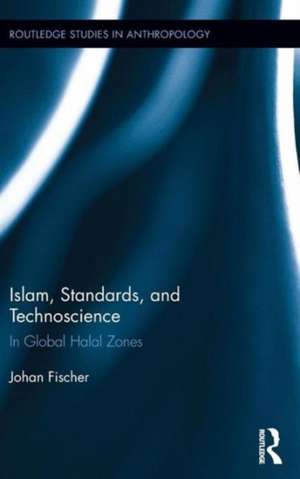
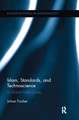
Islam, Standards, and Technoscience: In Global Halal Zones: Routledge Studies in Anthropology
Autor Johan Fischeren Limba Engleză Hardback – 11 dec 2015
| Toate formatele și edițiile | Preț | Express |
|---|---|---|
| Paperback (1) | 432.59 lei 6-8 săpt. | |
| Taylor & Francis – 24 mai 2017 | 432.59 lei 6-8 săpt. | |
| Hardback (1) | 1118.84 lei 6-8 săpt. | |
| Taylor & Francis – 11 dec 2015 | 1118.84 lei 6-8 săpt. |
Din seria Routledge Studies in Anthropology
-
 Preț: 376.91 lei
 -
 Preț: 336.02 lei
 -
 Preț: 335.20 lei
 -
 Preț: 335.97 lei
 -
 Preț: 134.58 lei
 -
 Preț: 368.43 lei
 - 18%
 Preț: 1063.81 lei
 -
 Preț: 370.10 lei
 - 18%
 Preț: 1013.01 lei
 - 15%
 Preț: 416.29 lei
 - 18%
 Preț: 1069.09 lei
 - 34%
 Preț: 788.87 lei
 -
 Preț: 374.34 lei
 - 18%
 Preț: 1065.61 lei
 -
 Preț: 432.59 lei
 -
 Preț: 424.26 lei
 - 18%
 Preț: 1176.61 lei
 - 34%
 Preț: 901.40 lei
 - 34%
 Preț: 786.76 lei
 -
 Preț: 429.14 lei
 - 34%
 Preț: 842.88 lei
 -
 Preț: 431.01 lei
 -
 Preț: 352.15 lei
 - 18%
 Preț: 1118.40 lei
 - 15%
 Preț: 411.58 lei
 - 18%
 Preț: 1069.85 lei
 -
 Preț: 374.91 lei
 - 18%
 Preț: 1069.09 lei
 - 18%
 Preț: 1064.25 lei
 - 18%
 Preț: 1119.14 lei
 - 34%
 Preț: 874.03 lei
 - 18%
 Preț: 1066.82 lei
 - 15%
 Preț: 413.93 lei
 - 34%
 Preț: 843.29 lei
 - 34%
 Preț: 786.36 lei
 - 18%
 Preț: 1013.77 lei
 - 18%
 Preț: 1012.83 lei
 - 18%
 Preț: 1117.64 lei
 - 18%
 Preț: 1068.65 lei
 - 18%
 Preț: 1066.82 lei
Preț: 1118.84 lei
Preț vechi: 1364.43 lei
-18% Nou
Puncte Express: 1678
Preț estimativ în valută:
197.99€ • 232.16$ • 173.87£
197.99€ • 232.16$ • 173.87£
Carte tipărită la comandă
Livrare economică 09-23 februarie 26
Preluare comenzi: 021 569.72.76
Specificații
ISBN-13: 9781138954182
ISBN-10: 1138954187
Pagini: 224
Ilustrații: 18 black & white illustrations, 18 black & white halftones
Dimensiuni: 152 x 229 x 17 mm
Greutate: 0.47 kg
Ediția:1
Editura: Taylor & Francis
Colecția Routledge
Seria Routledge Studies in Anthropology
Locul publicării:Oxford, United Kingdom
ISBN-10: 1138954187
Pagini: 224
Ilustrații: 18 black & white illustrations, 18 black & white halftones
Dimensiuni: 152 x 229 x 17 mm
Greutate: 0.47 kg
Ediția:1
Editura: Taylor & Francis
Colecția Routledge
Seria Routledge Studies in Anthropology
Locul publicării:Oxford, United Kingdom
V-ar putea interesa
-
 -5%Preț: 289.25 lei304.16 lei
 -
 Preț: 191.67 lei
 -
 -43%Preț: 67.82 lei119.08 lei
 -
 Preț: 450.54 lei
 -
 -15%Preț: 417.36 lei491.01 lei
 -
 The Islamic WorldAndrew Rippin-15%Preț: 438.75 lei516.17 lei
 -
 -15%Preț: 413.93 lei486.98 lei
 -
 Preț: 444.04 lei
 -
 The Anthropology of Islam ReaderJens Kreinath-30%Preț: 369.70 lei528.29 lei
 -
 -5%Preț: 1122.63 lei1181.72 lei
 -
 Islamic Branding and MarketingPaul TemporalPreț: 315.76 lei
 -
 The Princeton Encyclopedia of Islamic Political ThoughtGerhard Bowering-23%Preț: 681.14 lei884.60 lei
 -
 Destiny DisruptedTamim Ansary-27%Preț: 93.70 lei129.03 lei
 -
 40 HadithsAli Budak-18%Preț: 59.02 lei71.54 lei
 -
 Visibly Muslim: Fashion, Politics, FaithEmma Tarlo-15%Preț: 228.64 lei267.45 lei
Public țintă
Postgraduate and UndergraduateCuprins
Introduction: Halal Between Islam, Standards, and Technoscience 1. In the Halal Zones of Malaysia and Singapore 2. Global Halal Networks 3. Halal Training 4. In the Halal Lab 5. Halal Activism 6. Manufacturing Companies 7. Shops and Restaurants. Conclusion.
Recenzii
"Although unfamiliar to non-Muslim publics, the Islamic classification of goods and actions into the categories of ‘lawful’ and ‘forbidden’ has in recent years become a religious and techno-scientific industry in its own right. In this fascinating and original work, Johan Fischer explores the politics, ethics, and technoscience of halal certification in Southeast Asia and Europe. The account tells us much about the emergent interface of science, authority, and ethics in the contemporary Muslim world. This is a thoughtful and thought-provoking study."
- Robert W. Hefner, Director, Institute on Culture, Religion, and World Affairs, Boston University
"Johan Fischer’s latest book provides an engaging, sophisticated, and deeply nuanced account of the intersection of Islamic technoscience, state power, and globalizing religious and economic development in Malaysia, Singapore, London, and beyond. Clearly written and well argued, this multi-sited ethnography simultaneously offers incisive perspectives on Islamization, class formation, audit regimes and their proliferation, and the sacralization of commodities produced for global religious markets. It will be welcomed by specialists across a number of different academic disciplines and also has great potential for use in the classroom."
- Michael G. Peletz, Emory University
"In fascinating ethnographic detail Johan Fischer shows the entanglement of the religious notion of halal with scientific technologies for certification in Malaysia and Singapore. The book demonstrates how halal is a marker of Muslim distinctiveness, but nevertheless as a globalized commodity cannot escape secular audit standards. This is a must read for any interested in the intersection of Islam and the global economy."
- Peter van der Veer, Max Planck Institute for the Study of Religious and Ethnic Diversity, author of the Modern Spirit of Asia
- Robert W. Hefner, Director, Institute on Culture, Religion, and World Affairs, Boston University
"Johan Fischer’s latest book provides an engaging, sophisticated, and deeply nuanced account of the intersection of Islamic technoscience, state power, and globalizing religious and economic development in Malaysia, Singapore, London, and beyond. Clearly written and well argued, this multi-sited ethnography simultaneously offers incisive perspectives on Islamization, class formation, audit regimes and their proliferation, and the sacralization of commodities produced for global religious markets. It will be welcomed by specialists across a number of different academic disciplines and also has great potential for use in the classroom."
- Michael G. Peletz, Emory University
"In fascinating ethnographic detail Johan Fischer shows the entanglement of the religious notion of halal with scientific technologies for certification in Malaysia and Singapore. The book demonstrates how halal is a marker of Muslim distinctiveness, but nevertheless as a globalized commodity cannot escape secular audit standards. This is a must read for any interested in the intersection of Islam and the global economy."
- Peter van der Veer, Max Planck Institute for the Study of Religious and Ethnic Diversity, author of the Modern Spirit of Asia
Descriere
Halal production, trade, and standards have become essential to state-regulated Islam and to companies in Malaysia and Singapore, giving these two countries a special position in the expanding global market for halal products: they are the only nations where state bodies certify halal products as well as spaces and work processes, and so consumers can find state halal-certified products from Malaysia and Singapore in shops around the world. This book provides an exploration of the role of halal production, trade, and regulation, explaining how the global markets for halal comprise divergent zones in which Islam, markets, regulatory institutions, and technoscience interact and diverge.