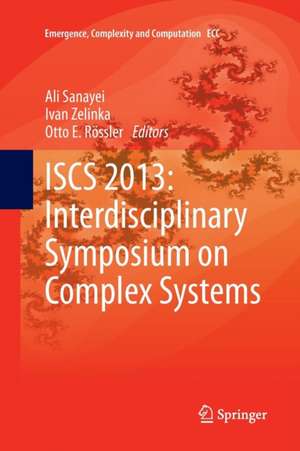
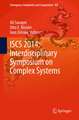
ISCS 2013: Interdisciplinary Symposium on Complex Systems: Emergence, Complexity and Computation, cartea 8
Editat de Ali Sanayei, Otto E. Rössler, Ivan Zelinkaen Limba Engleză Paperback – 3 sep 2016
Din seria Emergence, Complexity and Computation
- 18%
 Preț: 1137.78 lei
 - 18%
 Preț: 951.01 lei
 - 20%
 Preț: 655.84 lei
 - 47%
 Preț: 566.73 lei
 - 15%
 Preț: 631.76 lei
 - 15%
 Preț: 626.44 lei
 - 15%
 Preț: 629.28 lei
 - 20%
 Preț: 944.85 lei
 -
 Preț: 394.52 lei
 - 15%
 Preț: 650.48 lei
 - 15%
 Preț: 674.16 lei
 - 15%
 Preț: 647.94 lei
 - 15%
 Preț: 628.90 lei
 - 8%
 Preț: 399.82 lei
 - 18%
 Preț: 1375.71 lei
 - 20%
 Preț: 1268.80 lei
 - 20%
 Preț: 1260.29 lei
 - 20%
 Preț: 658.40 lei
 - 15%
 Preț: 626.84 lei
 - 18%
 Preț: 957.61 lei
 - 20%
 Preț: 635.10 lei
 - 18%
 Preț: 1121.21 lei
 - 20%
 Preț: 996.98 lei
 - 15%
 Preț: 631.40 lei
 - 20%
 Preț: 627.48 lei
 - 15%
 Preț: 632.77 lei
 - 20%
 Preț: 639.20 lei
Preț: 654.93 lei
Preț vechi: 818.67 lei
-20%
Puncte Express: 982
Carte tipărită la comandă
Livrare economică 17-31 octombrie
Livrare prin curier în România Termenul estimat este afișat lângă disponibilitate.
Transport gratuit pentru acest produs Plată online sau ramburs, în funcție de opțiunile comenzii.
Retur gratuit în 14 zile Comandă securizată și suport în română.
Specificații
ISBN-13: 9783662521939
ISBN-10: 3662521938
Pagini: 412
Ilustrații: X, 400 p. 158 illus., 108 illus. in color.
Dimensiuni: 155 x 235 x 23 mm
Greutate: 0.62 kg
Ediția:Softcover reprint of the original 1st edition 2014
Editura: Springer Berlin, Heidelberg
Colecția Emergence, Complexity and Computation
Seria Emergence, Complexity and Computation
Locul publicării:Berlin, Heidelberg, Germany
ISBN-10: 3662521938
Pagini: 412
Ilustrații: X, 400 p. 158 illus., 108 illus. in color.
Dimensiuni: 155 x 235 x 23 mm
Greutate: 0.62 kg
Ediția:Softcover reprint of the original 1st edition 2014
Editura: Springer Berlin, Heidelberg
Colecția Emergence, Complexity and Computation
Seria Emergence, Complexity and Computation
Locul publicării:Berlin, Heidelberg, Germany
V-ar putea interesa
-
 The Designer's Guide to VHDLPeter J. Ashenden-34%Preț: 372.13 lei566.47 lei
 -
 Deep SimplicityJohn GribbinPreț: 91.21 lei
 -
 The Computer and the BrainJohn Von NeumannPreț: 111.06 lei
 -
 Introduction to Systems TheoryNiklas LuhmannPreț: 166.73 lei
 -
 Perturbation Analysis of Optimization ProblemsJ.Frederic Bonnans-18%Preț: 1341.26 lei1635.67 lei
 -
 Stochastic Networked Control SystemsSerdar Yüksel-18%Preț: 964.55 lei1176.28 lei
 -
 Stochastic Networked Control SystemsSerdar Yüksel-18%Preț: 909.87 lei1109.60 lei
 -
 -18%Preț: 918.59 lei1120.23 lei
 -
 Modeling and Control of Discrete-Event Dynamic SystemsBranislav Hrúz-15%Preț: 471.15 lei554.30 lei
 -
 Introducing ChaosIwona AbramsPreț: 63.55 lei
 -
 Model-Based Control of Networked SystemsEloy Garcia-15%Preț: 654.93 lei770.51 lei
 -
 Introduction to Time-Delay Systems: Analysis and ControlEmilia Fridman-46%Preț: 513.77 lei945.44 lei
Cuprins
A. Complex Systems Science .- B. Systemic Modeling.-
C. Systemic Networking .-
D. Complex Systems Science Applications .
A. Complex Systems Science .- B. Systemic Modeling.-
C. Systemic Networking .-
D. Complex Systems Science Applications .
C. Systemic Networking .-
D. Complex Systems Science Applications .
D. Complex Systems Science Applications .
C. Systemic Networking .-
D. Complex Systems Science Applications .
A. Complex Systems Science .- B. Systemic Modeling.-
C. Systemic Networking .-
D. Complex Systems Science Applications .
C. Systemic Networking .-
D. Complex Systems Science Applications .
D. Complex Systems Science Applications .
Textul de pe ultima copertă
The book you hold in your hands is the outcome of the "ISCS 2013: Interdisciplinary Symposium on Complex Systems" held at the historical capital of Bohemia as a continuation of our series of symposia in the science of complex systems. Prague, one of the most beautiful European cities, has its own beautiful genius loci. Here, a great number of important discoveries were made and many important scientists spent fruitful and creative years to leave unforgettable traces. The perhaps most significant period was the time of Rudolf II who was a great supporter of the art and the science and attracted a great number of prominent minds to Prague. This trend would continue. Tycho Brahe, Niels Henrik Abel, Johannes Kepler, Bernard Bolzano, August Cauchy Christian Doppler, Ernst Mach, Albert Einstein and many others followed developing fundamental mathematical and physical theories or expanding them. Thus in the beginning of the 17th century, Kepler formulated here the first two of his three laws of planetary motion on the basis of Tycho Brahe’s observations. In the 19th century, nowhere differentiable continuous functions (of a fractal character) were constructed here by Bolzano along with a treatise on infinite sets, titled “Paradoxes of Infinity” (1851). Weierstrass would later publish a similar function in 1872. In 1842, Doppler as a professor of mathematics at the Technical University of Prague here first lectured about a physical effect to bear his name later. And the epoch-making physicist Albert Einstein – while being a chaired professor of theoretical physics at the German University of Prague – arrived at the decisive steps of his later finished theory of general relativity during the years 1911–1912. In Prague, also many famous philosophers and writers accomplished their works; for instance, playwright arel ape coined the word "robot" in Prague (“robot” comes from the Czech word “robota” which means “forced labor”).
Caracteristici
Introduction to recent research in ISCS 2013: Interdisciplinary Symposium on Complex Systems Special focus on control of different types of complex systems and emergence of complex networks in dynamics of computer algorithms Written by leading experts in the field Includes supplementary material: sn.pub/extras