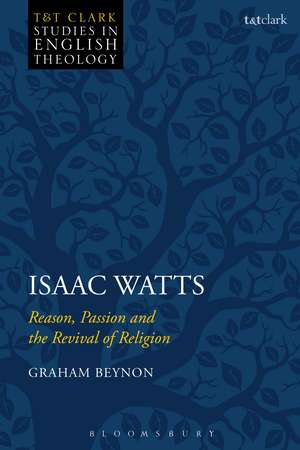
Isaac Watts: Reason, Passion and the Revival of Religion: T&T Clark Studies in English Theology
Autor Dr Graham Beynonen Limba Engleză Hardback – 20 oct 2016
Graham Beynon examines the motivation for Watts' work in writing hymns, and the way in which he wrote them; and discusses his preaching and prayer. In each of these practical topics Watts's position is compared to earlier Puritans to show the difference his thinking on reason and passion makes in practice. Isaac Watts is shown to have a coherent position on the foundational issues of reason and passion which drove his view of revival of religion.
Din seria T&T Clark Studies in English Theology
- 14%
 Preț: 522.57 lei
 - 25%
 Preț: 256.05 lei
 - 16%
 Preț: 255.03 lei
 - 16%
 Preț: 244.87 lei
 - 27%
 Preț: 235.86 lei
 - 26%
 Preț: 215.85 lei
 - 23%
 Preț: 238.85 lei
 - 25%
 Preț: 211.07 lei
 - 28%
 Preț: 212.15 lei
 - 25%
 Preț: 213.24 lei
 - 29%
 Preț: 204.44 lei
 - 26%
 Preț: 207.19 lei
 - 30%
 Preț: 503.92 lei
 - 25%
 Preț: 209.73 lei
 - 27%
 Preț: 203.26 lei
 - 26%
 Preț: 206.07 lei
Preț: 898.31 lei
Preț vechi: 1337.12 lei
-33%
Puncte Express: 1347
Carte tipărită la comandă
Livrare economică 30 noiembrie-14 decembrie
Livrare prin curier în România Termenul estimat este afișat lângă disponibilitate.
Transport gratuit pentru acest produs Plată online sau ramburs, în funcție de opțiunile comenzii.
Retur gratuit în 14 zile Comandă securizată și suport în română.
Specificații
ISBN-13: 9780567670137
ISBN-10: 0567670139
Pagini: 224
Dimensiuni: 156 x 234 x 23 mm
Greutate: 0.48 kg
Editura: Bloomsbury Publishing
Colecția T&T Clark
Seria T&T Clark Studies in English Theology
Locul publicării:London, United Kingdom
ISBN-10: 0567670139
Pagini: 224
Dimensiuni: 156 x 234 x 23 mm
Greutate: 0.48 kg
Editura: Bloomsbury Publishing
Colecția T&T Clark
Seria T&T Clark Studies in English Theology
Locul publicării:London, United Kingdom
V-ar putea interesa
-
 -21%Preț: 374.03 lei474.20 lei
 -
 Preț: 117.80 lei
 -
 Simple TruthsFulton SheenPreț: 86.52 lei
 -
 The Glories of MaryAlphonsus LiguoriPreț: 150.70 lei
 -
 God and Contemporary SciencePhilip ClaytonPreț: 185.23 lei
 -
 EschatologyJoseph RatzingerPreț: 115.38 lei
 -
 Pocket Handbook of Christian ApologeticsPeter KreeftPreț: 96.24 lei
 -
 A Ready Defense: The Best of Josh McDowellJosh McDowellPreț: 168.33 lei
 -
 HeavenRandy AlcornPreț: 179.43 lei
 -
 -8%Preț: 604.37 lei656.93 lei
 -
 Fifty Reasons Why Jesus Came to DieJohn PiperPreț: 64.06 lei
 -
 Postmodernism 101Heath WhitePreț: 133.38 lei
 -
 How Good Is Good Enough?Andy StanleyPreț: 70.32 lei
 -
 Skeletons of a Course of Theological Lectures.Charles Grandison FinneyPreț: 190.64 lei
 -
 Skeletons of a Course of Theological Lectures.Charles G. FinneyPreț: 121.27 lei
Cuprins
Introduction
Part 1: Reason and Passion
Chapter 1: The Role of Reason
Chapter 2: The Place of Passion
Chapter 3: The Art of Preaching
Part 2: The Revival of Religion
Chapter 3: The Art of Preaching
Chapter 4: The Need for Praise
Chapter 5: The Method of Prayer
Conclusion
Bibliography
Index
Part 1: Reason and Passion
Chapter 1: The Role of Reason
Chapter 2: The Place of Passion
Chapter 3: The Art of Preaching
Part 2: The Revival of Religion
Chapter 3: The Art of Preaching
Chapter 4: The Need for Praise
Chapter 5: The Method of Prayer
Conclusion
Bibliography
Index
Recenzii
Beynon has produced an erudite, brilliant investigation into the work of Watts.
Isaac Watts the Dissenting hymnwriter was also an eighteenth-century intellectual who exerted a powerful influence over several generations through his extensive writings. His achievement, as Graham Beynon shows, was to build on his Puritan inheritance by engaging with contemporary thought so as to lay the foundations for the reformation of religion. In many ways he anticipated the concerns of the Evangelical Revival that took off in his later years.
Reason and passion and the relationship between them are key themes in the early eighteenth century. Graham Beynon has made a significant contribution in this area with this volume on reason and passion in the works of Isaac Watts. Beynon examines Watts's approach to reason and passion and the interconnections between those subjects and preaching, worship and prayer. His study makes a significant contribution to the understanding of English Dissent in the first part of the 18th century.
The theologian and hymn-writer Isaac Watts was one of the major shapers of eighteenth-century evangelicalism, yet he has received far less scrutiny than the Wesleys or Jonathan Edwards. Graham Beynon's book joins other recent studies by Isabel Rivers and Tessa Whitehouse in turning the spotlight onto Watts. He reveals a serious and consistent thinker, one who found a place for religious passion within the context of England's Protestant Enlightenment. What makes the book particularly useful is its judicious assessment of how Watts perpetuated and modified the Puritan tradition.
The strength of this book is that it takes Isaac Watts seriously as a thinker. As such, it will be particularly useful for scholars who wish to better understand Watts' views of reason and passion, and to see how these positions informed his approach to preaching, praise and prayer.
Isaac Watts the Dissenting hymnwriter was also an eighteenth-century intellectual who exerted a powerful influence over several generations through his extensive writings. His achievement, as Graham Beynon shows, was to build on his Puritan inheritance by engaging with contemporary thought so as to lay the foundations for the reformation of religion. In many ways he anticipated the concerns of the Evangelical Revival that took off in his later years.
Reason and passion and the relationship between them are key themes in the early eighteenth century. Graham Beynon has made a significant contribution in this area with this volume on reason and passion in the works of Isaac Watts. Beynon examines Watts's approach to reason and passion and the interconnections between those subjects and preaching, worship and prayer. His study makes a significant contribution to the understanding of English Dissent in the first part of the 18th century.
The theologian and hymn-writer Isaac Watts was one of the major shapers of eighteenth-century evangelicalism, yet he has received far less scrutiny than the Wesleys or Jonathan Edwards. Graham Beynon's book joins other recent studies by Isabel Rivers and Tessa Whitehouse in turning the spotlight onto Watts. He reveals a serious and consistent thinker, one who found a place for religious passion within the context of England's Protestant Enlightenment. What makes the book particularly useful is its judicious assessment of how Watts perpetuated and modified the Puritan tradition.
The strength of this book is that it takes Isaac Watts seriously as a thinker. As such, it will be particularly useful for scholars who wish to better understand Watts' views of reason and passion, and to see how these positions informed his approach to preaching, praise and prayer.