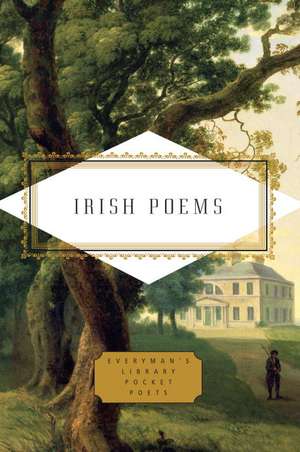
Irish Poems: Borzoi Books
Editat de Matthew McGuireen Limba Engleză Hardback – 31 ian 2011
From the romantic ballad to the rebel song, from devotional Christian verse to revivals of ancient Celtic myth, poetry has long been Ireland’s most eloquent response to its turbulent and colorful history. Irish Poems gives us a dazzling selection from a long and distinguished poetic tradition, ranging from the earliest Gaelic bards up to the present. Organized around such themes as politics, religion, Gaelic culture, the Irish landscape, and matters of the heart, the poems collected here come from a wide range of writers old and new, including such literary giants as Jonathan Swift, Oliver Goldsmith, Oscar Wilde, W. B. Yeats, J. M. Synge, Samuel Beckett, Louis MacNeice, Patrick Kavanagh, Paul Muldoon, Evan Boland, Seamus Heaney, and many more.
Preț: 108.88 lei
Puncte Express: 163
Carte disponibilă
Livrare economică 16-30 noiembrie
Livrare prin curier în România Termenul estimat este afișat lângă disponibilitate.
Transport gratuit de la 400.00 lei Plată online sau ramburs, în funcție de opțiunile comenzii.
Retur gratuit în 14 zile Comandă securizată și suport în română.
Specificații
ISBN-13: 9780307594983
ISBN-10: 030759498X
Pagini: 240
Dimensiuni: 108 x 168 x 19 mm
Greutate: 0.22 kg
Editura: Everyman's Library
Seria Borzoi Books
ISBN-10: 030759498X
Pagini: 240
Dimensiuni: 108 x 168 x 19 mm
Greutate: 0.22 kg
Editura: Everyman's Library
Seria Borzoi Books
V-ar putea interesa
-
 Stay, Illusion: PoemsLucie Brock-BroidoPreț: 100.28 lei
 -
 This BlueMaureen N. McLanePreț: 94.97 lei
 -
 The Road to Emmaus: PoemsSpencer ReecePreț: 92.17 lei
 -
 Plath: PoemsDiane Wood MiddlebrookPreț: 109.29 lei
 -
 Love Speaks Its NameJ. D. McClatchyPreț: 109.10 lei
 -
 Dickinson: PoemsPeter WashingtonPreț: 109.29 lei
 -
 Auden: PoemsW. H. AudenPreț: 99.35 lei
 -
 Rilke: PoemsRainer Maria RilkePreț: 109.10 lei
 -
 Night Train Red DustSheila PackaPreț: 78.38 lei
 -
 Not All HoneyRoddy Lumsden-20%Preț: 54.39 lei68.31 lei
 -
 Dreamland TheatreRob BuddePreț: 75.08 lei
Notă biografică
Matthew McGuire was born in Belfast and is a lecturer at the University of Glasgow. He has published widely on both Irish and Scottish literature.
Extras
From the Preface by Matthew McGuire
Out of the argument with others we make rhetoric; out of the argument with ourselves we make poetry. So said Ireland's most famous poet, W. B. Yeats. And it is poetry, rather than prose, that is seen as providing the most sustained and meaningful response to Ireland's turbulent history. From the romantic ballad to the rebel song, Irish poetry has been 'involved', to borrow a local euphemism, in mediating and mitigating histories of loyalty and loss. For some Irish writers poetry has been a place of self-reflection and self-doubt, a moment of quietude amid the deafening roar of partisan politics and all its bloody consequences. Argument, altercation, accommodation; the leitmotifs of many of the poems gathered in this volume. Over this aspect of Irish poetry preside the towering figures of William Butler Yeats and Seamus Heaney. Their most famous work emerged in response to the collapse of Irish society, Yeats during the aftermath of the 1916 Rising and Heaney during the outbreak of the Northern Irish Troubles in 1969. Ironically, if civil war made civil hands unclean, it also unearthed a fertile ground for the poetic imagination. Under the heading of 'Political Matters' this book features attempts by Yeats, Heaney and others to interrogate the past, realize the present, and realign the co-ordinates of Ireland's future.
Dating back over fourteen hundred years, Irish poetry has its roots in two traditions: the devotional verse of the early Christian church and the long lyric poem of the bard, or seanchaidhe, the carrier of communal memory. Religion has always been part of Ireland's historical and cultural makeup, both a blessing and a curse, the pathway to another world and an obstacle on the road to renewal. Under the aegis of 'Religious Matters' this book features a number of attempts, both ancient and modern, to map the landscape of Ireland's theological inheritance.
'Gaelic Matters' turns its attention to that other vital source of Irish poetry, the Irish language. Up until the eighteenth century Irish poetry was primarily a Gaelic affair. The deep well of Gaelic culture, its steady decline and the catastrophic effects of the Irish famine all feature in this volume. There is an extract from Brian Merriman's eighteenth-century epic, The Midnight Court. The high point of modern Gaelic poetry, it is an epic masterpiece, deeply wrought and darkly comic. The book also features the interest in ancient Celtic myth, including the stories of Cuchulain and Deirdre, by various Anglo-Irish writers, not least W. B. Yeats himself.
One might be forgiven for thinking that Irish poetry is on long meditation in a time of civil war. The remaining sections of the book offer a welcome antidote to such mistaken notions. 'Place Matters' includes a diverse set of responses to the experience of the various Irish landscapes, both rural and urban. It explores what it means to come from, and reside in, a particular place. 'Experience Matters' charts the ways in which Irish writers, from the eighteenth century to the present day, deploy the rigours of poetic form to illuminate and transform the everyday world. 'Love Matters' concludes this selection, recording an array of Irish responses to what is the most popular and recurrent theme in the whole of poetry.
Out of the argument with others we make rhetoric; out of the argument with ourselves we make poetry. So said Ireland's most famous poet, W. B. Yeats. And it is poetry, rather than prose, that is seen as providing the most sustained and meaningful response to Ireland's turbulent history. From the romantic ballad to the rebel song, Irish poetry has been 'involved', to borrow a local euphemism, in mediating and mitigating histories of loyalty and loss. For some Irish writers poetry has been a place of self-reflection and self-doubt, a moment of quietude amid the deafening roar of partisan politics and all its bloody consequences. Argument, altercation, accommodation; the leitmotifs of many of the poems gathered in this volume. Over this aspect of Irish poetry preside the towering figures of William Butler Yeats and Seamus Heaney. Their most famous work emerged in response to the collapse of Irish society, Yeats during the aftermath of the 1916 Rising and Heaney during the outbreak of the Northern Irish Troubles in 1969. Ironically, if civil war made civil hands unclean, it also unearthed a fertile ground for the poetic imagination. Under the heading of 'Political Matters' this book features attempts by Yeats, Heaney and others to interrogate the past, realize the present, and realign the co-ordinates of Ireland's future.
Dating back over fourteen hundred years, Irish poetry has its roots in two traditions: the devotional verse of the early Christian church and the long lyric poem of the bard, or seanchaidhe, the carrier of communal memory. Religion has always been part of Ireland's historical and cultural makeup, both a blessing and a curse, the pathway to another world and an obstacle on the road to renewal. Under the aegis of 'Religious Matters' this book features a number of attempts, both ancient and modern, to map the landscape of Ireland's theological inheritance.
'Gaelic Matters' turns its attention to that other vital source of Irish poetry, the Irish language. Up until the eighteenth century Irish poetry was primarily a Gaelic affair. The deep well of Gaelic culture, its steady decline and the catastrophic effects of the Irish famine all feature in this volume. There is an extract from Brian Merriman's eighteenth-century epic, The Midnight Court. The high point of modern Gaelic poetry, it is an epic masterpiece, deeply wrought and darkly comic. The book also features the interest in ancient Celtic myth, including the stories of Cuchulain and Deirdre, by various Anglo-Irish writers, not least W. B. Yeats himself.
One might be forgiven for thinking that Irish poetry is on long meditation in a time of civil war. The remaining sections of the book offer a welcome antidote to such mistaken notions. 'Place Matters' includes a diverse set of responses to the experience of the various Irish landscapes, both rural and urban. It explores what it means to come from, and reside in, a particular place. 'Experience Matters' charts the ways in which Irish writers, from the eighteenth century to the present day, deploy the rigours of poetic form to illuminate and transform the everyday world. 'Love Matters' concludes this selection, recording an array of Irish responses to what is the most popular and recurrent theme in the whole of poetry.
Cuprins
RELIGIOUS MATTERS
St Columbanus A Boat Song
Anon. Monastic Poem
Anon. Hermit’s Song
Anon. Saint Patrick’s Breastplate
Austin Clarke Penal Law
Denis Devlin Ank’hor Vat
W. R. Rodgers Lent
Tom Paulin Desertmartin
Peter Fallon The Herd
John Hewitt from Freehold: from The Lonely Heart
GAELIC MATTERS
Fear Flatha Ó Gnimh from The Passing of the Poets
Mathghamlain Ó Hifearnáin My Son, Forsake Your Art
Dàibhí Ó Bruadair For the Family of Cúchonnacht Ó Dálaigh
Aogán Ó Rathaille The Brightest of the Bright
Brian Merriman from The Midnight Court
Antoine Raifterirí ‘I am Raifeirí, the poet’
Sir Samuel Ferguson Deirdre’s Lament for the Sons of Usnach
William Allingham The Fairies
W. B. Yeats Cuchulain’s Fight with the Sea
Seàn Ó Ríordáin Claustrophobia
Nuala Ní Dhomhnaill Miraculous Grass
POLITICAL MATTERS
Fearghal Óg MacWard from The Flight of the Earls, 1607
Anon. The Croppy Boy
Anon. The Shan Van Vocht
Anon. The Orange Lily
James Clarence Mangan Kathaleen Ny-Houlahan
Thomas Davis Lament for the Death of Eoghan Ruadh O’Neill
Thomas Davis A Nation Once Again
Robert Dwyer Joyce The Wind that Shakes the Barley
W. B. Yeats September 1913
W. B. Yeats The Wild Swans at Coole
Seamus Heaney Requiem for the Croppies
Seamus Heaney Punishment
Seamus Heaney from Whatever You Say Say Nothing
Seamus Heaney from The Cure at Troy
Derek Mahon A Disused Shed in Co. Wexford
Eiléan Ní Chuilleanàn Deaths and Engines
Paul Muldoon Lunch with Pancho Villa
Paul Muldoon Anseo
Paul Muldoon Cuba
Alan Gillis Progress
Macdara Woods Seconds Out
PLACE MATTERS
Jonathan Swift Holyhead. Sept. 25, 1727
Oliver Goldsmith from The Deserted Village
Thomas Moore ‘Dear Harp of my Country!’
W. B. Yeats The Lake Isle of Innisfree
Patrick Kavanagh Epic
Louis MacNeice Belfast
Louis MacNeice Dublin
Peter St John The Fields of Athenry
Seamus Heaney Anahorish
Michael Longley The Linen Industry
Derek Mahon Glengormley
Thomas McCarthy The Standing Trains
Ciaran Carson Belfast Confetti
EXPERIENCE MATTERS
Samuel Thompson To a Hedgehog
James Orr from The Irish Cottier’s Death and Burial
Thomas Moore ‘’Tis the last rose of summer’
James Clarence Mangan Dark Rosaleen
James Clarence Mangan The Nameless One
James Clarence Mangan Good Counsel
Oscar Wilde from The Ballad of Reading Gaol
Francis Ledwidge June
W. B. Yeats The Stolen Child
W. B. Yeats Down by the Salley Gardens
W. B. Yeats To a Wealthy Man Who Promised a Second
Subscription to the Dublin Municipal Gallery if It
were Proved the People Wanted Pictures
W. B. Yeats An Irish Airman Forsees His Death
W. B. Yeats The Second Coming
W. B. Yeats Sailing to Byzantium
James Joyce Ecce Puer
Patrick Kavanagh Memory of My Father
Patrick Kavanagh Prelude
Samuel Beckett Gnome
Thomas Kinsella Chrysalides
John Montague ‘Like dolmens round my childhood, the old people’
John Montague 11 rue Daguerre
Michael Hartnet There Will be a Talking
Richard Murphy Seals at High Island
Louis MacNeice Snow
Louis MacNeice Wolves
Michael Longley In Memoriam
Seamus Heaney Mid-Term Break
Seamus Heaney from Clearances
Seamus Heaney The Underground
Eiléan Ní Chuilleanàn London
Eiléan Ní Chuilleanàn So She Looked, in that Company
Eavan Boland In Her Own Image
Eavan Boland Night Feed
Eavan Boland Nocturne
Ciaran Carson Turn Again
Ciaran Carson The Exiles’ Club
Medbh McGuckian The ‘Singer’
Medbh McGuckian The Flower Master
Medbh McGuckian The Sitting
Paul Muldoon Quoof
Paul Muldoon Symposium
Colette Bryce The Full Indian Rope Trick
Alan Gillis The Ulster Way
Nick Laird Poetry
LOVE MATTERS
J. M. Synge ‘Is it a month’
W. B. Yeats He Wishes for the Cloths of Heaven
W. B. Yeats No Second Troy
Padraic Colum She Moved Through the Fair
Patrick Kavanagh On Raglan Road
James Simmons The Archaeologist
Paul Durcan The Haulier’s Wife Meets Jesus on the Road Near Moone
Louis MacNeice Mayfly
Medbh McGuckian On Not Being Your Lover
Sinead Morrissey & Forgive Us Our Trespasses
Leontia Flynn Come Live with Me
Index of First Lines
Acknowledgments
St Columbanus A Boat Song
Anon. Monastic Poem
Anon. Hermit’s Song
Anon. Saint Patrick’s Breastplate
Austin Clarke Penal Law
Denis Devlin Ank’hor Vat
W. R. Rodgers Lent
Tom Paulin Desertmartin
Peter Fallon The Herd
John Hewitt from Freehold: from The Lonely Heart
GAELIC MATTERS
Fear Flatha Ó Gnimh from The Passing of the Poets
Mathghamlain Ó Hifearnáin My Son, Forsake Your Art
Dàibhí Ó Bruadair For the Family of Cúchonnacht Ó Dálaigh
Aogán Ó Rathaille The Brightest of the Bright
Brian Merriman from The Midnight Court
Antoine Raifterirí ‘I am Raifeirí, the poet’
Sir Samuel Ferguson Deirdre’s Lament for the Sons of Usnach
William Allingham The Fairies
W. B. Yeats Cuchulain’s Fight with the Sea
Seàn Ó Ríordáin Claustrophobia
Nuala Ní Dhomhnaill Miraculous Grass
POLITICAL MATTERS
Fearghal Óg MacWard from The Flight of the Earls, 1607
Anon. The Croppy Boy
Anon. The Shan Van Vocht
Anon. The Orange Lily
James Clarence Mangan Kathaleen Ny-Houlahan
Thomas Davis Lament for the Death of Eoghan Ruadh O’Neill
Thomas Davis A Nation Once Again
Robert Dwyer Joyce The Wind that Shakes the Barley
W. B. Yeats September 1913
W. B. Yeats The Wild Swans at Coole
Seamus Heaney Requiem for the Croppies
Seamus Heaney Punishment
Seamus Heaney from Whatever You Say Say Nothing
Seamus Heaney from The Cure at Troy
Derek Mahon A Disused Shed in Co. Wexford
Eiléan Ní Chuilleanàn Deaths and Engines
Paul Muldoon Lunch with Pancho Villa
Paul Muldoon Anseo
Paul Muldoon Cuba
Alan Gillis Progress
Macdara Woods Seconds Out
PLACE MATTERS
Jonathan Swift Holyhead. Sept. 25, 1727
Oliver Goldsmith from The Deserted Village
Thomas Moore ‘Dear Harp of my Country!’
W. B. Yeats The Lake Isle of Innisfree
Patrick Kavanagh Epic
Louis MacNeice Belfast
Louis MacNeice Dublin
Peter St John The Fields of Athenry
Seamus Heaney Anahorish
Michael Longley The Linen Industry
Derek Mahon Glengormley
Thomas McCarthy The Standing Trains
Ciaran Carson Belfast Confetti
EXPERIENCE MATTERS
Samuel Thompson To a Hedgehog
James Orr from The Irish Cottier’s Death and Burial
Thomas Moore ‘’Tis the last rose of summer’
James Clarence Mangan Dark Rosaleen
James Clarence Mangan The Nameless One
James Clarence Mangan Good Counsel
Oscar Wilde from The Ballad of Reading Gaol
Francis Ledwidge June
W. B. Yeats The Stolen Child
W. B. Yeats Down by the Salley Gardens
W. B. Yeats To a Wealthy Man Who Promised a Second
Subscription to the Dublin Municipal Gallery if It
were Proved the People Wanted Pictures
W. B. Yeats An Irish Airman Forsees His Death
W. B. Yeats The Second Coming
W. B. Yeats Sailing to Byzantium
James Joyce Ecce Puer
Patrick Kavanagh Memory of My Father
Patrick Kavanagh Prelude
Samuel Beckett Gnome
Thomas Kinsella Chrysalides
John Montague ‘Like dolmens round my childhood, the old people’
John Montague 11 rue Daguerre
Michael Hartnet There Will be a Talking
Richard Murphy Seals at High Island
Louis MacNeice Snow
Louis MacNeice Wolves
Michael Longley In Memoriam
Seamus Heaney Mid-Term Break
Seamus Heaney from Clearances
Seamus Heaney The Underground
Eiléan Ní Chuilleanàn London
Eiléan Ní Chuilleanàn So She Looked, in that Company
Eavan Boland In Her Own Image
Eavan Boland Night Feed
Eavan Boland Nocturne
Ciaran Carson Turn Again
Ciaran Carson The Exiles’ Club
Medbh McGuckian The ‘Singer’
Medbh McGuckian The Flower Master
Medbh McGuckian The Sitting
Paul Muldoon Quoof
Paul Muldoon Symposium
Colette Bryce The Full Indian Rope Trick
Alan Gillis The Ulster Way
Nick Laird Poetry
LOVE MATTERS
J. M. Synge ‘Is it a month’
W. B. Yeats He Wishes for the Cloths of Heaven
W. B. Yeats No Second Troy
Padraic Colum She Moved Through the Fair
Patrick Kavanagh On Raglan Road
James Simmons The Archaeologist
Paul Durcan The Haulier’s Wife Meets Jesus on the Road Near Moone
Louis MacNeice Mayfly
Medbh McGuckian On Not Being Your Lover
Sinead Morrissey & Forgive Us Our Trespasses
Leontia Flynn Come Live with Me
Index of First Lines
Acknowledgments