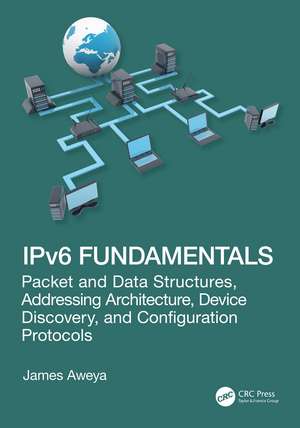
IPv6 Fundamentals: Packet and Data Structures, Addressing Architecture, Device Discovery, and Configuration Protocols
Autor James Aweyaen Limba Engleză Paperback – 10 feb 2026
IPv6 Fundamentals: Packet and Data Structures, Addressing Architecture, Device Discovery, and Configuration Protocols delivers critical knowledge through detailed explanations of IPv6 header and extension formats, addressing architecture, neighbor discovery protocols, and DHCPv6 operations. Readers benefit from comprehensive coverage of mobility mechanisms that enable seamless roaming across networks, along with practical implementation guidance for transitioning from IPv4. This book uniquely bridges theoretical concepts with real-world applications, explaining not just how IPv6 functions work individually, but how they interconnect within the broader network ecosystem between hosts and routers. The author specifically focuses on the technical foundations of IPv6 packet structures and neighbor discovery protocols at a deeper level than existing titles. Finally, this book includes appendices covering Ethernet frame formats, IPv4 packet structures, and various ARP mechanisms, providing valuable context for understanding the evolution from IPv4 to IPv6.
This book is intended for network engineers, IT administrators, system architects, and telecommunications professionals responsible for planning, implementing, and managing network infrastructure. Academic readers, including advanced undergraduate and graduate students in computer networking courses, will appreciate the clear explanations of fundamental concepts.
Preț: 622.87 lei
Preț vechi: 778.58 lei
-20%
Puncte Express: 934
Carte indisponibilă temporar
Livrare prin curier în România Termenul estimat este afișat lângă disponibilitate.
Transport gratuit pentru acest produs Plată online sau ramburs, în funcție de opțiunile comenzii.
Retur gratuit în 14 zile Comandă securizată și suport în română.
Specificații
ISBN-13: 9781041192138
ISBN-10: 1041192134
Pagini: 470
Ilustrații: 331
Dimensiuni: 178 x 254 mm
Greutate: 0.87 kg
Ediția:1
Editura: CRC Press
Colecția CRC Press
ISBN-10: 1041192134
Pagini: 470
Ilustrații: 331
Dimensiuni: 178 x 254 mm
Greutate: 0.87 kg
Ediția:1
Editura: CRC Press
Colecția CRC Press
V-ar putea interesa
-
 Computer Networks: A Systems ApproachLarry L. Peterson-40%Preț: 577.87 lei956.74 lei
 -
 Introduction to Networks Companion Guide (Ccnav7)Cisco Networking Academy-19%Preț: 579.09 lei714.92 lei
 -
 -20%Preț: 450.69 lei563.37 lei
 -
 TCP/IP IllustratedKevin Fall-20%Preț: 403.13 lei503.92 lei
 -
 The Real Internet ArchitecturePamela Zave-20%Preț: 809.96 lei1012.44 lei
 -
 The Real Internet ArchitecturePamela Zave-20%Preț: 230.01 lei287.52 lei
 -
 -20%Preț: 251.02 lei313.77 lei
 -
 -22%Preț: 464.76 lei594.29 lei
 -
 Internetworking with TCP/IP, Volume 1Douglas Comer-13%Preț: 576.39 lei662.51 lei
 -
 Preț: 294.64 lei
 -
 Networking All-In-One for DummiesDoug Lowe-20%Preț: 258.11 lei322.63 lei
 -
 Ipv6 EssentialsSilvia Hagen-20%Preț: 209.08 lei261.35 lei
 -
 -20%Preț: 335.34 lei419.18 lei
 -
 -20%Preț: 447.36 lei559.21 lei
 -
 The TCP/IP GuideCharles M. Kozierok-27%Preț: 502.99 lei686.90 lei
 -
 -36%Preț: 284.35 lei440.95 lei
 -
 The Book of PF, 4th Edition: A No-Nonsense Guide to the OpenBSD FirewallPeter N.M. Hansteen-35%Preț: 282.67 lei437.64 lei
 -
 Computer Networks in Packet Tracer for Intermediate UsersDamian Strojek-20%Preț: 265.31 lei331.65 lei
Public țintă
General, Postgraduate, Professional Practice & Development, and Professional ReferenceNotă biografică
James Aweya, PhD, was recently a Chief Research Scientist at the Etisalat British Telecom Innovation Center, Khalifa University, Abu Dhabi, UAE. Before then, he was a technical lead and senior systems architect with Nortel, Ottawa, Canada, from 1996 to 2009. He was awarded the 2007 Nortel Technology Award of Excellence for his pioneering and innovative research on Timing and Synchronization across Packet and TDM Networks. He has been granted 70 US patents and has published over 54 journal papers, 40 conference papers, and 43 technical reports. He has extensive experience and expertise that cover many aspects of telecoms systems design and networking. He is the sole author of eight recent engineering books, including this book, on telecom systems and networks.
Cuprins
1. Introduction to IPv6 2. IPv6 Packet Format and Related Data Structures 3. IPv6 Addressing Architecture 4. IPv6 Neighbor Discovery, Address Configuration, and IPv6 Routing Table 5. Dynamic Host Configuration Protocol for IPv6 (DHCPv6) 6. Mobile IP: Mobility Mechanisms for IPv4 and IPv6 Appendix A. Ethernet Frame Format Appendix B. IPv4 Packet Format and Addressing Appendix C. Address Resolution Protocol (ARP) for IPv4 Appendix D. Gratuitous ARP for IPv4 Appendix E. Proxy ARP for IPv4 Appendix F. Private VLANs and Port Isolation
Descriere
This book explores the essential concepts and practical implementation of IPv6, the next-generation Internet Protocol designed to address the limitations of IPv4 and support the exponential growth of internet-connected devices.