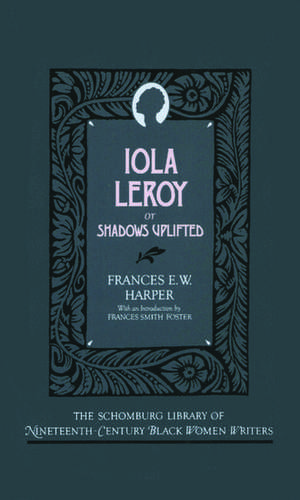
Iola Leroy: Or Shadows Uplifted: The Schomburg Library of Nineteenth-Century Black Women Writers
Autor Frances E. W. Harper Introducere de Frances Smith Fosteren Limba Engleză Paperback – 12 iul 1990
Din seria The Schomburg Library of Nineteenth-Century Black Women Writers
- 31%
 Preț: 528.16 lei
 -
 Preț: 139.34 lei
 - 32%
 Preț: 1068.92 lei
 - 28%
 Preț: 424.40 lei
 - 16%
 Preț: 109.63 lei
 - 28%
 Preț: 507.19 lei
 - 16%
 Preț: 187.37 lei
 - 31%
 Preț: 959.21 lei
 - 29%
 Preț: 475.27 lei
 - 31%
 Preț: 785.82 lei
 - 15%
 Preț: 140.91 lei
 - 31%
 Preț: 527.18 lei
 - 31%
 Preț: 708.75 lei
 - 28%
 Preț: 512.59 lei
 - 29%
 Preț: 461.06 lei
 - 31%
 Preț: 682.53 lei
 - 11%
 Preț: 612.18 lei
 - 29%
 Preț: 449.72 lei
 - 32%
 Preț: 717.47 lei
 - 16%
 Preț: 158.12 lei
 - 15%
 Preț: 184.68 lei
 - 29%
 Preț: 461.16 lei
 - 20%
 Preț: 304.91 lei
 - 17%
 Preț: 168.79 lei
 - 31%
 Preț: 541.03 lei
 - 28%
 Preț: 406.15 lei
 - 31%
 Preț: 543.77 lei
 - 31%
 Preț: 575.01 lei
 - 10%
 Preț: 644.45 lei
 - 31%
 Preț: 690.04 lei
 - 31%
 Preț: 689.87 lei
 - 28%
 Preț: 424.75 lei
 - 31%
 Preț: 546.34 lei
 - 29%
 Preț: 535.04 lei
 - 28%
 Preț: 386.92 lei
 - 31%
 Preț: 773.67 lei
 - 29%
 Preț: 476.23 lei
 - 31%
 Preț: 1123.52 lei
 - 33%
 Preț: 756.47 lei
 - 32%
 Preț: 924.36 lei
 - 16%
 Preț: 182.30 lei
 - 31%
 Preț: 671.88 lei
Preț: 215.40 lei
Preț vechi: 257.44 lei
-16%
Puncte Express: 323
Carte tipărită la comandă
Livrare economică 03-09 decembrie
Livrare prin curier în România Termenul estimat este afișat lângă disponibilitate.
Transport gratuit de la 400.00 lei Plată online sau ramburs, în funcție de opțiunile comenzii.
Retur gratuit în 14 zile Comandă securizată și suport în română.
Specificații
ISBN-13: 9780195063240
ISBN-10: 0195063244
Pagini: 336
Dimensiuni: 140 x 219 x 21 mm
Greutate: 0.42 kg
Editura: Oxford University Press
Colecția OUP USA
Seria The Schomburg Library of Nineteenth-Century Black Women Writers
Locul publicării:New York, United States
ISBN-10: 0195063244
Pagini: 336
Dimensiuni: 140 x 219 x 21 mm
Greutate: 0.42 kg
Editura: Oxford University Press
Colecția OUP USA
Seria The Schomburg Library of Nineteenth-Century Black Women Writers
Locul publicării:New York, United States
V-ar putea interesa
-
 Uncle Tom's CabinHarriet Beecher StowePreț: 28.01 lei
 -
 The Portable Nineteenth-Century African American Women WritersHenry Louis Gates-17%Preț: 102.39 lei124.00 lei
 -
 From Man to Man or Perhaps Only—Olive Schreiner-16%Preț: 68.33 lei81.49 lei
 -
 -21%Preț: 147.29 lei185.47 lei
 -
 -29%Preț: 446.56 lei630.04 lei
 -
 Preț: 45.03 lei
 -
 Their Eyes Were Watching GodZora Neale Hurston-26%Preț: 58.35 lei79.09 lei
 -
 Twelve Years a SlaveSolomon NorthupPreț: 187.39 lei
 -
 The Bondwoman's NarrativeHannah CraftsPreț: 118.38 lei
 -
 Incidents in the Life of a Slave GirlHarriet Jacobs-32%Preț: 24.59 lei36.40 lei
 -
 Preț: 78.91 lei
 -
 Preț: 48.68 lei
 -
 The Marrow of TraditionCharles W. ChesnuttPreț: 46.64 lei
 -
 The Invention of WingsSue Monk Kidd-25%Preț: 59.57 lei79.80 lei
 -
 Frances E. W. Harper - A Call to ConscienceUtz McKnightPreț: 91.41 lei
 -
 Contending ForcesPauline E. HopkinsPreț: 66.16 lei
 -
 -21%Preț: 233.52 lei294.96 lei
 -
 Preț: 69.51 lei
 -
 Zora Neale HurstonCheryl R HopsonPreț: 87.88 lei
Recenzii
A most useful novel by which to teach the conflicts surrounding race and gender in the nineteenth century.
Well worth including. I found it to be a wonderful addition
Probably the best-selling novel by an African-American before the twentieth century.
For all its heavy-handed moralizing, [Iola Leroy] purposefully fought the prevailing negative views about blacks.
Clearly Harper's words prove her awareness of the cultural and political functions of narrative. With its intricate plot, about a mulatto who first assumes she is white, subsequently learns she is the daughter of a slave ('the child follows the condition of its mother') and is therefore black, and who ultimately makes the conscious choice not to pass for white but to live as a black woman, Iola Leroy is a novel filled with the complexities and contradictions of black-and-female existence in America in the nineteenth century. While the success of the novel is indisputable in terms of copies sold, what is harder to measure is the extent to which it altered cultural and racial attitudes.
Splendid novel, broad and useful portrait of society during reconstruction from the black point of view.
Praise for the series:
What an astonishing gift...the collection is!
The collaboration among The Schomburg Center, Oxford University Press, and these exceptional scholars is an extraordinary event...but the collection is a spectacular achievement.
In an editorial feat of epic proportions, Henry Louis Gates, Jr. has rescued the vast writings of nineteenth-century black women from oblivion....He has reinstated black literary ancestresses to their positions of prominence....Groundbreaking.
A literary treasure-chest....A collection we will have to turn to again and again.
[With] The Schomburg Library, I feel as if I were watching a gigantic ebony figure being unearthed. It is a woman writing.
Well worth including. I found it to be a wonderful addition
Probably the best-selling novel by an African-American before the twentieth century.
For all its heavy-handed moralizing, [Iola Leroy] purposefully fought the prevailing negative views about blacks.
Clearly Harper's words prove her awareness of the cultural and political functions of narrative. With its intricate plot, about a mulatto who first assumes she is white, subsequently learns she is the daughter of a slave ('the child follows the condition of its mother') and is therefore black, and who ultimately makes the conscious choice not to pass for white but to live as a black woman, Iola Leroy is a novel filled with the complexities and contradictions of black-and-female existence in America in the nineteenth century. While the success of the novel is indisputable in terms of copies sold, what is harder to measure is the extent to which it altered cultural and racial attitudes.
Splendid novel, broad and useful portrait of society during reconstruction from the black point of view.
Praise for the series:
What an astonishing gift...the collection is!
The collaboration among The Schomburg Center, Oxford University Press, and these exceptional scholars is an extraordinary event...but the collection is a spectacular achievement.
In an editorial feat of epic proportions, Henry Louis Gates, Jr. has rescued the vast writings of nineteenth-century black women from oblivion....He has reinstated black literary ancestresses to their positions of prominence....Groundbreaking.
A literary treasure-chest....A collection we will have to turn to again and again.
[With] The Schomburg Library, I feel as if I were watching a gigantic ebony figure being unearthed. It is a woman writing.
Notă biografică
Henry Louis Gates, Jr. is W. E. B. Du Bois Professor of Literature at Cornell University.
Cuprins
Acknowledgements
Introduction
Frances Ellen Watkins Harper: A Brief Chronology
A Note on the Text
Iola Leroy; Or, Shadows Uplifted
Appendix A: Slavery, Civil War and Emancipation, Reconstruction and Its Demise
Introduction
Frances Ellen Watkins Harper: A Brief Chronology
A Note on the Text
Iola Leroy; Or, Shadows Uplifted
Appendix A: Slavery, Civil War and Emancipation, Reconstruction and Its Demise
- From the Fugitive Slave Act (1850)
- United States Supreme Court Justice Roger Taney, the Dred Scott Decision (1857)
- From the First Confiscation Act (1861)
- From the Second Confiscation Act (1862)
- The Emancipation Proclamation (1863)
- From the Freedmen’s Bureau Act (1865)
- The Thirteenth Amendment (1865)
- From the Fourteenth Amendment (1868)
- The Fifteenth Amendment (1870)
- The Compromise of 1877
- From United States Supreme Court Justice Billings Brown, Plessy v. Ferguson (1896)
- From Abraham Lincoln, Address on Colonization to a Deputation of Negroes (1862)
- From Frances Harper, “Mrs. Frances E. Watkins Harper on the War and the President’s Colonization Scheme,” Christian Recorder (27 September 1862)
- From Michigan Supreme Court Justice James Campbell, The People v. Dean (1866)
- From Frederick Douglass, Narrative of the Life of Frederick Douglass (1845)
- Dictated letters between enslaved husbands and wives while separated by their owners
- From “Arrest of Fugitive Slaves,” Cincinnati Gazette (29 January 1856)
- Frances Harper, “The Slave Mother: A Tale of Ohio” 1857)
- Testimony about enslaved men and women who fled slavery to join the Union effort and often planned to return to help family members escape (1863)
- Letter from a black soldier to his children (1864)
- Letter from a black soldier to the owner of one of his daughters (1864)
- Newspaper Notices in Hopes of Finding Lost Loved Ones after Emancipation (1866–93)
- From the South Carolina Negro Act (1740)
- Account about an enslaved woman who ran a midnight school (1881)
- Account of teaching/learning in secret during slavery (1902)
- An account of finding the spark for learning while enslaved (1885)
- Accounts of the consequences of learning to read and write
- Account of black soldiers wanting education
- Account of recently emancipated people’s eagerness to learn
- Testimony on Ku Klux Klan preventing school attendance after Emancipation (1872)
- Laws constraining black girls and boys via apprenticeship and African Americans of every age via vagrancy statutes (1865)
- Testimony about Ku Klux Klan raping black women whose husbands/fathers voted (1871)
- From Henry W. Grady, “The Race Problem in the South” (1889)
- From Ida B. Wells, The Red Record: Tabulated Statistics and Alleged Causes of Lynching in the United States (1895)
- From Frances Harper, “We Are All Bound Up Together” (1866)
- Frances Harper, “Aunt Chloe’s Politics” (1872)
- From Frances Harper, “Colored Women of America,” Englishwoman’s Review (15 January 1878)
- From Frances Harper, “The Woman’s Christian Temperance Union and the ColoredWoman,” African Methodist Episcopal Church Review (1888)
- From Frances Harper, “Enlightened Motherhood: An Address … Before the Brooklyn Literary Society” (15 November 1892)
- From Fannie Barrier Williams, “The Intellectual Progress of The Colored Women of the United States Since the Emancipation Proclamation” (1893)
- William J. Watkins, “The Reformer,” Frederick Douglass’ Paper (7 April 1854)
- Grace Greenwood, Impressions of Harper as a Speaker (1866)
- From Anna Julia Cooper, “The Status of Woman in America” (1892)
- Reviews of Iola Leroy
- “Publications Reviewed,” Christian Recorder (12 January 1893)
- From “Review 1,” Independent (5 January 1893)
- Richmond Planet (21 January 1893)
- From “Recent Fiction,” The Nation (23 February 1893)
- From “Our Book List,” A.M.E. Church Review (April 1893)
- “Book Review,” Friends’ Review; a Religious, Literary and Miscellaneous Journal (22 June 1893)
- Review of Reviews (January 1895)
- From “Recent Fiction,” Independent (29 October 1896)
- From Edward Elmore Brock, “Brock’s Literary Leaves,” Freeman (Indianapolis) (14 August 1897)
- [W.E.B. Du Bois,] “Writers,” Crisis (April 1911)