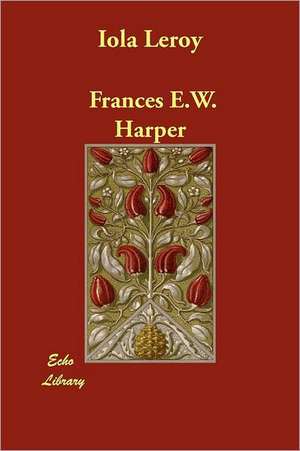
Iola Leroy
Autor FRANCES E.W. HARPERen Limba Engleză Paperback – apr 2012
Preț: 90.28 lei
Puncte Express: 135
Carte indisponibilă temporar
Livrare prin curier în România Termenul estimat este afișat lângă disponibilitate.
Transport gratuit de la 400.00 lei Plată online sau ramburs, în funcție de opțiunile comenzii.
Retur gratuit în 14 zile Comandă securizată și suport în română.
Specificații
ISBN-13: 9781406899696
ISBN-10: 1406899690
Pagini: 168
Dimensiuni: 152 x 229 x 10 mm
Greutate: 0.25 kg
Editura: Echo Library
Colecția Echo Library
ISBN-10: 1406899690
Pagini: 168
Dimensiuni: 152 x 229 x 10 mm
Greutate: 0.25 kg
Editura: Echo Library
Colecția Echo Library
V-ar putea interesa
-
 Uncle Tom's CabinHarriet Beecher StowePreț: 28.01 lei
 -
 The Portable Nineteenth-Century African American Women WritersHenry Louis Gates-17%Preț: 102.39 lei124.00 lei
 -
 From Man to Man or Perhaps Only—Olive Schreiner-16%Preț: 68.33 lei81.49 lei
 -
 -21%Preț: 147.29 lei185.47 lei
 -
 -29%Preț: 446.56 lei630.04 lei
 -
 Preț: 45.03 lei
 -
 Their Eyes Were Watching GodZora Neale Hurston-26%Preț: 58.35 lei79.09 lei
 -
 Twelve Years a SlaveSolomon NorthupPreț: 187.39 lei
 -
 The Bondwoman's NarrativeHannah CraftsPreț: 118.38 lei
 -
 Incidents in the Life of a Slave GirlHarriet Jacobs-32%Preț: 24.59 lei36.40 lei
 -
 Preț: 78.91 lei
 -
 Preț: 48.68 lei
 -
 The Marrow of TraditionCharles W. ChesnuttPreț: 46.64 lei
 -
 The Invention of WingsSue Monk Kidd-25%Preț: 59.57 lei79.80 lei
 -
 Frances E. W. Harper - A Call to ConscienceUtz McKnightPreț: 91.41 lei
 -
 Contending ForcesPauline E. HopkinsPreț: 66.16 lei
 -
 -21%Preț: 233.52 lei294.96 lei
 -
 Preț: 69.51 lei
 -
 Zora Neale HurstonCheryl R HopsonPreț: 87.88 lei
Descriere
Descriere de la o altă ediție sau format:
The Schomburg Library of Nineteenth-Century Black Women Writers General Editor: HENRY LOUIS GATES, JR. The past two decades have seen a dramatic resurgence of interest in black women writers, as authors such as Toni Morrison and Alice Walker have come to dominate the larger African-American literary landscape. Yet the works of the writers who founded and nurtured the black women's literary tradition--nineteenth-century African-American women--have remained buried in research libraries or in expensive hard-to-find reprints, often inaccessible to twentieth-century readers. Oxford University Press, in collaboration with the Schomburg Center for Research in Black Culture, a research unit of The New York Public Library, rescued the voice of an entire segment of the black tradition by offering thirty volumes of these compelling and rare works of fiction, poetry, autobiography, biography, essays, and journalism. Responding to the wide recognition this series has received, Oxford now presents four more of these volumes in paperback (to add to the four already available). Each book contains an introduction written by an expert in the field, as well as an overview by Henry Louis Gates, Jr., the General Editor.
The Schomburg Library of Nineteenth-Century Black Women Writers General Editor: HENRY LOUIS GATES, JR. The past two decades have seen a dramatic resurgence of interest in black women writers, as authors such as Toni Morrison and Alice Walker have come to dominate the larger African-American literary landscape. Yet the works of the writers who founded and nurtured the black women's literary tradition--nineteenth-century African-American women--have remained buried in research libraries or in expensive hard-to-find reprints, often inaccessible to twentieth-century readers. Oxford University Press, in collaboration with the Schomburg Center for Research in Black Culture, a research unit of The New York Public Library, rescued the voice of an entire segment of the black tradition by offering thirty volumes of these compelling and rare works of fiction, poetry, autobiography, biography, essays, and journalism. Responding to the wide recognition this series has received, Oxford now presents four more of these volumes in paperback (to add to the four already available). Each book contains an introduction written by an expert in the field, as well as an overview by Henry Louis Gates, Jr., the General Editor.
Recenzii
Frances Harper’s fourth novel follows the life of the beautiful, light-skinned Iola Leroy to tell the story of black families in slavery, during the Civil War, and after Emancipation. Iola Leroy adopts and adapts three genres that commanded significant audiences in the nineteenth century: the sentimental romance, the slave narrative, and plantation fiction. Written by the foremost black woman activist of the nineteenth century, the novel sheds light on the movements for abolition, public education, and voting rights through a compelling narrative.
This edition engages the latest research on Harper’s life and work and offers ways to teach these major moments in United States history by centering the experiences of African Americans. The appendices provide primary documents that help readers do what they are seldom encouraged to do: consider the experiences and perspectives of people who are not white. The Introduction traces Harper’s biography and the changing critical perspectives on the novel.
“Edited by one of the finest scholars of American literature, this Broadview edition of the much beloved, popular nineteenth-century classic Iola Leroy commands new attention and demonstrates fresh relevance. Koritha Mitchell elegantly argues for the merits of this early novel as an African American community text, based on its aesthetic qualities, the political currents that shaped it, and the material realities of its production, circulation, and readership. Appendices of thoughtfully curated secondary sources that privilege the firsthand testimonies of early African Americans about emancipatory, intellectual, social, and cultural matters, and that feature more creative and critical selections by Harper, bring distinction to this teachable, accessible edition. If one wishes to understand how the aftermath of enslavement has influenced and continues to shape the African American literary tradition and national conversations among and about African Americans, the Broadview edition of Iola Leroy is a necessary place to begin.” — Barbara McCaskill, University of Georgia
“Koritha Mitchell gives us the definitive edition of Iola Leroy, a novel that reflects the mature insight and creative prowess of teacher, activist, and writer Frances Ellen Watkins Harper. Readers are guided through this compelling saga of post–Civil War race, gender, class, and politics by Mitchell’s patient, expert hand. Her original interpretations are enriched by careful attention to the important debates that have always surrounded Harper’s work. Return to this edition again and again to discover the many meanings embedded in Iola Leroy and in Harper’s gifted prose.” — Martha S. Jones, Johns Hopkins University
“Koritha Mitchell’s Broadview Press edition is a triumph and a gift to the field. Her critical work in this volume ensures that generations of readers will recognize the novel as a touchstone in their literary educations and imaginations.… Like all the best critical and cultural editions, it serves as a model for the kind of scholarship we want to write and help our students to write. The contextual materials that bookend Mitchell’s introduction and the novel itself serve not only as citations for her critical throughlines but also as an invitation to readers to be more aware of how they read texts through one another. Mitchell has produced an unparalleled resource that positions Iola Leroy as a definitive text, and her editorial provocation urges us to keep reading, rereading, and reconsidering this novel.” —Mollie Barnes, Legacy
“Koritha Mitchell’s new cultural edition of Harper’s fourth novel, Iola Leroy; Or, Shadows of Uplift (first published in 1892), provides a compelling new entry in this tradition and an indispensable resource for those who assign Harper regularly or who have hesitated to teach Iola out of concern for the syllabus space required to get students up to speed on its historical and cultural contexts. Mitchell’s introduction on its own is worth the price of admission, as it synthesizes the latest work in Harper studies and situates Iola within it. … In addition to her biographical and bibliographic work, Mitchell offers a fresh take on Iola’s form and politics. Iola, Mitchell posits, ‘exemplifies the dynamism and complexity of … “community conversation” … the broad, dynamic discussions among African Americans about the countless issues affecting community members’ life chances and well-being’ (30). Throughout, Mitchell foregrounds Harper’s abiding faith in black communities and incisive critiques of white supremacy.…
“Mitchell’s critical apparatus speaks to previous scholars’ monumental efforts to make Harper studies a robust field. It speaks also to an ethics of citation that should be emulated. This cultural edition offers the nineteenth century in a box, robust enough to anchor a course in which Iola represents either the ‘early’ or ‘late’ text. Mitchell’s attention to the intersections of form, literary history, and politics make it an ideal edition for graduate seminars, exam lists, and research, as well.” — Derrick R. Spires, African American Review
This edition engages the latest research on Harper’s life and work and offers ways to teach these major moments in United States history by centering the experiences of African Americans. The appendices provide primary documents that help readers do what they are seldom encouraged to do: consider the experiences and perspectives of people who are not white. The Introduction traces Harper’s biography and the changing critical perspectives on the novel.
“Edited by one of the finest scholars of American literature, this Broadview edition of the much beloved, popular nineteenth-century classic Iola Leroy commands new attention and demonstrates fresh relevance. Koritha Mitchell elegantly argues for the merits of this early novel as an African American community text, based on its aesthetic qualities, the political currents that shaped it, and the material realities of its production, circulation, and readership. Appendices of thoughtfully curated secondary sources that privilege the firsthand testimonies of early African Americans about emancipatory, intellectual, social, and cultural matters, and that feature more creative and critical selections by Harper, bring distinction to this teachable, accessible edition. If one wishes to understand how the aftermath of enslavement has influenced and continues to shape the African American literary tradition and national conversations among and about African Americans, the Broadview edition of Iola Leroy is a necessary place to begin.” — Barbara McCaskill, University of Georgia
“Koritha Mitchell gives us the definitive edition of Iola Leroy, a novel that reflects the mature insight and creative prowess of teacher, activist, and writer Frances Ellen Watkins Harper. Readers are guided through this compelling saga of post–Civil War race, gender, class, and politics by Mitchell’s patient, expert hand. Her original interpretations are enriched by careful attention to the important debates that have always surrounded Harper’s work. Return to this edition again and again to discover the many meanings embedded in Iola Leroy and in Harper’s gifted prose.” — Martha S. Jones, Johns Hopkins University
“Koritha Mitchell’s Broadview Press edition is a triumph and a gift to the field. Her critical work in this volume ensures that generations of readers will recognize the novel as a touchstone in their literary educations and imaginations.… Like all the best critical and cultural editions, it serves as a model for the kind of scholarship we want to write and help our students to write. The contextual materials that bookend Mitchell’s introduction and the novel itself serve not only as citations for her critical throughlines but also as an invitation to readers to be more aware of how they read texts through one another. Mitchell has produced an unparalleled resource that positions Iola Leroy as a definitive text, and her editorial provocation urges us to keep reading, rereading, and reconsidering this novel.” —Mollie Barnes, Legacy
“Koritha Mitchell’s new cultural edition of Harper’s fourth novel, Iola Leroy; Or, Shadows of Uplift (first published in 1892), provides a compelling new entry in this tradition and an indispensable resource for those who assign Harper regularly or who have hesitated to teach Iola out of concern for the syllabus space required to get students up to speed on its historical and cultural contexts. Mitchell’s introduction on its own is worth the price of admission, as it synthesizes the latest work in Harper studies and situates Iola within it. … In addition to her biographical and bibliographic work, Mitchell offers a fresh take on Iola’s form and politics. Iola, Mitchell posits, ‘exemplifies the dynamism and complexity of … “community conversation” … the broad, dynamic discussions among African Americans about the countless issues affecting community members’ life chances and well-being’ (30). Throughout, Mitchell foregrounds Harper’s abiding faith in black communities and incisive critiques of white supremacy.…
“Mitchell’s critical apparatus speaks to previous scholars’ monumental efforts to make Harper studies a robust field. It speaks also to an ethics of citation that should be emulated. This cultural edition offers the nineteenth century in a box, robust enough to anchor a course in which Iola represents either the ‘early’ or ‘late’ text. Mitchell’s attention to the intersections of form, literary history, and politics make it an ideal edition for graduate seminars, exam lists, and research, as well.” — Derrick R. Spires, African American Review
Cuprins
Acknowledgements
Introduction
Frances Ellen Watkins Harper: A Brief Chronology
A Note on the Text
Iola Leroy; Or, Shadows Uplifted
Appendix A: Slavery, Civil War and Emancipation, Reconstruction and Its Demise
Introduction
Frances Ellen Watkins Harper: A Brief Chronology
A Note on the Text
Iola Leroy; Or, Shadows Uplifted
Appendix A: Slavery, Civil War and Emancipation, Reconstruction and Its Demise
- From the Fugitive Slave Act (1850)
- United States Supreme Court Justice Roger Taney, the Dred Scott Decision (1857)
- From the First Confiscation Act (1861)
- From the Second Confiscation Act (1862)
- The Emancipation Proclamation (1863)
- From the Freedmen’s Bureau Act (1865)
- The Thirteenth Amendment (1865)
- From the Fourteenth Amendment (1868)
- The Fifteenth Amendment (1870)
- The Compromise of 1877
- From United States Supreme Court Justice Billings Brown, Plessy v. Ferguson (1896)
- From Abraham Lincoln, Address on Colonization to a Deputation of Negroes (1862)
- From Frances Harper, “Mrs. Frances E. Watkins Harper on the War and the President’s Colonization Scheme,” Christian Recorder (27 September 1862)
- From Michigan Supreme Court Justice James Campbell, The People v. Dean (1866)
- From Frederick Douglass, Narrative of the Life of Frederick Douglass (1845)
- Dictated letters between enslaved husbands and wives while separated by their owners
- From “Arrest of Fugitive Slaves,” Cincinnati Gazette (29 January 1856)
- Frances Harper, “The Slave Mother: A Tale of Ohio” 1857)
- Testimony about enslaved men and women who fled slavery to join the Union effort and often planned to return to help family members escape (1863)
- Letter from a black soldier to his children (1864)
- Letter from a black soldier to the owner of one of his daughters (1864)
- Newspaper Notices in Hopes of Finding Lost Loved Ones after Emancipation (1866–93)
- From the South Carolina Negro Act (1740)
- Account about an enslaved woman who ran a midnight school (1881)
- Account of teaching/learning in secret during slavery (1902)
- An account of finding the spark for learning while enslaved (1885)
- Accounts of the consequences of learning to read and write
- Account of black soldiers wanting education
- Account of recently emancipated people’s eagerness to learn
- Testimony on Ku Klux Klan preventing school attendance after Emancipation (1872)
- Laws constraining black girls and boys via apprenticeship and African Americans of every age via vagrancy statutes (1865)
- Testimony about Ku Klux Klan raping black women whose husbands/fathers voted (1871)
- From Henry W. Grady, “The Race Problem in the South” (1889)
- From Ida B. Wells, The Red Record: Tabulated Statistics and Alleged Causes of Lynching in the United States (1895)
- From Frances Harper, “We Are All Bound Up Together” (1866)
- Frances Harper, “Aunt Chloe’s Politics” (1872)
- From Frances Harper, “Colored Women of America,” Englishwoman’s Review (15 January 1878)
- From Frances Harper, “The Woman’s Christian Temperance Union and the ColoredWoman,” African Methodist Episcopal Church Review (1888)
- From Frances Harper, “Enlightened Motherhood: An Address … Before the Brooklyn Literary Society” (15 November 1892)
- From Fannie Barrier Williams, “The Intellectual Progress of The Colored Women of the United States Since the Emancipation Proclamation” (1893)
- William J. Watkins, “The Reformer,” Frederick Douglass’ Paper (7 April 1854)
- Grace Greenwood, Impressions of Harper as a Speaker (1866)
- From Anna Julia Cooper, “The Status of Woman in America” (1892)
- Reviews of Iola Leroy
- “Publications Reviewed,” Christian Recorder (12 January 1893)
- From “Review 1,” Independent (5 January 1893)
- Richmond Planet (21 January 1893)
- From “Recent Fiction,” The Nation (23 February 1893)
- From “Our Book List,” A.M.E. Church Review (April 1893)
- “Book Review,” Friends’ Review; a Religious, Literary and Miscellaneous Journal (22 June 1893)
- Review of Reviews (January 1895)
- From “Recent Fiction,” Independent (29 October 1896)
- From Edward Elmore Brock, “Brock’s Literary Leaves,” Freeman (Indianapolis) (14 August 1897)
- [W.E.B. Du Bois,] “Writers,” Crisis (April 1911)
Notă biografică
Henry Louis Gates, Jr. is W. E. B. Du Bois Professor of Literature at Cornell University.