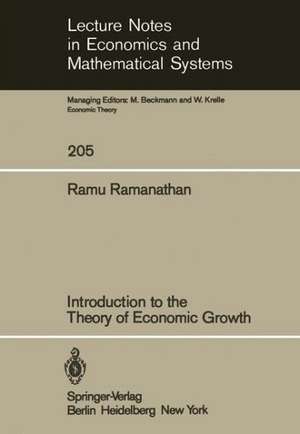
Introduction to the Theory of Economic Growth: Lecture Notes in Economics and Mathematical Systems, cartea 205
Autor R. Ramanathanen Limba Engleză Paperback – 8 oct 1982
Din seria Lecture Notes in Economics and Mathematical Systems
-
 Preț: 366.40 lei
 -
 Preț: 370.46 lei
 - 15%
 Preț: 634.38 lei
 -
 Preț: 369.36 lei
 - 15%
 Preț: 494.14 lei
 - 15%
 Preț: 616.67 lei
 -
 Preț: 365.65 lei
 -
 Preț: 369.53 lei
 -
 Preț: 429.25 lei
 -
 Preț: 478.35 lei
 -
 Preț: 370.26 lei
 -
 Preț: 363.99 lei
 -
 Preț: 384.48 lei
 - 15%
 Preț: 618.34 lei
 -
 Preț: 364.71 lei
 -
 Preț: 437.98 lei
 -
 Preț: 371.00 lei
 - 15%
 Preț: 619.61 lei
 -
 Preț: 364.71 lei
 -
 Preț: 332.45 lei
 -
 Preț: 409.58 lei
 -
 Preț: 363.99 lei
 - 18%
 Preț: 745.61 lei
 -
 Preț: 377.68 lei
 -
 Preț: 386.37 lei
 - 15%
 Preț: 621.48 lei
 -
 Preț: 367.70 lei
 -
 Preț: 363.99 lei
 - 15%
 Preț: 613.00 lei
 - 15%
 Preț: 622.29 lei
 -
 Preț: 363.41 lei
 -
 Preț: 430.76 lei
 - 15%
 Preț: 619.61 lei
 -
 Preț: 371.37 lei
 - 15%
 Preț: 629.18 lei
 -
 Preț: 399.23 lei
 -
 Preț: 395.89 lei
 -
 Preț: 383.75 lei
 -
 Preț: 383.75 lei
 - 15%
 Preț: 610.96 lei
 - 20%
 Preț: 628.32 lei
 -
 Preț: 365.45 lei
 -
 Preț: 476.52 lei
 -
 Preț: 364.35 lei
 - 15%
 Preț: 612.55 lei
 -
 Preț: 371.20 lei
 -
 Preț: 364.19 lei
 - 15%
 Preț: 640.81 lei
 -
 Preț: 365.65 lei
Preț: 380.09 lei
Nou
Puncte Express: 570
Preț estimativ în valută:
67.27€ • 78.89$ • 58.98£
67.27€ • 78.89$ • 58.98£
Carte tipărită la comandă
Livrare economică 24 ianuarie-07 februarie 26
Preluare comenzi: 021 569.72.76
Specificații
ISBN-13: 9783540119432
ISBN-10: 3540119434
Pagini: 364
Ilustrații: X, 350 p.
Dimensiuni: 170 x 244 x 19 mm
Greutate: 0.58 kg
Ediția:Softcover reprint of the original 1st ed. 1982
Editura: Springer Berlin, Heidelberg
Colecția Springer
Seria Lecture Notes in Economics and Mathematical Systems
Locul publicării:Berlin, Heidelberg, Germany
ISBN-10: 3540119434
Pagini: 364
Ilustrații: X, 350 p.
Dimensiuni: 170 x 244 x 19 mm
Greutate: 0.58 kg
Ediția:Softcover reprint of the original 1st ed. 1982
Editura: Springer Berlin, Heidelberg
Colecția Springer
Seria Lecture Notes in Economics and Mathematical Systems
Locul publicării:Berlin, Heidelberg, Germany
V-ar putea interesa
-
 Capital and Time: A Neo-Austrian TheoryJ. R. Hicks-15%Preț: 351.84 lei412.59 lei
 -
 Economic Growth 2eRobert J. Barro-16%Preț: 682.23 lei812.18 lei
 -
 Welfare EconomicsRW BoadwayPreț: 459.64 lei
 -
 Readings in Industrial OrganizationLMB Cabral-23%Preț: 464.89 lei603.75 lei
 -
 -23%Preț: 583.04 lei757.19 lei
 -
 Learning and Expectations in MacroeconomicsGeorge W. Evans-19%Preț: 597.58 lei737.75 lei
 -
 The Theory of IncentivesJean-Jacques LaffontPreț: 411.84 lei
 -
 Advances in Behavioral EconomicsColin F Camerer-19%Preț: 546.89 lei675.17 lei
 -
 PareconMichael AlbertPreț: 114.01 lei
 -
 Preț: 343.17 lei
 -
 Handbook of New Institutional EconomicsClaude Ménard-18%Preț: 728.59 lei888.52 lei
 -
 Economic DynamicsGiancarlo Gandolfo-18%Preț: 936.35 lei1141.89 lei
Public țintă
ResearchCuprins
1. Introduction.- 2. Review of Production functions and their properties.- 2.1 Production with Fixed Coefficients.- 2.2 Substitution Between Capital and Labor.- References.- Exercises.- 3. Basic Neo-Classical growth models.- 3.1 The Harrod-Domar Model.- 3.2 The Solow-Swan Model.- 3.3 Summary.- References.- Exercises.- Appendix: Differential Equations.- 4. Technical Progress.- 4.1 Neutral and Non-Neutral Technical Change.- 4.2 Endogenous Technical Progress.- 4.3 Induced Bias in Technical Change.- 4.4 Embodied Technical Progress: Vintage Models.- 4.5 Measurement of Technical Change.- 4.6 Summary.- References.- Exercises.- 5. Money and economic growth.- 5.1 Tobin’s Model.- 5.2 Money as a Consumer Good.- 5.3 Money as a Producer Good.- 5.4 The Keynes-Wicksell Approach.- 5.5 A Synthesis of Neo-Classical and Keynes-Wicksell Models.- 5.6 Summary.- References.- Exercises.- 6. Neo-Classical models with two income classes.- 6.1 Different Saving Propensities for Workers and Firms.- 6.2 Wage Earners Receiving Dividend Income Also.- 6.3 The Pasinetti Paradox in a Two-Class Monetary Growth Model.- 6.4 Summary.- References.- Exercises.- 7. Cambridge growth models.- 7.1 A Simple Kaldorian Model.- 7.2 A Neo-Keynesian Model with Pasinetti Saving Behavior.- 7.3 The Technical Progress Function.- 7.4 Robinson’s Criticisms.- 7.5 Summary.- References.- Exercises.- 8. The speed of adjustment in growth models.- 8.1 The Solow-Swan Model.- 8.2 A Model With Unemployment.- 8.3 Other Models.- References.- Exercises.- 9. Optimal Growth.- 9.1 Inter-temporal Optimization.- 9.2 Economic Interpretations.- 9.3 Phase Diagram Analysis.- References.- Exercises.- 10. Two sector growth models.- 10.1 The Static Two-Sector Model.- 10.2 The Dynamic Two-Sector Model.- 10.3 Stability of the Long-runEquilibrium.- 10.4 Extension to the Case of Variable Savings Ratio.- References.- Exercises.- 11. International Trade and Economic Growth.- 11.1 A Static Two-Sector Trade Model.- 11.2 A Dynamic Two-Sector Trade Model.- 11.3 A Monetary Growth Model of an Open Economy.- References.- Exercises.- Review Questions.