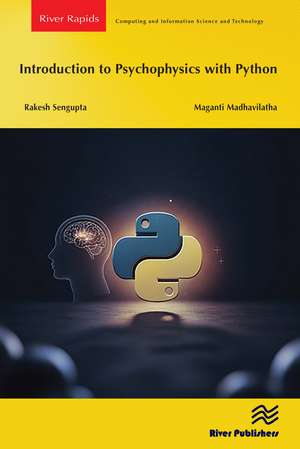
Introduction to Psychophysics with Python: River Publishers Series in Computing and Information Science and Technology
Autor Rakesh Sengupta, Maganti Madhavilathaen Limba Engleză Paperback – 30 apr 2026
Starting from the foundations laid by Weber, Fechner, and Stevens, the book traces the evolution of psychophysics into contemporary practice. Readers gain a clear grounding in sensory physiology, experimental design, and statistical analysis, always tied to the central challenge: connecting physical stimuli to perceptual responses and making sense of the data.
What sets this book apart is its practical, step-by-step approach. Through tutorials and annotated code using PsychoPy, readers learn Python essentials—loops, conditionals, data handling—while building real experiments. These skills extend seamlessly into advanced methods like curve fitting, bootstrapping, and statistical inference.
Illustrated with intuitive explanations, diagrams, and thought-provoking exercises, the book blends conceptual clarity with real-world application. By the end, readers will not only understand the principles of psychophysics but also have the coding expertise to create and analyze their own experiments—opening the door to deeper insights into sensation and perception.
Din seria River Publishers Series in Computing and Information Science and Technology
- 20%
 Preț: 418.84 lei
 - 20%
 Preț: 723.90 lei
 - 20%
 Preț: 788.46 lei
 - 18%
 Preț: 794.15 lei
 - 20%
 Preț: 722.73 lei
 - 18%
 Preț: 802.54 lei
 - 20%
 Preț: 683.36 lei
 - 20%
 Preț: 772.59 lei
 - 18%
 Preț: 817.96 lei
 - 20%
 Preț: 821.06 lei
 - 20%
 Preț: 820.31 lei
 - 20%
 Preț: 786.01 lei
 - 20%
 Preț: 797.17 lei
 - 20%
 Preț: 353.82 lei
 - 20%
 Preț: 708.92 lei
 - 20%
 Preț: 888.10 lei
 - 20%
 Preț: 787.55 lei
 - 20%
 Preț: 946.11 lei
 - 18%
 Preț: 860.68 lei
 - 20%
 Preț: 893.03 lei
 - 20%
 Preț: 948.40 lei
 - 20%
 Preț: 810.99 lei
 - 18%
 Preț: 834.28 lei
 - nou
 Preț: 829.18 lei
 - nou
 Preț: 900.23 lei
 - nou
 Preț: 793.66 lei
 - nou
 Preț: 753.57 lei
Preț: 554.58 lei
Preț vechi: 693.23 lei
-20%
Puncte Express: 832
Carte tipărită la comandă
Livrare economică 26 noiembrie-10 decembrie
Livrare prin curier în România Termenul estimat este afișat lângă disponibilitate.
Transport gratuit pentru acest produs Plată online sau ramburs, în funcție de opțiunile comenzii.
Retur gratuit în 14 zile Comandă securizată și suport în română.
Specificații
ISBN-13: 9788743809449
ISBN-10: 8743809448
Pagini: 138
Ilustrații: 31
Dimensiuni: 156 x 234 mm
Greutate: 0.2 kg
Ediția:1
Editura: River Publishers
Colecția River Publishers
Seria River Publishers Series in Computing and Information Science and Technology
ISBN-10: 8743809448
Pagini: 138
Ilustrații: 31
Dimensiuni: 156 x 234 mm
Greutate: 0.2 kg
Ediția:1
Editura: River Publishers
Colecția River Publishers
Seria River Publishers Series in Computing and Information Science and Technology
Public țintă
Academic, Postgraduate, and Professional Practice & DevelopmentCuprins
1. History of Psychophysics 2. Understanding Sensory Systems 3. Signal Detection Theory and Experimental Design 4. Using PsychoPy to Build Experiments
Notă biografică
Dr. Rakesh Sengupta has been a researcher and Assistant Professor at School of Inter-woven Arts and Sciences, Krea University, Sri City, India since 2025, holding a PhD from the University of Hyderabad (2015). His interdisciplinary background spans developmental and educational psychology, cognitive and computational neuroscience, and creative cognition. With a growing scholarly record (25 publications, 300 citations, h index of 8) and robust collaborations across psychology and brain research communities, he brings both empirical rigor and a multicultural perspective essential for cognitive science. He is actively involved in experiments combining behavioral assessment and neuroscientific measures (e.g., EEG, eye tracking) to explore cognitive faculties in culturally grounded settings.
Madhavilatha Maganti is an Associate Professor of Psychology at Krea University with expertise in Developmental Psychology and Cognitive Science, specializing in infancy and early childhood development. Her research examines developmental trajectories from the neonatal period to early childhood in high-risk and typically developing populations. Using behavioral and computational methods, her lab investigates mother–child interactions, perceptual and attentional processes, and language acquisition, contributing to embodied models of cognition. Additional work includes narrative-based language assessments, and studies on socio-emotional development in children. Further, her work involves functional assessments of children with neurodevelopmental disorders using the World Health Organization’s International Classification of Functioning, Disability and Health for Children and Youth (ICF-CY) framework.Taking this work further, she is involved in developing early childhood development interventions to reduce the impact of risks associated with early adversity. Her long-term objective is to leverage emerging empirical evidence from developmental science to advance translational research and promote scalable, evidence-based practices, with an emphasis on improving developmental outcomes for all children.
Madhavilatha Maganti is an Associate Professor of Psychology at Krea University with expertise in Developmental Psychology and Cognitive Science, specializing in infancy and early childhood development. Her research examines developmental trajectories from the neonatal period to early childhood in high-risk and typically developing populations. Using behavioral and computational methods, her lab investigates mother–child interactions, perceptual and attentional processes, and language acquisition, contributing to embodied models of cognition. Additional work includes narrative-based language assessments, and studies on socio-emotional development in children. Further, her work involves functional assessments of children with neurodevelopmental disorders using the World Health Organization’s International Classification of Functioning, Disability and Health for Children and Youth (ICF-CY) framework.Taking this work further, she is involved in developing early childhood development interventions to reduce the impact of risks associated with early adversity. Her long-term objective is to leverage emerging empirical evidence from developmental science to advance translational research and promote scalable, evidence-based practices, with an emphasis on improving developmental outcomes for all children.
Descriere
Introduction to Psychophysics with Python bridges classical theories of sensation and perception with modern computational tools. Featuring tutorials, annotated PsychoPy code, and real-world examples, it equips readers to design, run, and analyze psychophysical experiments confidently.