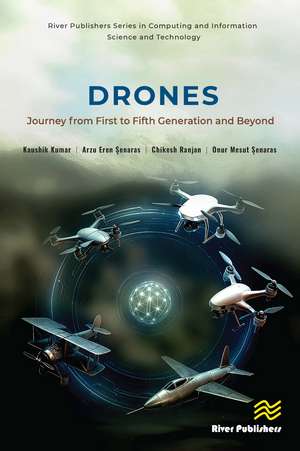
DRONES: Journey from First to Fifth Generation and Beyond: River Publishers Series in Computing and Information Science and Technology
Autor Kaushik Kumar, Arzu Eren Şenaras, Chikesh Ranjan, Onur Mesut Şenarasen Limba Engleză Hardback – 20 iul 2026
Across nine concise chapters, the book delivers a clear, step-by-step understanding of UAV evolution, core engineering principles, and real-world applications. It spans the full arc of the drone revolution—from manually controlled prototypes of the early 1900s to fifth-generation, AI-driven swarms that define modern aerospace innovation. Each chapter integrates historical context, technical foundations, and forward-looking insights.
Key topics include:
- A chronological overview of UAV generations and their defining capabilities
- Aerodynamics, propulsion, control systems, and sensor integration
- Applications in defense, agriculture, logistics, environmental monitoring, and smart cities
- Advances in autonomy, artificial intelligence, swarm coordination, and quantum navigation
- Global perspectives on policy, ethics, sustainability, and emerging research.
Din seria River Publishers Series in Computing and Information Science and Technology
- 20%
 Preț: 418.84 lei
 - 20%
 Preț: 723.90 lei
 - 20%
 Preț: 788.46 lei
 - 18%
 Preț: 794.15 lei
 - 20%
 Preț: 722.73 lei
 - 18%
 Preț: 802.54 lei
 - 20%
 Preț: 683.36 lei
 - 20%
 Preț: 772.59 lei
 - 18%
 Preț: 817.96 lei
 - 20%
 Preț: 821.06 lei
 - 20%
 Preț: 820.31 lei
 - 20%
 Preț: 786.01 lei
 - 20%
 Preț: 797.17 lei
 - 20%
 Preț: 353.82 lei
 - 20%
 Preț: 708.92 lei
 - 20%
 Preț: 888.10 lei
 - 20%
 Preț: 787.55 lei
 - 20%
 Preț: 554.58 lei
 - 20%
 Preț: 946.11 lei
 - 20%
 Preț: 893.03 lei
 - 20%
 Preț: 948.40 lei
 - 20%
 Preț: 810.99 lei
 - 18%
 Preț: 834.28 lei
 - nou
 Preț: 829.18 lei
 - nou
 Preț: 900.23 lei
 - nou
 Preț: 793.66 lei
 - nou
 Preț: 753.57 lei
Preț: 860.68 lei
Preț vechi: 1049.62 lei
-18% Nou
Puncte Express: 1291
Carte tipărită la comandă
Livrare economică 24 noiembrie-08 decembrie
Livrare prin curier în România Termenul estimat este afișat lângă disponibilitate.
Transport gratuit pentru acest produs Plată online sau ramburs, în funcție de opțiunile comenzii.
Retur gratuit în 14 zile Comandă securizată și suport în română.
Specificații
ISBN-13: 9788743812395
ISBN-10: 8743812392
Pagini: 388
Ilustrații: 122
Dimensiuni: 156 x 234 mm
Greutate: 0.72 kg
Ediția:1
Editura: River Publishers
Colecția River Publishers
Seria River Publishers Series in Computing and Information Science and Technology
ISBN-10: 8743812392
Pagini: 388
Ilustrații: 122
Dimensiuni: 156 x 234 mm
Greutate: 0.72 kg
Ediția:1
Editura: River Publishers
Colecția River Publishers
Seria River Publishers Series in Computing and Information Science and Technology
Public țintă
Academic, Postgraduate, and Professional Practice & DevelopmentCuprins
1 Overview of Drone Technology 2 First Generation Drones 3 Second Generation Drones 4 Third Generation Drones 5 Fourth Generation Drones 6 Fifth Generation Drones 7 Key Challenges in Drone Evolution 8 Evolutionary Impacts of UAVs on Modern Systems 9 Future of Drones
Notă biografică
Dr. Kaushik Kumar holds a Ph.D. in Virtual Manufacturing from Jadavpur University, India, an MBA in Marketing Management from Indira Gandhi National Open University, India, and a Bachelor of Technology from Regional Engineering College (now National Institute of Technology), Warangal, India. He has over 25 years of rich teaching and research experience, complemented by 11 years of professional exposure in a globally reputed manufacturing unit. Currently, he serves as a Professor in the Department of Mechanical Engineering at Birla Institute of Technology, Mesra, Ranchi, India. His research interests span composites, optimization, non-conventional machining, CAD/CAM, rapid prototyping, and quality management systems. Dr. Kumar has been instrumental in pioneering innovative product development for both industrial and societal applications, earning 45+ patents for his contributions. He has established a state-of-the-art composite research laboratory and has authored more than 60+ books (including 31 edited volumes). Additionally, he has published 100 book chapters and over 200 research papers in reputed national and international journals. Dr. Kumar has held numerous editorial roles, including editor-in-chief, series editor, guest editor, and editorial board member, and actively serves as a reviewer for multiple international and national journals. Throughout his career, he has secured sponsored research and consultancy projects worth approximately ₹1 crore from government and international agencies. He has been invited as a keynote speaker, resource person, and expert lecturer at various international and national conferences, workshops, and faculty development programs. He has successfully guided numerous doctoral, master’s, and undergraduate students in India and abroad and served as an examiner and reviewer for dissertations and theses internationally.
Prof. Dr. Arzu Eren Şenaras is a Professor in the Department of Econometrics at Bursa Uludağ University, where she also serves as the Head of the Operations Research Division. She is a distinguished academic and researcher specializing in operations research, system dynamics modeling, and simulation-based optimization. Her expertise spans logistics, supply chain management, energy systems, and complex system modeling, with a strong focus on practical applications of quantitative methods. Prof. Dr. Eren Şenaras earned her bachelor’s degree in Econometrics from Uludağ University in 2007, followed by a master’s degree, during which she developed a novel simulation application for revenue determination in intercity bus routes. She completed her Ph.D. in Econometrics in 2016, focusing on the dynamic behaviors of exchange rates through system dynamics modeling. Since beginning her academic career as a research assistant in 2008, she has built a robust research and teaching portfolio, advancing to associate professor in 2018 before attaining full professorship. Her research contributions include over 20 peer-reviewed journal articles, numerous conference presentations, and interdisciplinary projects such as agent-based simulations for disaster-prepared food supply chains and modeling Turkey’s electricity market. She has applied techniques like dynamic programming, causal loop diagrams, and ant colony optimization to real-world challenges in manufacturing and logistics. Beyond research, Prof. Dr. Eren Şenaras is a committed mentor, guiding graduate students in innovative projects that address sustainability, digital transformation, and practical problem-solving.
Dr. Chikesh Ranjan is currently serving as a Project Engineer in the Department of Mechanical Engineering at the National Institute of Technology, Rourkela, Odisha, India. He earned his Ph.D. in Mechanical Engineering from Birla Institute of Technology, Mesra, Ranchi in 2024, with a research focus on the tribological properties and thermal degradation kinetics of natural fiber-reinforced polymeric composites. Prior to this, he completed his Master of Engineering in Mechanical Engineering (Design of Mechanical Equipment) with distinction from the same institute in 2013 and a Bachelor of Engineering in Mechanical Engineering from Marathwada Institute of Technology, Aurangabad in 2010. Dr. Ranjan has extensive academic and research experience, having worked as an Assistant Professor at R.T.C Institute of Technology, Ranchi from 2013 to 2020, where he also served as Program Officer for the National Service Scheme (NSS). He has a prolific scholarly output, with over 24 Scopus-indexed book chapters, 13 SCOPUS/WoS publications, four SCI/SCIE journal articles, and more than 14 authored books, both national and international, focusing on areas such as drones, robotics, polymeric composites, additive manufacturing, and smart materials. His inventive contributions include multiple national and international patents, encompassing designs and applications in drones, renewable energy devices, automated systems, and functionally graded composites. He is an active educator, having organized and coordinated numerous workshops, boot camps, and training programs on drone technology, CAD/CAM, robotics, and automation. He is proficient in software tools such as AUTOCAD, CREO, CATIA, and ANSYS and has a keen interest in integrating artificial intelligence and optimization techniques into mechanical systems. Dr. Ranjan’s research and professional profiles are available on SCOPUS, Web of Science, ORCID, Google Scholar, and Vidwan. His work bridges theoretical research with practical engineering solutions, fostering innovation in mechanical engineering and allied technologies.
Dr. Onur Mesut Şenaras is a distinguished engineer and academic specializing in automotive engineering, industrial optimization, and lean manufacturing. He earned his B.Sc. in Industrial Engineering from Dokuz Eylül University (2004), his M.Sc. in Automotive Engineering from Uludağ University (2013), and his Ph.D. in Automotive Engineering from Uludağ University (2024). With nearly two decades of professional experience, Dr. Şenaras began his career as Controlling and Budget Responsible at Vestel Beyaz Eşya (2005–2007) and subsequently joined Oyak Renault, holding key roles such as Body Performance Responsible, Kaizen Pilot, and Design Automation Leader. His contributions have driven digitalization, automation, and system optimization within the automotive sector. He has received multiple prestigious awards, including the Renault Ergonomics Award (2010), Renault Investment Optimization Award (2011), and several factory ergonomics awards, and holds a national patent in ergonomics. As a researcher and author, Dr. Şenaras focuses on automated guided vehicles (AGVs), artificial intelligence, system dynamics, and simulation. He co-authored Expulsion in Resistance Spot Welding (2017) and has contributed chapters on flexible manufacturing systems and subway passenger flow modeling. At Uludağ University, he mentors students and teaches courses on lean manufacturing, logistics management, and genetic algorithms, bridging cutting-edge research with practical industry applications. Dr. Şenaras’s professional and academic work significantly advances the fields of automotive engineering and industrial systems, establishing him as a leading figure in integrating innovation, research, and practical solutions.
Prof. Dr. Arzu Eren Şenaras is a Professor in the Department of Econometrics at Bursa Uludağ University, where she also serves as the Head of the Operations Research Division. She is a distinguished academic and researcher specializing in operations research, system dynamics modeling, and simulation-based optimization. Her expertise spans logistics, supply chain management, energy systems, and complex system modeling, with a strong focus on practical applications of quantitative methods. Prof. Dr. Eren Şenaras earned her bachelor’s degree in Econometrics from Uludağ University in 2007, followed by a master’s degree, during which she developed a novel simulation application for revenue determination in intercity bus routes. She completed her Ph.D. in Econometrics in 2016, focusing on the dynamic behaviors of exchange rates through system dynamics modeling. Since beginning her academic career as a research assistant in 2008, she has built a robust research and teaching portfolio, advancing to associate professor in 2018 before attaining full professorship. Her research contributions include over 20 peer-reviewed journal articles, numerous conference presentations, and interdisciplinary projects such as agent-based simulations for disaster-prepared food supply chains and modeling Turkey’s electricity market. She has applied techniques like dynamic programming, causal loop diagrams, and ant colony optimization to real-world challenges in manufacturing and logistics. Beyond research, Prof. Dr. Eren Şenaras is a committed mentor, guiding graduate students in innovative projects that address sustainability, digital transformation, and practical problem-solving.
Dr. Chikesh Ranjan is currently serving as a Project Engineer in the Department of Mechanical Engineering at the National Institute of Technology, Rourkela, Odisha, India. He earned his Ph.D. in Mechanical Engineering from Birla Institute of Technology, Mesra, Ranchi in 2024, with a research focus on the tribological properties and thermal degradation kinetics of natural fiber-reinforced polymeric composites. Prior to this, he completed his Master of Engineering in Mechanical Engineering (Design of Mechanical Equipment) with distinction from the same institute in 2013 and a Bachelor of Engineering in Mechanical Engineering from Marathwada Institute of Technology, Aurangabad in 2010. Dr. Ranjan has extensive academic and research experience, having worked as an Assistant Professor at R.T.C Institute of Technology, Ranchi from 2013 to 2020, where he also served as Program Officer for the National Service Scheme (NSS). He has a prolific scholarly output, with over 24 Scopus-indexed book chapters, 13 SCOPUS/WoS publications, four SCI/SCIE journal articles, and more than 14 authored books, both national and international, focusing on areas such as drones, robotics, polymeric composites, additive manufacturing, and smart materials. His inventive contributions include multiple national and international patents, encompassing designs and applications in drones, renewable energy devices, automated systems, and functionally graded composites. He is an active educator, having organized and coordinated numerous workshops, boot camps, and training programs on drone technology, CAD/CAM, robotics, and automation. He is proficient in software tools such as AUTOCAD, CREO, CATIA, and ANSYS and has a keen interest in integrating artificial intelligence and optimization techniques into mechanical systems. Dr. Ranjan’s research and professional profiles are available on SCOPUS, Web of Science, ORCID, Google Scholar, and Vidwan. His work bridges theoretical research with practical engineering solutions, fostering innovation in mechanical engineering and allied technologies.
Dr. Onur Mesut Şenaras is a distinguished engineer and academic specializing in automotive engineering, industrial optimization, and lean manufacturing. He earned his B.Sc. in Industrial Engineering from Dokuz Eylül University (2004), his M.Sc. in Automotive Engineering from Uludağ University (2013), and his Ph.D. in Automotive Engineering from Uludağ University (2024). With nearly two decades of professional experience, Dr. Şenaras began his career as Controlling and Budget Responsible at Vestel Beyaz Eşya (2005–2007) and subsequently joined Oyak Renault, holding key roles such as Body Performance Responsible, Kaizen Pilot, and Design Automation Leader. His contributions have driven digitalization, automation, and system optimization within the automotive sector. He has received multiple prestigious awards, including the Renault Ergonomics Award (2010), Renault Investment Optimization Award (2011), and several factory ergonomics awards, and holds a national patent in ergonomics. As a researcher and author, Dr. Şenaras focuses on automated guided vehicles (AGVs), artificial intelligence, system dynamics, and simulation. He co-authored Expulsion in Resistance Spot Welding (2017) and has contributed chapters on flexible manufacturing systems and subway passenger flow modeling. At Uludağ University, he mentors students and teaches courses on lean manufacturing, logistics management, and genetic algorithms, bridging cutting-edge research with practical industry applications. Dr. Şenaras’s professional and academic work significantly advances the fields of automotive engineering and industrial systems, establishing him as a leading figure in integrating innovation, research, and practical solutions.
Descriere
This book covers aerodynamics, propulsion, control, sensors, swarm coordination, defense, agriculture, logistics, environmental monitoring, policy, ethics, and emerging UAV technologies.