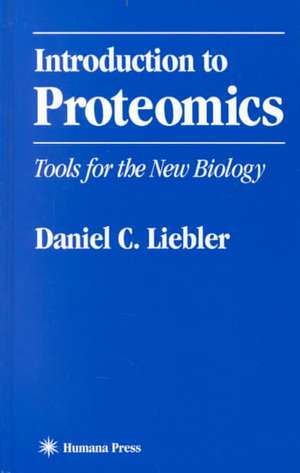
Introduction to Proteomics
Autor Daniel C. Liebleren Limba Engleză Hardback – 4 dec 2001
Trecerea de la secvențierea genomică la înțelegerea funcțională a sistemelor vii impune o provocare clinică majoră: cum putem cartografia precis dinamica proteinelor într-un organism complex? Introduction to Proteomics de Daniel C. Liebler răspunde acestei necesități, oferind o fundamentare riguroasă a modului în care proteinele și proteomii sunt analizați și utilizați pentru a investiga procesele biologice. Reținem că autorul nu se limitează la teorie, ci explică mecanismele interne ale instrumentației analitice și rolul crucial al software-ului de data mining în interpretarea rezultatelor. Descoperim o structură organizată logic în trei părți: după o introducere în conceptul de proteom, textul trece la arsenalul tehnic — separări peptidice, tehnici de digestie și spectrometrie de masă — finalizând cu aplicații în profilarea expresiei proteinelor. Un element distinctiv este capitolul dedicat algoritmului SALSA, o metodă specifică de explorare a datelor MS, care subliniază rigoarea matematică a volumului. Considerăm acest manual o alternativă la Proteome Research: Mass Spectrometry de Peter James pentru cercetători, având avantajul unei abordări pedagogice care pune accent pe integrarea sistemelor, nu doar pe tehnica izolată a spectrometriei. În timp ce Proteomics in Functional Genomics de P. Jolles se concentrează pe tranziția de la sănătate la boală, lucrarea lui Liebler oferă cadrul tehnic fundamental necesar pentru a înțelege diversitatea proteomică și interacțiunile de rețea. Tonul este precis, clinic, fiind orientat către specialiștii care au nevoie de o bază solidă în utilizarea spectrometriei de masă în tandem pentru identificarea proteinelor și a modificărilor post-translaționale.
Preț: 1125.28 lei
Preț vechi: 1184.51 lei
-5%
Carte tipărită la comandă
Livrare economică 18 noiembrie-02 decembrie
Specificații
ISBN-10: 0896039919
Pagini: 212
Ilustrații: IX, 198 p. 31 illus., 2 illus. in color.
Dimensiuni: 132 x 209 x 18 mm
Greutate: 0.32 kg
Ediția:2002
Editura: Humana
Locul publicării:Totowa, NJ, United States
V-ar putea interesa
-
 -21%Preț: 393.74 lei499.83 lei
 -
 From Proteins to Proteomics: Basic Concepts, Techniques, and ApplicationsSanjeeva SrivastavaPreț: 440.69 lei
 -
 -32%Preț: 821.06 lei1201.31 lei
 -
 Principles of ProteomicsRichard Twyman-9%Preț: 690.00 lei758.24 lei
 -
 Practical Computing for BiologistsSteven H. D. Haddock-27%Preț: 797.38 lei1092.30 lei
 -
 Bioinformatics and Functional GenomicsJonathan Pevsner-23%Preț: 833.61 lei1082.62 lei
 -
 -19%Preț: 509.00 lei628.39 lei
 -
 Peptide Analysis ProtocolsBen M. Dunn-18%Preț: 896.62 lei1093.45 lei
 -
 Statistical Analysis in ProteomicsKlaus Jung-15%Preț: 625.53 lei735.92 lei
 -
 The Proteomics Protocols HandbookJohn M Walker-18%Preț: 1867.21 lei2277.09 lei
 -
 Biomacromolecular Mass Spectrometry Yearbook: Volume 1Simone Koenig-27%Preț: 1548.85 lei2110.29 lei
 -
 Proteome InformaticsConrad Bessant-14%Preț: 1388.95 lei1615.06 lei
 -
 -14%Preț: 1392.69 lei1619.41 lei
 -
 Quantitative ProteomicsClaire E Eyers-14%Preț: 1281.58 lei1490.21 lei
 -
 Agricultural Proteomics Volume 1Ghasem Hosseini Salekdeh-24%Preț: 889.84 lei1170.85 lei
 -
 -14%Preț: 730.88 lei849.86 lei
 -
 Protein Biomarkers: Discovery and Applications in Clinical DiagnosticsSumit Kumar Singh-5%Preț: 1374.65 lei1447.00 lei
 -
 -18%Preț: 1221.57 lei1489.72 lei
Public țintă
ResearchDe ce să citești această carte
Recomandăm această carte cercetătorilor și studenților la medicină care doresc să stăpânească fundamentele tehnice ale proteomicii. Cititorul câștigă o înțelegere clară a fluxului de lucru experimental, de la separarea peptidelor la analiza bioinformatică a datelor. Este o resursă esențială pentru oricine dorește să utilizeze spectrometria de masă ca instrument de diagnostic sau de investigație moleculară, oferind claritate într-un domeniu dominat de date complexe.
Cuprins
Recenzii
"...a tutorial of mass spectrometry for the biological sciences in general and more specifically for the field of proteomics,...Although designated as a book for beginners, it will almost certainly find a wider audience. In particular, both academics and researchers working in associated fields with a need to hone their knowledge skills will find much to interest them in this well written book." - Chromatographia
"...an excellent overview of this field in an easy-to-read, succcinct format." - Expert Reviews in Proteomics
"...there is a wonderful description of mass spectrometry of peptides, both simple, accurate, up-to-date and very pleasant to read....This book can be recommended for people needing an update in mass spectrometry in proteomics..." - Proteomics
Textul de pe ultima copertă
Comprehensive, concise, and easy-to-read, Introduction to Proteomics: Tools for the New Biology provides researchers new to proteomics with all the essential concepts and background needed to use the powerful new proteomic techniques in their research, to make intelligent requests to proteomics service facilities, and to better understand and utilize the rapidly growing proteomics literature.