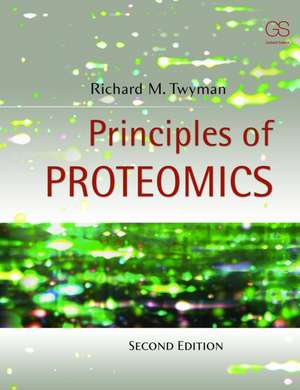
Principles of Proteomics
Autor Richard Twyman, Ph.D Cfe, George A.en Limba Engleză Paperback – 16 sep 2013
Proteomics is a fast-advancing field in which researchers seek to capture all the proteins in the cell and characterize them in ever more detail. Principles of Proteomics has been fully updated to reflect the most recent developments in the field without losing its focus on the underlying principles. With worked examples, case studies profiling both established and emerging technologies, and further reading lists for each chapter, Principles of Proteomics is an ideal introduction for students, researchers and those working in the industry.
Preț: 700.92 lei
Preț vechi: 770.24 lei
-9%
Puncte Express: 1051
Carte disponibilă
Livrare economică 09-23 noiembrie
Livrare express 23-29 octombrie pentru 50.82 lei
Livrare prin curier în România Termenul estimat este afișat lângă disponibilitate.
Transport gratuit pentru acest produs Plată online sau ramburs, în funcție de opțiunile comenzii.
Retur gratuit în 14 zile Comandă securizată și suport în română.
Specificații
ISBN-13: 9780815344728
ISBN-10: 0815344724
Pagini: 288
Ilustrații: 151 black & white illustrations, 9 colour illustrations, 142 colour line drawings
Dimensiuni: 210 x 280 x 8 mm
Greutate: 0.9 kg
Ediția:Revizuită
Editura: CRC Press
Colecția Garland Science
ISBN-10: 0815344724
Pagini: 288
Ilustrații: 151 black & white illustrations, 9 colour illustrations, 142 colour line drawings
Dimensiuni: 210 x 280 x 8 mm
Greutate: 0.9 kg
Ediția:Revizuită
Editura: CRC Press
Colecția Garland Science
V-ar putea interesa
-
 Understanding Biology Using PeptidesSylvie E Blondelle-18%Preț: 1861.03 lei2269.54 lei
 -
 Introduction to Protein StructureCarl Ivar Branden-9%Preț: 697.95 lei766.98 lei
 -
 Proteins: Concepts in BiochemistryPaulo Almeida-15%Preț: 600.84 lei706.87 lei
 -
 -14%Preț: 1167.58 lei1357.65 lei
 -
 Basic Methods in Protein Purification and Analysis: A Laboratory ManualRichard J. Simpson-11%Preț: 562.98 lei632.57 lei
 -
 GenomicsPrimrose-5%Preț: 661.89 lei696.72 lei
 -
 Principles of Gene Manipulation and GenomicsSandy B Primrose-19%Preț: 476.05 lei587.71 lei
 -
 -26%Preț: 1474.64 lei2004.36 lei
 -
 Protein Research ProgressAlan B Boscoe-23%Preț: 1308.51 lei1705.13 lei
 -
 Advanced Molecular Biology: A Concise ReferenceRichard Twyman-18%Preț: 921.36 lei1123.60 lei
 -
 BIOS Instant Notes in Developmental BiologyDr Richard TwymanPreț: 386.21 lei
 -
 Proteomics: From Protein Sequence to FunctionDr Stephen Pennington-15%Preț: 516.15 lei607.24 lei
Public țintă
Postgraduate, Professional, and UndergraduateCuprins
Table of Contents:
1: The Origin and Scope of Proteomics
2: Strategies for Protein Separation
3: Strategies for Protein Identification
4: Strategies for Protein Quantitation
5: The Analysis of Protein Sequences
6: The Analysis of Protein Structures
7: Interaction Proteomics
8: Protein Modification in Proteomics
9: Protein Microarrays
10: Applications of Proteomics
1: The Origin and Scope of Proteomics
2: Strategies for Protein Separation
3: Strategies for Protein Identification
4: Strategies for Protein Quantitation
5: The Analysis of Protein Sequences
6: The Analysis of Protein Structures
7: Interaction Proteomics
8: Protein Modification in Proteomics
9: Protein Microarrays
10: Applications of Proteomics
Notă biografică
Richard Twyman is a scientific writer and lecturer in molecular biology and biotechnology, focusing on developmental and cell biology, gene transfer to microbes, animals and plants, transgenics, genetic manipulation, genomics, proteomics and systems biology. He has worked extensively in these topic areas and has written all manner of articles ranging from primary research papers and reviews in high-impact journals to some of the most popular scientific textbooks in the world, including Principles of Gene Manipulation (now nearly 30 years in print and in its 8th edition). He is also a contributor for Human Molecular Genetics (now 10 years in print and in its 3rd edition).
After working as a research scientist and scientific writer for 10 years, Richard set up a scientific management consultancy in 2001 which has been very successful, with a client base now including many research institutes (e.g. Fraunhofer IME, RWTH University of Aachen, University of Verona, St Georges Hospital Medical School, University of Lleida, University of York, University of Oxford, University of Cambridge), prominent public institutions (e.g. Wellcome Trust, Spanish National Research Council), publishers (e.g. Garland Press, Taylor & Francis, Wiley-VCH, Ashley Publications, Blackwell Science, Elsevier) international research consortia (e.g. Pharma-Planta, Smart-Cell, Comofarm) and industrial customers (e.g. Sartorius-Stedim Biotech, Dow AgroScience). The work involves writing research articles, reviews, book chapters, grant proposals, reports, white papers and steering documents, including business development and strategy plans. In order to keep up with the latest in developmental biology, biotechnology, genomics and proteomics, Richard has links with a number of companies and academic institutions including the Fraunhofer IME in Germany, RWTH Aachen, the University of Warwick and Cranfield University where he lectures in biotechnology/genomics and scientific writing and management.
After working as a research scientist and scientific writer for 10 years, Richard set up a scientific management consultancy in 2001 which has been very successful, with a client base now including many research institutes (e.g. Fraunhofer IME, RWTH University of Aachen, University of Verona, St Georges Hospital Medical School, University of Lleida, University of York, University of Oxford, University of Cambridge), prominent public institutions (e.g. Wellcome Trust, Spanish National Research Council), publishers (e.g. Garland Press, Taylor & Francis, Wiley-VCH, Ashley Publications, Blackwell Science, Elsevier) international research consortia (e.g. Pharma-Planta, Smart-Cell, Comofarm) and industrial customers (e.g. Sartorius-Stedim Biotech, Dow AgroScience). The work involves writing research articles, reviews, book chapters, grant proposals, reports, white papers and steering documents, including business development and strategy plans. In order to keep up with the latest in developmental biology, biotechnology, genomics and proteomics, Richard has links with a number of companies and academic institutions including the Fraunhofer IME in Germany, RWTH Aachen, the University of Warwick and Cranfield University where he lectures in biotechnology/genomics and scientific writing and management.
Recenzii
"The layout of this book is excellent, with nice, highly readable tables and very good illustrations, which help the reader to grasp immediately the sense of the written text. I highly recommend it to any newcomer in the field and I believe it could well be adopted in university courses dealing with proteomics."
- Journal of Proteomics
"This is the ideal textbook for anyone wishing to gain a well-rounded appreciation of established and developing large-scale protein analysis technologies. It equips readers with the necessary knowledge to understand functioning principles while providing concrete examples illustrating applications of these technologies. Anyone considering proteomic approaches should explore this book -- with its broad topic coverage, it serves as the perfect introduction to this fast-evolving technological area. Since this field has drastically changed over the last decade, the second edition is certainly warranted." -Doody's
- Journal of Proteomics
"This is the ideal textbook for anyone wishing to gain a well-rounded appreciation of established and developing large-scale protein analysis technologies. It equips readers with the necessary knowledge to understand functioning principles while providing concrete examples illustrating applications of these technologies. Anyone considering proteomic approaches should explore this book -- with its broad topic coverage, it serves as the perfect introduction to this fast-evolving technological area. Since this field has drastically changed over the last decade, the second edition is certainly warranted." -Doody's
Descriere
Principles of Proteomics, Second Edition, provides a concise and user-friendly introduction to the diverse technologies used for the large-scale analysis of proteins, as well as their applications, and their impact in areas such as drug discovery, agriculture, and the fight against disease.
Proteomics is a fast-advancing field in which researchers seek to capture all the proteins in the cell and characterize them in ever more detail. Principles of Proteomics has been fully updated to reflect the most recent developments in the field without losing its focus on the underlying principles. With worked examples, case studies profiling both established and emerging technologies, and further reading lists for each chapter, Principles of Proteomics is an ideal introduction for students, researchers and those working in the industry.
Proteomics is a fast-advancing field in which researchers seek to capture all the proteins in the cell and characterize them in ever more detail. Principles of Proteomics has been fully updated to reflect the most recent developments in the field without losing its focus on the underlying principles. With worked examples, case studies profiling both established and emerging technologies, and further reading lists for each chapter, Principles of Proteomics is an ideal introduction for students, researchers and those working in the industry.