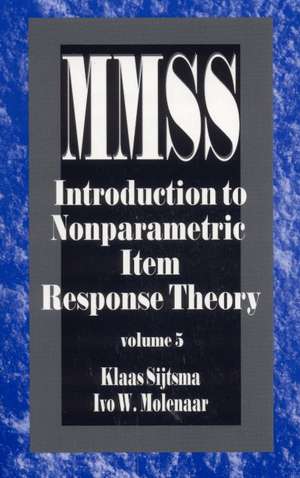
Introduction to Nonparametric Item Response Theory
Autor Klaas Sijtsma, Ivo W. Molenaaren Limba Engleză Paperback – 12 mar 2002
Preț: 609.81 lei
Preț vechi: 717.43 lei
-15%
Puncte Express: 915
Carte tipărită la comandă
Livrare economică 30 noiembrie-14 decembrie
Livrare prin curier în România Termenul estimat este afișat lângă disponibilitate.
Transport gratuit pentru acest produs Plată online sau ramburs, în funcție de opțiunile comenzii.
Retur gratuit în 14 zile Comandă securizată și suport în română.
Specificații
ISBN-13: 9780761908135
ISBN-10: 0761908137
Pagini: 182
Ilustrații: Illustrations
Dimensiuni: 140 x 216 x 10 mm
Greutate: 0.24 kg
Ediția:New.
Editura: Sage Publications, Inc
Locul publicării:Thousand Oaks, United States
ISBN-10: 0761908137
Pagini: 182
Ilustrații: Illustrations
Dimensiuni: 140 x 216 x 10 mm
Greutate: 0.24 kg
Ediția:New.
Editura: Sage Publications, Inc
Locul publicării:Thousand Oaks, United States
V-ar putea interesa
-
 Interpreting Crime StatisticsMonica A. Walker-25%Preț: 217.73 lei290.29 lei
 -
 Preț: 225.85 lei
 -
 Qualitative Inquiry in Everyday LifeSvend Brinkmann-8%Preț: 421.06 lei457.66 lei
 -
 Set-Theoretic Methods for the Social SciencesCarsten Q. SchneiderPreț: 333.70 lei
 -
 Natural Experiments in the Social SciencesThad DunningPreț: 351.85 lei
 -
 Qualitative Data AnalysisCarol Grbich-8%Preț: 483.86 lei525.93 lei
 -
 -18%Preț: 738.88 lei901.08 lei
 -
 Researching the VisualMichael Emmison-8%Preț: 482.86 lei524.85 lei
 -
 Doing Qualitative Research DifferentlyWendy Hollway-8%Preț: 481.65 lei523.53 lei
 -
 Collaborative AutoethnographyHeewon ChangPreț: 369.76 lei
 -
 Doing Excellent Small-Scale ResearchDerek Layder-15%Preț: 564.30 lei663.88 lei
 -
 Comparative-Historical MethodsMatthew Lange-8%Preț: 419.19 lei455.64 lei
Recenzii
“Introduction to Nonparametric Item Response Theory is an accessible introduction to constructing tests/scales using nonparametric IRT. It should be of great use to social scientists who construct their own measurement instruments, as well as those who provide them statistical support. For those who focus on larger scale standardized tests, the volume provides a refreshing step back to look at some important issues in the field and some alternative methods of analysis.”
Notă biografică
Vice dean of research Tilburg School of Social and Behavioral Sciences, program director research master, and professor of methodology and statistics
Descriere
This book introduces social and behavioral science students and researchers to the theory and practice of the highly powerful methods of nonparametric item response theory (IRT). Anyone who uses or constructs tests or questionnaires for measuring abilities, achievements, personality traits, attitudes, or opinions will find nonparametric IRT useful for designing and improving such measurements. The authors show how the broadness of the nonparametric item response models allows them to fit many data sets and remain powerful enough for implying useful measurement properties, such as the ordering of persons using the simple total score (number-correct for dichotomous item tests and sum of rating scale score for polytomous item tests) and the ordering of the items using the item means.