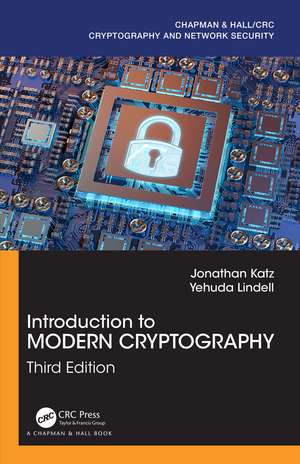
Introduction to Modern Cryptography: Chapman & Hall/CRC Cryptography and Network Security Series
Autor Jonathan Katz, Yehuda Lindellen Limba Engleză Hardback – 21 dec 2020
Bazându-ne pe datele furnizate de editura CRC Press și pe structura seriei Chapman & Hall/CRC Cryptography and Network Security Series, observăm că această a treia ediție revizuită a Introduction to Modern Cryptography își consolidează poziția de resursă fundamentală pentru învățământul universitar. Apreciem modul în care Jonathan Katz și Yehuda Lindell au recalibrat conținutul pentru a reflecta peisajul tehnologic actual, introducând secțiuni despre funcții hash de tip „sponge” (SHA-3) și o analiză extinsă a criptografiei pe curbe eliptice.
Spre deosebire de abordarea din Cryptography de Douglas Robert Stinson, care funcționează ca un manual cuprinzător de metode și protocoale, textul de față se distinge prin rigoarea matematică aplicată. Este o alternativă metodologică la Understanding Cryptography pentru cursurile de securitate informatică, având avantajul unei fundamentări teoretice mult mai stricte: securitatea nu este doar descrisă, ci demonstrată prin dovezi riguroase. Structura este organizată logic în 15 capitole, debutând cu conceptele de secretizare perfectă și avansând spre construcții practice ale primitivelor simetrice, înainte de a aborda revoluția cheilor publice.
Suntem de părere că relevanța acestui manual pentru curriculumul actual este sporită de noul capitol dedicat criptografiei post-cuantice. Această ediție rafinează conceptele prezentate în Introduction to Modern Cryptography, Second Edition, corectând erorile semnalate de comunitatea academică și integrând mecanisme moderne precum criptarea autentificată și cifrurile bazate pe „nonce”.
Din seria Chapman & Hall/CRC Cryptography and Network Security Series
- 18%
 Preț: 1491.87 lei
 - 9%
 Preț: 793.99 lei
 - 8%
 Preț: 439.45 lei
 -
 Preț: 438.44 lei
 - 8%
 Preț: 482.52 lei
 - 20%
 Preț: 446.59 lei
 -
 Preț: 445.39 lei
 - 18%
 Preț: 888.52 lei
 - 20%
 Preț: 969.41 lei
 - 20%
 Preț: 843.30 lei
 - 18%
 Preț: 900.40 lei
 - 20%
 Preț: 1387.34 lei
 -
 Preț: 437.18 lei
 - 20%
 Preț: 1194.53 lei
 -
 Preț: 481.51 lei
 - 25%
 Preț: 1203.74 lei
 - 24%
 Preț: 1126.59 lei
 - nou
 Preț: 435.79 lei
Preț: 823.28 lei
Preț vechi: 1004.00 lei
-18%
Carte disponibilă
Livrare economică 05-19 noiembrie
Specificații
ISBN-10: 0815354363
Pagini: 648
Ilustrații: 50 Illustrations, black and white
Dimensiuni: 156 x 234 x 43 mm
Greutate: 1.02 kg
Ediția:Nouă
Editura: CRC Press
Colecția Chapman and Hall/CRC
Seria Chapman & Hall/CRC Cryptography and Network Security Series
V-ar putea interesa
-
 Software Architecture for Big Data and the CloudIvan Mistrík-39%Preț: 576.43 lei941.68 lei
 -
 Machine Learning with Python for EveryoneMark Fenner-20%Preț: 270.86 lei338.57 lei
 -
 -23%Preț: 825.63 lei1072.25 lei
 -
 Bayesian Analysis of StochastiInsuari-9%Preț: 731.40 lei803.74 lei
 -
 -27%Preț: 1854.89 lei2540.95 lei
 -
 -27%Preț: 1848.67 lei2532.42 lei
 -
 Introduction to Probability Theory and Statistical InferenceHarold J. Larson-27%Preț: 1586.39 lei2173.14 lei
 -
 Statistical Concepts and MethodsGouri K. Bhattacharyya-27%Preț: 1478.88 lei2025.86 lei
 -
 Sampling TechniquesWilliam G. Cochran-27%Preț: 1407.55 lei1928.15 lei
 -
 -27%Preț: 1547.01 lei2119.19 lei
 -
 An Introduction to Probability Theory and Its ApplicationsWilliam Feller-27%Preț: 1430.61 lei1959.75 lei
 -
 Queueing Systems Vol 1Kleinrock-9%Preț: 1002.30 lei1101.42 lei
 -
 Preț: 338.19 lei
 -
 Solutions Manual to Accompany Introduction to Abstract AlgebraW. Keith NicholsonPreț: 286.94 lei
 -
 -20%Preț: 560.66 lei700.82 lei
 -
 Model Optimization Methods for Efficient and Edge AIPethuru Raj Chelliah-20%Preț: 806.13 lei1007.66 lei
 -
 Practical Methods in EcologyHenderson-8%Preț: 447.14 lei486.02 lei
 -
 -20%Preț: 918.75 lei1148.44 lei
 -
 Tutorials on the Foundations of CryptographyYehuda Lindell-20%Preț: 626.99 lei783.74 lei
 -
 Composition of Secure Multi-Party ProtocolsYehuda Lindell-20%Preț: 330.54 lei413.18 lei
 -
 Efficient Secure Two-Party ProtocolsCarmit Hazay-39%Preț: 822.49 lei1355.70 lei
 -
 Theory of CryptographyYehuda Lindell-20%Preț: 359.31 lei449.14 lei
 -
 Generalization with Deep LearningChen Zhenghua-20%Preț: 647.20 lei808.99 lei
 -
 THETA FUNCTIONS AND KNOTSGelca Razvan-18%Preț: 950.74 lei1159.44 lei
Public țintă
Undergraduate CoreDe ce să citești această carte
Recomandăm această lucrare studenților și cercetătorilor care doresc să înțeleagă nu doar cum funcționează algoritmii, ci și de ce sunt considerați siguri. Cititorul câștigă o bază matematică solidă necesară pentru a evalua protocoalele moderne. Este un manual de referință care face puntea între teoria abstractă și standardele utilizate în prezent în industrie, precum GCM sau Poly1305.
Despre autor
Jonathan Katz este un specialist recunoscut în domeniul securității informatice, fiind coautorul acestei serii de referință în cadrul Chapman & Hall/CRC. Expertiza sa se concentrează pe fundamentele teoretice ale criptografiei, contribuind de-a lungul anilor la definirea standardelor de securitate prin ediții succesive ale lucrărilor sale. Alături de Yehuda Lindell, acesta a dezvoltat un stil pedagogic bazat pe rigoare și claritate, transformând Introduction to Modern Cryptography în cel mai utilizat manual de profil la nivel global.
Descriere scurtă
Cuprins
Notă biografică
Yehuda Lindell is a professor in the Department of Computer Science at Bar-Ilan University where he conducts research on cryptography with a focus on the theory of secure computation and its application in practice. Lindell received a Raviv Fellowship[1] and spent two years at IBM's cryptography research group at the T.J. Watson Research Center.
Recenzii
I find Chapters 2 and 5 to be the best. Both for its clarity. Chapter 2 is clear on certain details that, in my view, make the material much easier to understand than other treatments I have come across. E.g., clearly clarifying that when we consider the notion of "secret," we address the case only that one single message is sent. Not multiple messages. This really helps one quickly understand the technical details and proofs. Similarly, Chapter 5 on hash functions, in my view, is tricky to present. E.g., it must be clear that one is not dealing with a particular instance of a collision, but really finding collisions. This distinction is made very clearly in this book.- Mahesh Tripunitara