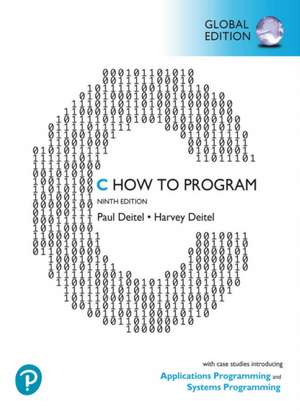
C How to Program: With Case Studies in Applications and Systems Programming, Global Edition
Autor Paul Deitel, Harvey Deitelen Limba Engleză Paperback – 27 mai 2022
Considerăm ediția a 9-a a C How to Program: With Case Studies in Applications and Systems Programming, Global Edition un standard esențial pentru dezvoltatorii care doresc să stăpânească limbajul C în ecosisteme moderne. Această versiune pune un accent major pe portabilitate și medii de execuție actuale, oferind ghiduri practice pentru configurarea și testarea codului în Microsoft Visual Studio, Apple Xcode sau GNU gcc, inclusiv în medii izolate precum containerele Docker. Într-o eră în care securitatea și performanța sunt critice, autorii aliniază conținutul cu cele mai noi recomandări curriculare ACM/IEEE.
Elementul distinctiv al acestei lucrări este metodologia „live-code”. Spre deosebire de alte manuale care prezintă fragmente teoretice, Paul Deitel și Harvey Deitel integrează 142 de programe complete, permițând cititorului să observe execuția și rezultatul final în context real. Dacă Programming in C de Stephen Kochan v-a oferit cadrul teoretic și o introducere clasică în limbaj, această carte oferă instrumentele practice și studiile de caz necesare pentru programarea sistemelor și aplicațiilor complexe. De asemenea, dacă C Recipes se concentrează pe soluții punctuale la probleme specifice, C How to Program: With Case Studies in Applications and Systems Programming, Global Edition construiește o bază solidă prin progresie logică, de la fundamentele algoritmice la gestionarea complexă a pointerilor și a memoriei.
Structura este riguros organizată în secțiuni care facilitează învățarea incrementală. Prima parte se concentrează pe fundamentele programării structurate (if/else, while, for), în timp ce partea a doua trece la nivelul intermediar, explorând în detaliu tablourile, pointerii și procesarea șirurilor de caractere. În contextul operei autorilor, această lucrare menține rigoarea tehnică întâlnită în C++20 for Programmers, însă este adaptată pentru a fi mai accesibilă celor care fac primii pași în dezvoltarea software sau celor care vin dinspre limbaje de nivel înalt, oferind o punte de legătură către programarea la nivel de sistem.
Preț: 560.66 lei
Preț vechi: 700.82 lei
-20%
Carte disponibilă
Livrare economică 14-28 noiembrie
Livrare express 31 octombrie-06 noiembrie pentru 70.55 lei
Specificații
ISBN-10: 1292437073
Pagini: 832
Dimensiuni: 202 x 254 x 33 mm
Greutate: 1.52 kg
Ediția:9. Auflage
Editura: Pearson
V-ar putea interesa
-
 Database Management SystemsRaghu Ramakrishnan-40%Preț: 1343.87 lei2224.22 lei
 -
 Software Architecture for Big Data and the CloudIvan Mistrík-38%Preț: 596.40 lei954.78 lei
 -
 Machine Learning with Python for EveryoneMark Fenner-20%Preț: 270.86 lei338.57 lei
 -
 -23%Preț: 829.05 lei1076.69 lei
 -
 C++20 for ProgrammersPaul Deitel-20%Preț: 373.07 lei466.34 lei
 -
 Fundamentals of Entrepreneurial FinanceMarco Da Rin-23%Preț: 626.66 lei809.83 lei
 -
 Marketing AnalyticsRajkumar VenkatesanPreț: 247.57 lei
 -
 Introduction to Modern CryptographyJonathan Katz-18%Preț: 823.28 lei1004.00 lei
 -
 -18%Preț: 949.36 lei1157.76 lei
 -
 Marketing Management, Global EditionPhilip Kotler-13%Preț: 642.60 lei738.62 lei
 -
 -11%Preț: 652.14 lei732.73 lei
 -
 -9%Preț: 588.72 lei646.94 lei
 -
 Essentials of Services MarketingJochen Wirtz-9%Preț: 593.62 lei652.32 lei
 -
 Perpetuating the Family BusinessJ. Ward-15%Preț: 546.82 lei643.31 lei
 -
 -26%Preț: 497.98 lei672.19 lei
 -
 Entrepreneurial FinanceJanet Kiholm Smith-19%Preț: 672.08 lei829.74 lei
 -
 Business Plan Template and ExampleAlex GenadinikPreț: 122.78 lei
 -
 -20%Preț: 918.75 lei1148.44 lei
 -
 Understanding the Family BusinessKeanon J. AldersonPreț: 115.90 lei
 -
 Preț: 439.17 lei
 -
 Économie d¿entrepriseAbdelkader RACHEDI-8%Preț: 450.72 lei489.91 lei
 -
 Generalization with Deep LearningChen Zhenghua-20%Preț: 669.26 lei836.57 lei
De ce să citești această carte
Recomandăm această carte programatorilor care doresc să înțeleagă arhitectura software de la bază. Prin cele 142 de programe complete și peste 340 de exerciții de autoevaluare, veți dobândi o experiență practică directă. Este resursa ideală pentru studenții la informatică și profesioniștii care vizează optimizarea performanței și securitatea codului în medii de producție diverse, de la Windows la Docker.
Despre autor
Paul Deitel și Harvey Deitel sunt fondatorii Deitel & Associates, Inc. și sunt recunoscuți la nivel mondial pentru seria lor de manuale „How to Program”. Harvey Deitel are o experiență de peste cinci decenii în domeniu, fiind un pionier în educația informatică. Paul Deitel este unul dintre cei mai experimentați instructori de programare din lume, specializat în limbaje precum C, C++, Java și Python. Împreună, au scris zeci de cărți care au devenit standarde academice, abordarea lor fiind caracterizată prin claritate, rigoare tehnică și o orientare constantă către aplicațiile practice din industria software.
Cuprins
1. Introduction to Computers and C: Test-Driving Microsoft Visual Studio, Apple Xcode, GNU gcc, and GNU gcc in a Docker container 2. Intro to C Programming: Input, Output, Types, Arithmetic, Decision Making 3. Structured Program Development: Algorithmic Development, Problem Solving, if, if/else, while 4. Program Control: for, do/while, switch, break, continue, Logical Operators 5. Functions: Custom Functions, Simulation, Random-Number Generation, Enumerations, Function Call and Return Mechanism, Recursion, Recursive Factorial, Recursive Fibonacci
PART 2: (Intermediate) Arrays, Pointers, and Strings
6. Arrays: One- and Two-Dimensional Arrays, Passing Arrays to Functions, Searching, Sorting 7. Pointers: Pointers operators & and , Pass-By-Value vs. Pass-By-Reference, Array and Pointer Relationship 8. Characters and Strings: C Standard Library String- and Character-Processing Functions
PART 3: (Intermediate) Formatted Input/Output, Structures, and File Processing
9. Formatted Input/Output: scanf and printf formatting 10. Structures, Unions, Bit Manipulation and Enumerations: Creating Custom Types with structs and unions, Bitwise Operators, Named Constants 11. File Processing: Streams, Text and Binary Files, CSV Files, Sequential and Random-Access Files
PART 4: (Advanced) Algorithms and Data Structures
12. Data Structures: Dynamic Memory Allocation and Deallocation, Lists, Stacks, Queues, Binary Trees 13. Computer-Science Thinking: Sorting Algorithms and Big O Insertion Sort, Selection Sort, Merge Sort, Additional Algorithms including Quicksort in the Exercises
PART 5: (Advanced) Preprocessor and Other Topics
14. Preprocessor: #include, Conditional Compilation, Macros with Arguments, Assertions 15. Other Topics: Variable-Length Argument Lists, Command-line Arguments, Multiple-Source-Pile Programs, extern, exit/atexit, calloc/realloc, goto, Numeric Literal Suffixes, Signal Handling
Appendices Operator Precedence Chart ASCII Character Set Number Systems Multithreading/Multicore and other C18/C11/C99 Topics Intro to Object-Oriented Programming Concepts
Online Appendices F-H. Using the Visual Studio Debugger, Using the GNU gdb Debugger, and Using the Xcode Debugger
Case Studies
System Programming Case Studies Systems Software: Building Your Own Computer Systems Software: Building Your Own Compiler Embedded Systems Programming: Robotics with the Webots Simulator Performance with Multithreading and Multicore Systems
Applications Programming Case Studies Random-Number Simulation: Building a Casino Game Random-Number Simulation: Card Shuffling and Dealing Random-Number Simulation: The Tortoise and the Hare Race Intro to Data Science: Survey Data Analysis Direct-Access File Processing: Transaction-Processing System Visualizing a Sorting Algorithm: Merge Sort Artificial Intelligence/Data Science: NLP: Who Wrote Shakespeare's Works? Artificial Intelligence/Data Science: Machine Learning with the GNU Scientific Library Game Programming: SpotOn Game with the raylib Library Game Programming: Cannon Game with the raylib Library Security and Cryptography: Implementing a Vigen�re Cipher Visualization with gnuplot: Law of Large Numbers Animation Web Services and the Cloud: libcurl and OpenWeatherMap
Descriere scurtă
C How to Program is a user-friendly, code-intensive introduction to C programming with case studies introducing applications and system programming. Like other texts of the Deitels' How to Program series, the book's modular presentation serves as a detailed beginner source of information for college students looking to embark on a career in coding, or instructors and software-development professionals seeking to learn how to program with C. The signature Deitel live-code approach presents concepts in the context of 142 full-working programs rather than incomplete snips of code. This gives you a chance to run each program as you study it and see how your learning applies to real-world programming scenarios.
Current standards, contemporary practice, and hands-on learning opportunities are integrated throughout the 9th Edition. Over 340 new integrated Self-Check exercises with answers allow you to test your understanding of important concepts - and check your code - as you read. New and enhanced case studies and exercises use real-world data and focus on the latest ACM/IEEE computing curricula recommendations, highlighting security, data science, ethics, privacy, and performance concepts.
Notă biografică
Dr. Harvey M. Deitel, Chairman and Chief Strategy Officer of Deitel & Associates, Inc., has 59 years of experience in computing. Dr. Deitel earned B.S. and M.S. degrees in Electrical Engineering from MIT and a Ph.D. in Mathematics from Boston University; he studied computing in each of these programs before they spun off Computer Science programs. He has extensive college teaching experience, including earning tenure and serving as the Chairman of the Computer Science Department at Boston College before founding Deitel & Associates, Inc., in 1991 with his son, Paul. The Deitels' publications have earned international recognition, with more than 100 translations published in Japanese, German, Russian, Spanish, French, Polish, Italian, Simplified Chinese, Traditional Chinese, Korean, Portuguese, Greek, Urdu and Turkish. Dr. Deitel has delivered 100s of programming courses to academic, corporate, government and military clients.