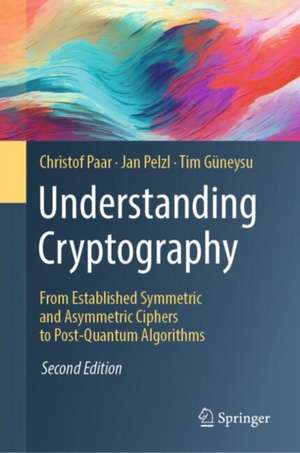
Understanding Cryptography
Autor Christof Paar, Jan Pelzl, Tim Güneysuen Limba Engleză Hardback – 16 mai 2024
Subliniem faptul că lucrarea Understanding Cryptography necesită un nivel minim de cunoștințe prealabile, fiind concepută special pentru studenți la nivel de licență avansată sau master și pentru inginerii care au nevoie de o bază solidă în securitatea digitală. Credem că această a doua ediție, publicată în 2024, reprezintă un instrument esențial, deoarece integrează cele mai noi standarde și algoritmi utilizați în prezent, de la sisteme cloud și blockchain până la dispozitive medicale implantabile. Abordarea autorilor diferă de Introduction to Modern Cryptography de Jonathan Katz prin faptul că este mult mai puțin abstractă și se concentrează pe aplicabilitatea imediată. În timp ce lucrarea lui Katz pune accent pe definiții formale și demonstrații riguroase de securitate, Understanding Cryptography preferă să explice mecanismele interne ale algoritmilor și implementarea lor practică, păstrând matematica la un nivel accesibil. Această orientare către inginerie este vizibilă și în comparație cu Serious Cryptography, oferind un parcurs academic mai structurat, ideal pentru studiu individual sau cursuri universitare. Structura volumului este una progresivă: începe cu fundamentele securității datelor, trece prin cifruri simetrice precum DES și AES, explorează criptografia cu chei publice (RSA, curbe eliptice) și culminează cu un capitol crucial dedicat criptografiei post-cuantice. Lucrarea se aliniază tematic cu alte titluri semnate de Christof Paar, precum Embedded Security in Cars, extinzând expertiza autorului de la sistemele înglobate (embedded) către întregul spectru al comunicațiilor digitale moderne. Fiecare capitol este riguros organizat, incluzând recenzii ale conceptelor și seturi de probleme care ajută la fixarea cunoștințelor tehnice.
Preț: 496.82 lei
Preț vechi: 528.10 lei
-6%
Carte disponibilă
Livrare economică 12-26 noiembrie
Specificații
ISBN-10: 3662690063
Pagini: 568
Ilustrații: XXI, 543 p.
Dimensiuni: 160 x 241 x 34 mm
Greutate: 1.06 kg
Ediția:Second Edition 2024
Editura: Springer
Locul publicării:Berlin, Heidelberg, Germany
V-ar putea interesa
-
 Cryptography: A Very Short IntroductionFred PiperPreț: 65.28 lei
 -
 Cryptography: A Very Short IntroductionSean Murphy-35%Preț: 49.20 lei76.17 lei
 -
 Everyday Cryptography: Fundamental Principles and ApplicationsKeith M. Martin-28%Preț: 309.99 lei430.37 lei
 -
 Cryptography EngineeringBruce Schneier-20%Preț: 294.41 lei368.01 lei
 -
 Cryptography: The Science of Secret WritingLaurence D. SmithPreț: 53.69 lei
 -
 Systematic Security: A CISO’s PlaybookTimur Qader-20%Preț: 367.98 lei459.97 leiRecomandat
 -
 Crypto Engine DesignWen-Long Chin-20%Preț: 410.27 lei512.83 lei
 -
 -20%Preț: 386.38 lei482.97 lei
 -
 Implementing Cryptography Using PythonShannon W Bray-20%Preț: 250.47 lei313.09 lei
 -
 Cryptography ApocalypseRoger A. Grimes-20%Preț: 172.96 lei216.21 lei
 -
 Alice and Bob Learn Application SecurityTanya Janca-20%Preț: 259.38 lei324.23 lei
 -
 Cryptography and Network SecurityWilliam Stallings-20%Preț: 634.17 lei792.71 lei
 -
 Modern CryptographySandip Dholakia-20%Preț: 294.39 lei368.00 lei
 -
 The Manga Guide To CryptographyMasaaki Mitani-35%Preț: 119.07 lei183.64 lei
 -
 Serious Cryptography: A Practical Introduction to Modern EncryptionJean-Philippe Aumasson-36%Preț: 244.93 lei385.48 lei
 -
 Real-World CryptographyDavid WongPreț: 435.42 lei
 -
 Serious Cryptography, 2nd Edition: A Practical Introduction to Modern EncryptionJean-Philippe Aumasson-36%Preț: 298.89 lei464.51 lei
 -
 Computer Security and the InternetPaul C. van Oorschot-20%Preț: 453.22 lei566.53 lei
 -
 Classical and Modern Cryptography for BeginnersRajkumar Banoth-20%Preț: 390.08 lei487.59 lei
 -
 CryptographySimon Rubinstein-SalzedoPreț: 368.16 lei
De ce să citești această carte
Recomandăm această carte inginerilor și designerilor de sisteme care doresc să înțeleagă cum funcționează algoritmii de criptare fără a se pierde în demonstrații matematice excesiv de complexe. Veți câștiga o perspectivă clară asupra standardelor actuale (AES, SHA-3) și a noilor familii de cifruri post-cuantice, esențiale pentru securizarea infrastructurilor viitoare. Este manualul practic definitiv pentru oricine lucrează în securitate cibernetică.
Despre autor
Christof Paar deține catedra de Securitate a Comunicațiilor la Universitatea Ruhr din Bochum, Germania, și este director al Institutului Horst Görtz pentru Securitatea IT. Cu o experiență vastă de șapte ani în cadrul departamentului ECE de la WPI (SUA), el este cofondatorul CHES, cel mai important workshop internațional dedicat securității hardware și sistemelor înglobate. Christof Paar a publicat peste 70 de lucrări de specialitate și deține numeroase brevete în domeniul securității aplicate, susținând cursuri pentru organizații de renume precum NASA, Motorola și Philips.
Descriere scurtă
Heavily revised and updated, the long-awaited second edition of Understanding Cryptography follows the unique approach of making modern cryptography accessible to a broad audience, requiring only a minimum of prior knowledge. After introducing basic cryptography concepts, this seminal textbook covers nearly all symmetric, asymmetric, and post-quantum cryptographic algorithms currently in use in applications—ranging from cloud computing and smart phones all the way to industrial systems, block chains, and cryptocurrencies.
Topics and features:
- Opens with a foreword by cryptography pioneer and Turing Award winner, Ron Rivest
- Helps develop a comprehensive understanding of modern applied cryptography
- Provides a thorough introduction to post-quantum cryptography consisting of the three standardized cipher families
- Includes for every chapter a comprehensive problem set, extensive examples, and a further-reading discussion
- Communicates, using a unique pedagogical approach, the essentials about foundations and use in practice, while keeping mathematics to a minimum
- Supplies up-to-date security parameters for all cryptographic algorithms
- Incorporates chapter reviews and discussion on such topics as historical and societal context
This must-have book is indispensable as a textbook for graduate and advanced undergraduate courses, as well as for self-study by designers and engineers.
The authors have more than 20 years’ experience teaching cryptography at various universities in the US and Europe. In addition to being renowned scientists, they have extensive experience with applying cryptography in industry, fromwhich they have drawn important lessons for their teaching.
Cuprins
Notă biografică
Caracteristici
Descriere
Cryptography is now ubiquitous – moving beyond the traditional environments, such as government communications and banking systems, we see cryptographic techniques realized in Web browsers, e-mail programs, cell phones, manufacturing systems, embedded software, smart buildings, cars, and even medical implants. Today's designers need a comprehensive understanding of applied cryptography.
After an introduction to cryptography and data security, the authors explain the main techniques in modern cryptography, with chapters addressing stream ciphers, the Data Encryption Standard (DES) and 3DES, the Advanced Encryption Standard (AES), block ciphers, the RSA cryptosystem, public-key cryptosystems based on the discrete logarithm problem, elliptic-curve cryptography (ECC), digital signatures, hash functions, Message Authentication Codes (MACs), and methods for key establishment, including certificates and public-key infrastructure (PKI). Throughout the book, the authors focus on communicating the essentials and keeping the mathematics to a minimum, and they move quickly from explaining the foundations to describing practical implementations, including recent topics such as lightweight ciphers for RFIDs and mobile devices, and current key-length recommendations.
The authors have considerable experience teaching applied cryptography to engineering and computer science students and to professionals, and they make extensive use of examples, problems, and chapter reviews, while the book’s website offers slides, projects and links to further resources. This is a suitable textbook for graduate and advanced undergraduate courses and also for self-study by engineers.