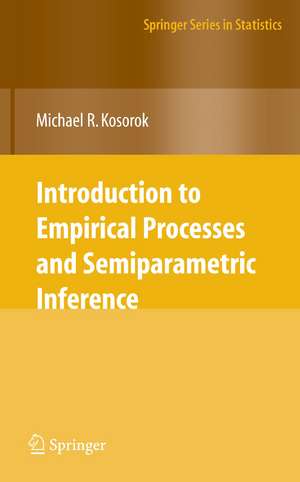
Introduction to Empirical Processes and Semiparametric Inference
Autor Michael R. Kosoroken Limba Engleză Hardback – 31 ian 2008
Observăm că utilitatea practică a volumului Introduction to Empirical Processes and Semiparametric Inference rezidă în capacitatea sa de a oferi instrumente riguroase pentru analizarea modelelor statistice complex-realiste, depășind limitările modelelor parametrice clasice. Michael R. Kosorok propune o abordare didactică a unor tehnici de cercetare adesea considerate opace, oferind o punte de legătură necesară către literatura de specialitate de nivel înalt. Subliniem faptul că, deși tratează subiecte avansate, textul este structurat ca un manual, facilitând tranziția cercetătorilor către utilizarea proceselor empirice în inferența semiparametrică.
Din punct de vedere al ariei tematice, lucrarea acoperă segmente similare cu Mathematical Statistics de Peter J. Bickel, însă se diferențiază printr-o focalizare mult mai specifică pe procesele empirice și o introducere mai graduală, dar la fel de riguroasă, în complexitatea spațiului parametrilor. Spre deosebire de Asymptotic Statistics de A. W. van der Vaart, care oferă o privire de ansamblu asupra aproximărilor prin experimente limită, volumul de față prioritizează aplicabilitatea metodelor de tip M-estimatori și Z-estimatori în contextul inferenței pe eșantioane mari.
Structura cărții este remarcabil de echilibrată, alternând teoria pură cu „Case Studies”. Primele capitole pun bazele convergenței stocastice și ale metodelor de entropie, progresând natural către bootstrapping și rezultate funcționale complexe. Reținem organizarea în trei blocuri majore: fundamentarea proceselor empirice, urmată de mecanismele inferenței semiparametrice (atât pentru parametri fini, cât și infiniți), totul fiind ancorat în exemple practice care validează conceptele matematice expuse.
Preț: 1190.52 lei
Preț vechi: 1451.86 lei
-18%
Carte tipărită la comandă
Livrare economică 13-27 iunie
Specificații
ISBN-10: 0387749772
Pagini: 500
Ilustrații: XIV, 483 p.
Dimensiuni: 160 x 241 x 32 mm
Greutate: 0.91 kg
Ediția:2008
Editura: Springer
Locul publicării:New York, NY, United States
V-ar putea interesa
-
 Feynman-Kac FormulaePierre Del Moral-18%Preț: 1086.82 lei1325.40 lei
 -
 Random Fields and GeometryR. J. Adler-18%Preț: 865.67 lei1055.69 lei
 -
 A Probabilistic Theory of Pattern RecognitionLuc Devroye-18%Preț: 778.20 lei949.03 lei
 -
 Probability Through ProblemsMarek Capiński-18%Preț: 959.68 lei1170.35 lei
 -
 Efficient and Adaptive Estimation for Semiparametric ModelsPeter J. Bickel-20%Preț: 752.18 lei940.23 lei
 -
 Elements of Large-Sample TheoryE L Lehmann-18%Preț: 928.19 lei1131.94 lei
 -
 Time Series AnalysisW Palma-14%Preț: 863.47 lei1004.03 lei
 -
 Linear Models 2eSR Searle-27%Preț: 890.09 lei1219.30 lei
 -
 The Probabilistic MethodJoel H. Spencer-23%Preț: 670.25 lei870.45 lei
 -
 Matrix Analysis for Statistics 3eJR Schott-27%Preț: 738.43 lei1011.54 lei
 -
 -27%Preț: 749.88 lei1027.24 lei
 -
 Spatial Point Patterns: Methodology and Applications with RAdrian Baddeley-18%Preț: 794.90 lei969.40 lei
 -
 Interpolation and Extrapolation Optimal Designs 1Giorgio Celant-9%Preț: 949.18 lei1043.06 lei
 -
 Concentration Inequalities and Model SelectionPascal Massart-15%Preț: 457.43 lei538.15 lei
Public țintă
ResearchDe ce să citești această carte
Recomandăm această lucrare statisticienilor și cercetătorilor care doresc să stăpânească tehnici moderne de inferență fără a se pierde în abstractizarea extremă a monografiilor de nișă. Cititorul câștigă o înțelegere clară a modului în care procesele empirice pot fi aplicate în estimarea modelelor complexe. Este resursa ideală pentru cei care se pregătesc pentru un doctorat în statistică sau econometrie, oferind un parcurs de învățare structurat și studii de caz aplicate.
Descriere scurtă
Cuprins
Recenzii
"Introduction to Empirical Processes and Semiparametric Inference is a very good combination of both the empirical processes and semiparametric theories. This is the first book of its kind....I agree with the author that this book is 'more of a textbook than a research monograph.' As the semiparametric inference is currently an extremely active research area in statistical research, the book will open the door for graduate students to identify significant future research potentials. In fact, this book contains the author's newest research result, the application of semiparametric method in microarray data analysis. This book can be used as a textbook for graduate students in statistics, biostatistics, and economics (econometrics). In fact, the contents of this book can be tailored for different courses."
"Generally, this is a great book on empirical processes and semiparametric methods. It should be on the must-read list for a serious statistician, biostatistician, or econometrician." (Biometrics, September 2008)
"The main focus of this book is to introduce empirical processes and semiparametric inference methods to researchers interested in developing inferential tools for relatively complicated mathematical or statistical modeling problems. ...The material is structured in a sensible way supporting the learning and understanding of useful and challenging techniques of empirical processes and semiparametric inference. The book could well be very helpful for those studying and applying these techniques." (International Statistical Review 2008,77,2)
“This book is an introduction to what is commonly called the modern theory of empirical processes – empirical processes indexed by classes of functions – and to semiparametric inference, and the interplay between both fields. … This is clearly intended to be a book for the novice in empirical process theory and semiparametricinference. … The main material is presented in a clearly arranged and logical order. … will be useful to anybody who wants to learn about the modern theory of empirical processes and semiparametric inference.” (Erich Häusler, Zentralblatt MATH, Vol. 1180, 2010)
Textul de pe ultima copertă
The book consists of three parts. The first part is a concise overview of all of the main concepts covered in the book with a minimum of technicalities. The second and third parts cover the two respective main topics of empirical processes and semiparametric inference in depth. The connections between these two topics is also demonstrated and emphasized throughout the text. Each part has a final chapter with several case studies that use concrete examples to illustrate the concepts developed so far. The last two parts also each include a chapter which covers the needed mathematical preliminaries. Each main idea is introduced with a non-technical motivation, and examples are given throughout to illustrate important concepts. Homework problems are also included at the end of each chapter to help the reader gain additional insights.
Michael R. Kosorok is Professor and Chair, Department of Biostatistics, and Professor, Department of Statistics and Operations Research, at the University of North Carolina at Chapel Hill. His research has focused on the application of empirical processes and semiparametric inference to statistics and biostatistics. He is a Fellow of both the American Statistical Association and the Institute of Mathematical Statistics. He is an Associate Editor of the Annals of Statistics, Electronic Journal of Statistics, International Journal of Biostatistics, Statistics and Probability Letters, and Statistics Surveys.