
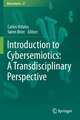
Introduction to Cybersemiotics: A Transdisciplinary Perspective: Biosemiotics, cartea 21
Editat de Carlos Vidales, Søren Brieren Limba Engleză Hardback – 15 apr 2021
Subsequent chapters introduce a cybersemiotic viewpoint on the capacity of arts and other practices for knowing. This suggests pathways for developing Practice as Research and practice-led research, and prompts the reader to view this new configuration in cybersemiotic terms. Other contributors discuss cultural and perceptual shifts that lead to interaction with hybrid environments such as Alexa. The relationship of storytelling and cybersemiotics is covered at chapter length, and another chapter describes an individual-collectivity dialectics, in which the latter (Commind) constrains the former (interactants), but the former fuels the latter.
The concluding chapter begins with the observation that digital technologies have infiltrated every corner of the metropolis - homes, workplaces, and places of leisure - to the extent that cities and bodies have transformed into interconnected interfaces. The book challenges the reader to participate in a broader discussion of the potential, limitations, alternatives, and criticisms of cybersemiotics.
| Toate formatele și edițiile | Preț | Express |
|---|---|---|
| Paperback (1) | 628.73 lei 6-8 săpt. | |
| Springer International Publishing – 16 apr 2022 | 628.73 lei 6-8 săpt. | |
| Hardback (1) | 635.00 lei 6-8 săpt. | |
| Springer International Publishing – 15 apr 2021 | 635.00 lei 6-8 săpt. |
Din seria Biosemiotics
- 18%
 Preț: 912.09 lei
 - 15%
 Preț: 615.84 lei
 - 18%
 Preț: 752.87 lei
 - 15%
 Preț: 619.45 lei
 - 15%
 Preț: 561.12 lei
 - 18%
 Preț: 1499.12 lei
 - 15%
 Preț: 622.11 lei
 - 24%
 Preț: 848.53 lei
 - 24%
 Preț: 840.99 lei
 - 18%
 Preț: 1588.14 lei
 - 18%
 Preț: 1061.02 lei
 - 15%
 Preț: 628.73 lei
 - 18%
 Preț: 694.50 lei
 - 18%
 Preț: 1064.20 lei
 - 18%
 Preț: 750.58 lei
 - 24%
 Preț: 696.45 lei
 - 18%
 Preț: 706.46 lei
 - 18%
 Preț: 763.32 lei
 - 18%
 Preț: 757.11 lei
 - 18%
 Preț: 754.23 lei
 - 18%
 Preț: 2033.82 lei
 - 18%
 Preț: 904.83 lei
 - 18%
 Preț: 911.05 lei
 - 18%
 Preț: 1169.91 lei
 - 18%
 Preț: 1596.35 lei
 - 18%
 Preț: 1170.47 lei
 - 18%
 Preț: 859.76 lei
Preț: 635.00 lei
Preț vechi: 747.05 lei
-15% Nou
112.40€ • 131.53$ • 98.33£
Carte tipărită la comandă
Livrare economică 23 ianuarie-06 februarie 26
Specificații
ISBN-10: 303052745X
Pagini: 555
Ilustrații: XIX, 555 p. 90 illus., 29 illus. in color.
Dimensiuni: 155 x 235 mm
Greutate: 0.98 kg
Ediția:1st ed. 2021
Editura: Springer International Publishing
Colecția Springer
Seria Biosemiotics
Locul publicării:Cham, Switzerland
Cuprins
Introduction
Carlos Vidales and Søren Brier
1. Cybersemiotics in the Information Age
Marcel Danesi
2. Cybersemiotic systemic and semiotical based transdisciplinarity
Søren Brier
3. From semiotics, to cybernetics to cybersemiotics: the question of communication and meaning processes in living systems
Carlos Vidales
4. System, sign, information, and communication in cybersemiotics, systems theory, and Peirce
Winfried Nöth
5. Transdisciplinary Realism
Basarab Nicolescu
6. Practice-led research as knowing: a cybersemiotic overview
Paul Cobley
7. The blind men and the elephant: Towards an organization of epistemic contexts
Michael Kleineberg
8. Communicology, Cybernetics, and Chiasm: A Synergism of Logic and Semiotic
Richard L. Lanigan
9. The Return of Philosophy: A Systemic Semiotics Approach
Berna Leticia Valle Canales
10. HCI Design and the Cybersemiotic Experience
Claudia Jacques
11. The Communication of Form. Why cybersemiotic star is necessary for information studies?
Liqian Zhou
12. From 'motivation' to 'constraints', from 'discourse' to 'modelling systems': pushing multimodal discourse analysis towards cybersemiotics
Sara Canizzaro
13. Towards a cybersemiotic philology of Buddhist knowledge forms: How to undo objects and concepts in process-philosophical terms
Alina Therese Lettner
14. Cybersemiotics and Phenomenology: a critical review of the conditions of possibility of "observation" from a Transcendental Semiotics
Julio Horta
15. Storytelling and Cybersemiotics
David M. Boje
16. Communication and evolution
Vivian Romeu
17. Prolegomena to Cybersemiotic discourse pragmatics. Total human evolutionary cognition and communication
Ole Nedergaard Thomsen
18. The cities and the bodies as cyberinterfaces
Lucia Santaella
Notă biografică
Carlos Vidales is a Faculty Member of the Department of Social Communication Studies at the University of Guadalajara in Mexico. He is the author of several books, articles and book chapters all related with semiotics and communication theory. He is scholar of the International Communicology Institute, and the general coordinator of the undergraduate program in Public Communication in the University of Guadalajara. He is member of the National Research System of the Mexican Council of Science and Technology. “Managing Editor of the Journal “Cybernetics and Human Knowing”.
Textul de pe ultima copertă
Subsequent chapters introduce a cybersemiotic viewpoint on the capacity of arts and other practices for knowing. This suggests pathways for developing Practice as Research and practice-led research, and prompts the reader to view this new configuration in cybersemiotic terms. Other contributors discuss cultural and perceptual shifts that lead to interaction with hybrid environments such as Alexa. The relationship of storytelling and cybersemiotics iscovered at chapter length, and another chapter describes an individual-collectivity dialectics, in which the latter (Commind) constrains the former (interactants), but the former fuels the latter.
The concluding chapter begins with the observation that digital technologies have infiltrated every corner of the metropolis - homes, workplaces, and places of leisure - to the extent that cities and bodies have transformed into interconnected interfaces. The book challenges the reader to participate in a broader discussion of the potential, limitations, alternatives, and criticisms of cybersemiotics.