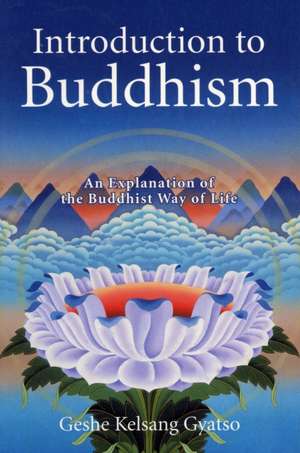
Introduction to Buddhism
Autor Geshe Kelsang Gyatsoen Limba Engleză Paperback – apr 2001
În peisajul academic și spiritual contemporan, se resimte adesea o lacună între studiile teoretice despre istoria religiilor și ghidurile practice de meditație care omit fundamentul filozofic. Introduction to Buddhism de Geshe Kelsang Gyatso vine să completeze exact acest spațiu, oferind o sinteză structurată care transformă înțelepciunea antică în instrumente aplicabile omului modern. Această a doua ediție revizuită nu doar că actualizează textul original, dar îl îmbogățește vizual cu picturi și fotografii care facilitează înțelegerea conceptelor abstracte. Ne-a atras atenția rigoarea organizării conținutului. Volumul progresează logic de la biografia lui Buddha și înțelegerea minții în prima parte („Basic Buddhism”), către mecanismele eliberării și, în final, către idealul de Bodhisattva în partea a treia. Această structură extinde cadrul propus de Buddhism for Beginners de Aura Heal cu date noi din tradiția Kadampa și o analiză mult mai detaliată a conceptelor de Karma și renaștere. Față de alte manuale introductive, lucrarea de față se distinge prin includerea unor anexe tehnice, precum rugăciunea eliberatoare și un glosar esențial pentru studiul aprofundat. În contextul operei sale, Introduction to Buddhism servește drept poartă de acces către lucrările sale mai tehnice, precum Clear Light of Bliss sau The New Guide to Dakini Land. Dacă în The Story of Buddha autorul se concentra pe narațiune, aici accentul cade pe aplicabilitatea metodei: meditația nu este prezentată ca o evadare, ci ca un instrument de cultivare a păcii interioare. Stilul este direct, specific unui maestru care a adaptat budismul tibetan pentru societatea occidentală, menținând un echilibru între precizia terminologică și accesibilitate.
Preț: 84.38 lei
Carte disponibilă
Livrare economică 09-23 noiembrie
Livrare express 24-30 octombrie pentru 20.44 lei
Specificații
ISBN-10: 0948006706
Pagini: 200
Ilustrații: paintings, drawings and photographs
Dimensiuni: 129 x 201 x 13 mm
Greutate: 0.23 kg
Ediția:2 Revised edition
Editura: Tharpa Publications
Locul publicării:United Kingdom
V-ar putea interesa
-
 Buddhist Meditation: Classic Teachings from TibetKurtis R. SchaefferPreț: 92.76 lei
 -
 Buddhism: A Very Short IntroductionDamien Keown-20%Preț: 57.15 lei71.12 lei
 -
 Kukai - Major WorksKukaiPreț: 302.52 lei
 -
 How to FeelThe BuddhaPreț: 100.84 lei
 -
 Buddhism for Beginners: A Guide to Enlightened LivingC. Alexander Simpkins-18%Preț: 65.53 lei79.80 lei
 -
 StretchingBob AndersonPreț: 146.69 lei
 -
 The Buddha in Your Mirror: Practical Buddhism and the Search for SelfWoody HochswenderPreț: 84.48 lei
 -
 Buddhism: A Complete Introduction: Teach YourselfClive Erricker-26%Preț: 79.23 lei107.67 lei
 -
 Preț: 96.02 lei
 -
 An Introduction to BuddhismDalai Lama-25%Preț: 90.69 lei120.29 lei
 -
 The Way of the BodhisattvaShantidevaPreț: 99.67 lei
 -
 The Path of Individual Liberation (volume 1)Chogyam Trungpa-29%Preț: 229.64 lei321.86 lei
 -
 How Not to Miss the PointJetsun Khandro RinpochePreț: 119.72 lei
 -
 Approaching the Buddhist PathDalai Lama-32%Preț: 103.93 lei152.77 lei
 -
 The New Eight Steps to HappinessGeshe Kelsang GyatsoPreț: 128.60 lei
 -
 The Buddha in YouLama Lhanang RinpochePreț: 100.51 lei
 -
 How to Understand the MindGeshe Kelsang GyatsoPreț: 129.59 lei
 -
 Preț: 93.27 lei
 -
 Essence of VajrayanaGeshe Kelsang GyatsoPreț: 144.59 lei
De ce să citești această carte
Recomandăm această carte oricărui cititor aflat la început de drum care dorește o bază solidă, nu doar o introducere superficială. Spre deosebire de alte ghiduri, acest volum oferă o structură clară a „Căii spre Iluminare” și instrumente concrete pentru gestionarea problemelor zilnice prin meditație. Este un manual esențial pentru cei care caută să înțeleagă legătura dintre minte, acțiune (karma) și fericirea durabilă, beneficiind de expertiza unui maestru recunoscut internațional.
Despre autor
Venerabilul Geshe Kelsang Gyatso a fost un maestru de meditație complet realizat și un învățător de budism de renume mondial, pionier al introducerii budismului modern în societatea contemporană. Autor a 22 de volume apreciate, el a reușit să transmită perfect înțelepciunea antică în limbaj modern. Fondator a peste 1200 de centre și grupuri budiste Kadampa la nivel global, Geshe Kelsang a pus întotdeauna accent pe aplicarea practică a învățăturilor în viața de zi cu zi, oferind metode accesibile pentru dezvoltarea compasiunii și a înțelepciunii.
Descriere
Cuprins
PART ONE: Basic Buddhism
Who was Buddha?
Understanding the Mind
Past and Future Lives
What is Karma?
Our Precious Human Life
What is Meditation?
Death
The Buddhist Way of Life
PART TWO: The Path to Liberation
What is Liberation?
Developing Renunciation
The Three Higher Trainings
PART THREE: The Path to Enlightenment
Becoming a Bodhisattva
The Bodhisattva’s Way of Life
Ultimate Truth
Enlightenment
Dedication
Appendix I—The Commitments of Going for Refuge
Appendix II—Liberating Prayer and Mahayana Sutra
Recenzii
Notă biografică
renowned teacher of Buddhism. Resident in the West since 1977, he is the author of 21 highly acclaimed
books that perfectly transmit the ancient wisdom of Buddhism to our modern world. He has also founded
over 1100 Kadampa Buddhist Centers and groups throughout the world.
Extras
The heart of Dharma practice is meditation. The purpose
of meditation is to make our mind calm and peaceful. If
our mind is peaceful, we will be free from worries and
mental discomfort, and so we will experience true happiness.
But if our mind is not peaceful, we will find it
very difficult to be happy, even if we are living in the very
best conditions. If we train in meditation, our mind will
gradually become more and more peaceful, and we will
experience a purer and purer form of happiness. Eventually,
we will be able to stay happy all the time, even in the most
difficult circumstances.
Usually we find it difficult to control our mind. It seems
as if our mind is like a balloon in the wind—blown here
and there by external circumstances. If things go well, our
mind is happy, but if they go badly, it immediately becomes
unhappy. For example, if we get what we want, such as a
new possession or a new partner, we become excited and
cling to them tightly. However, since we cannot have everything
we want, and since we will inevitably be separated from the
friends and possessions we currently enjoy, this
mental stickiness, or attachment, only causes us pain. On
the other hand, if we do not get what we want, or if we lose
something we like, we become depressed or irritated. For
example, if we are forced to work with a colleague we dislike,
we will probably become irritated and feel aggrieved, with
the result that we will not be able to work with him or her
efficiently and our time at work will become stressful and
unrewarding.
Such fluctuations of mood arise because we are too closely
involved in the external situation. We are like a child making
a sandcastle who is excited when it is first made, but who
becomes upset when it is destroyed by the incoming tide. By
training in meditation, we create an inner space and clarity
that enable us to control our mind regardless of the external
circumstances. Gradually we develop mental equilibrium,
a balanced mind that is happy all the time, rather than an
unbalanced mind that oscillates between the extremes of
excitement and depression.
If we train in meditation systematically, we will eventually
be able to eradicate from our mind the delusions that
are the causes of all our problems and suffering. In this way,
we will come to experience a permanent inner peace, known
as liberation or nirvana. Then, day and night in life after life,
we will experience only peace and happiness.